CNC Clamps: Machining, Tolerances & DFM for Precision Transmission (2026 Guide)
A precision transmission only stays precise as long as every part on the shaft stays put. The gear, the timing pulley, the encoder wheel, the bearing spacer - each one is located by a single, unglamorous component you probably never put on the critical-parts list: the clamp. When that clamp shifts by 0.02 mm, your backlash creeps, your timing drifts, and your servo starts hunting for a position it can no longer trust. The failure is quiet, and it shows up as lost repeatability long before anything breaks.
So if you are designing or sourcing a gearbox, a timing drive, a harmonic stage, or any shaft-coupled transmission, this guide is written for you. We walk through how CNC precision machining earns a clamp its place in a precision transmission, the tolerances that actually matter on the shaft, why the surface finish is a performance spec and not a cosmetic one, when a custom CNC part beats a catalog collar, and how to qualify a supplier without learning the hard way.
We are a Dongguan source factory for stainless steel and hard-alloy precision work, machining since 2015 across 60 CNC centers in a 4,000 m2 plant with monthly output around 500,000 parts. This is written from the shop floor, not a brochure - the numbers and trade-offs are the ones we argue through with transmission engineers before the first bar is cut.
Table of Contents
- 1. Why CNC Precision Machining Defines Clamp Accuracy in Precision Transmission
- 2. Types of Clamps Used in Precision Transmission Systems
- 3. How Tight Tolerance CNC Keeps a Clamp True on the Shaft
- 4. Stainless Steel Mirror Finishing for Transmission Clamps That Must Not Gall
- 5. Custom CNC Parts: When an Off-the-Shelf Clamp Costs You More
- 6. CNC Precision Machining Processes for Clamping Collars and Hubs
- 7. Clamps vs Set Screws: A Precision Transmission Buyer's Comparison
- 8. A Sourcing Checklist for Precision Transmission CNC Parts (Clamps)
- 9. Common Mistakes Engineers Make When Specifying Clamps for Precision Transmission
Precision Transmission CNC precision component
Why CNC Precision Machining Defines Clamp Accuracy in Precision Transmission
A clamp is a positioning device. Its accuracy is your transmission's accuracy.
In a precision transmission, a clamping collar or hub does two jobs at once: it locks a component axially on the shaft, and it does so without distorting the bore or inducing runout. Get either wrong and the gear you spent weeks qualifying now sits 15 microns off-axis. CNC precision machining is what lets a clamp do both jobs repeatably, because the bore, the clamp slot, and the locating face are cut in one controlled process rather than assembled from loose tolerances.
The physics is simple but unforgiving. A one-screw shaft collar grips the shaft on a line; a two-screw or split-hub clamp grips it on a ring. The ring grip distributes clamp load and keeps the bore concentric to the shaft, so runout stays in the low-micron range. We see the difference most clearly on high-speed servo shafts, where a poorly located pulley throws vibration straight into the bearing and halves its life.
What a clamp actually controls on your shaft
- Axial position - how far the gear or pulley sits from its mate, held to ±0.01 mm.
- Concentricity - how true the bore runs to the shaft, typically under 0.01 mm TIR.
- Clamp force vs distortion - enough grip to hold, little enough to avoid ovalizing the bore.
- Repeatability - the same torque seats the part in the same place every time.
Precision Transmission CNC precision component
Types of Clamps Used in Precision Transmission Systems
Pick the wrong clamp family and you will fight runout for the life of the program.
The word clamps covers a wider family than most buyers realize, and the right choice depends on load, speed, and how often you reconfigure the shaft. Knowing the families saves you from over-specifying a collar where a simpler part would do, or under-specifying where a slip would cost you a gear set.
The four clamp families you will meet
- Set-screw collar
- A one-screw collar that grips the shaft on a single line. Cheap, but it dents the shaft and induces runout under load.
- Split clamp collar
- A two-screw collar with a relieved bore that closes like a vise, gripping the shaft on a ring with near-zero runout.
- Clamping hub
- A flanged or keyed hub that clamps a pulley, gear, or encoder disc to the shaft and carries torque as well as position.
- Taper-lock clamp
- A two-piece clamp with a matched taper that pulls tight axially, popular where high torque meets frequent teardown.
| Clamp family | Typical runout | Torque capacity | Best use in transmission |
|---|---|---|---|
| Set-screw collar | 0.05-0.10 mm TIR | Low | Low-speed, non-critical spacers |
| Split clamp collar | 0.01-0.02 mm TIR | Medium | Encoders, timing pulleys, light gears |
| Clamping hub | 0.01 mm TIR | Medium-High | Gear and pulley mounting on servo shafts |
| Taper-lock clamp | <0.01 mm TIR | High | Reconfigurable drives, high-torque stages |
For most precision transmission CNC parts we build - timing pulleys, encoder wheels, harmonic-stage collars - the split clamp collar and the clamping hub are the workhorses. They let us hold the component true to the shaft while carrying real torque.
How Tight Tolerance CNC Keeps a Clamp True on the Shaft
Tolerance is a budget. Spend it on the bore and the locating face, relax everything else.
A clamp earns its keep only if the bore stays round and concentric after you tighten it. That is where tight tolerance CNC separates a functional collar from a decorative one. We concentrate the tolerance budget on three relationships: the bore diameter to the shaft, the face squareness to the bore axis, and the clamp-slot symmetry that lets the bore close evenly.
Tolerances we hold on transmission clamps
| Feature | Typical tolerance | Why it matters on the shaft |
|---|---|---|
| Bore diameter | ±0.005 mm | Interference or slip-fit to the shaft; sets runout. |
| Face squareness | ±0.01 mm | A tilted face tilts the gear or pulley it locates. |
| Slot symmetry | ±0.02 mm | Even clamping keeps the bore round, not oval. |
| Keyway / keyseat | ±0.02 mm | Torque transfer without side-loading the shaft. |
Pros
- Predictable shaft location
- Lower assembly scrap
- Stable runout under torque
- Easier servo tuning
Cons
- Tighter bores cost more to hold
- Not every face needs it
- Roundness inspection takes time
The honest supplier will tell you which tolerances matter for your clamp and which are quietly wasting your money. Tighter is not better by default; it has to serve the function.
Precision Transmission CNC precision component
Stainless Steel Mirror Finishing for Transmission Clamps That Must Not Gall
On a clamp that slides on a shaft, the surface is a friction spec, not a beauty spec.
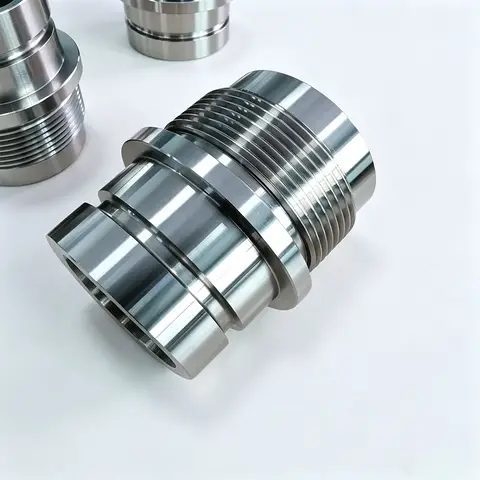
Transmission clamps are often assembled and reassembled, slid along the shaft for setup, or clamped against a hard shaft under high local pressure. On stainless, a rough bore will gall - microscopic welding that tears both surfaces the first time you tighten. Stainless steel mirror finishing is the fix: a smooth, passivated bore that slides and grips without cold-welding.
How we take a clamp bore to a mirror finish
- Machine the bore to a clean baseline so finishing has little material to remove.
- Passivate per ASTM A967 to rebuild the chromium-oxide layer that prevents corrosion.
- Electropolish to level micro-peaks and drive Ra toward 0.2 µm.
- Verify with a profilometer - we do not estimate the number, we measure it.
| Finish grade | Typical Ra | Where we use it on clamps |
|---|---|---|
| Standard machined | 0.8 µm | Non-sliding, clamped-in-place collars |
| Fine turned | 0.4 µm | Light-duty hubs, fixtures |
| Mirror (8K) | 0.2 µm | Sliding clamps, stainless-on-stainless shafts |
When you spec a stainless clamp, write the Ra target on the drawing. 'Smooth bore' is not a tolerance; 'Ra 0.2 µm max, passivated per ASTM A967' is.
Custom CNC Parts: When an Off-the-Shelf Clamp Costs You More
A catalog collar is cheap until it forces you to redesign the shaft around it.
Off-the-shelf clamps are a great default - until your transmission needs a collar with an integrated keyseat, a thinner wall to clear a neighbor, a weird bore to match a ground shaft, or a flange that doubles as a timing reference. At that point a custom CNC part is not the expensive option; the expensive option is the weeks of redesign and the tolerance stack-up you inherit from forcing a standard part to fit.
We build custom CNC parts like clamping hubs that combine the collar, the keyseat, and a locating flange in one clamped setup, so the features that must stay mutually true never leave the datum. That integration is usually cheaper than buying three catalog pieces and hiring an assembler to keep them aligned.
Choose a custom clamp if
- Your bore is non-standard or must match a ground/hardened shaft exactly.
- You need an integrated feature - keyseat, flange, lightening pocket, or sensor flag.
- Wall clearance is tight and a standard collar will not physically fit.
- You want one controlled setup instead of three sourced parts.
If you want to sanity-check a design, our engineering team reviews drawings for exactly these trade-offs. You can start a precision transmission CNC parts review and we will flag where a custom clamp beats the catalog.

Precision Transmission CNC precision component
CNC Precision Machining Processes for Clamping Collars and Hubs
Matching the process to the clamp is half the quality battle.
Clamping collars and hubs come in every shape - slender ground-shaft collars, flanged hubs with milled keyseats, thin-wall clamps with features on several faces. CNC precision machining lets us pick the right process for each, often combining operations in one clamped setup so the bore never loses its datum.
Process comparison for transmission clamps
| Process | Best for | Bore tolerance | Volume |
|---|---|---|---|
| Swiss-type turning | Long, slender collars | ±0.005 mm | Low to high |
| Turn-mill | Collars with milled keyseats/flanges | ±0.008 mm | Mid to high |
| 5-axis milling | Complex flanged hubs, multi-face | ±0.01 mm | Prototype to mid |
| Electropolish + passivate | Final bore finish on stainless | Ra 0.2 µm | All |
The best clamp is the one that needs the least fixing after machining - bore, face, and slot designed in one setup, not chased across three machines.
Combining operations in a single clamp reduces the error stack-up that comes from moving a part between machines. That is why process choice on a transmission clamp is a quality decision, not just a cost one. See more CNC precision machining guides for the full process map.
Clamps vs Set Screws: A Precision Transmission Buyer's Comparison
The two cheapest ways to locate a part on a shaft could not be more different in outcome.
Every transmission engineer faces this fork: locate the gear with a set screw, or spend a little more on a clamp. The set screw is seductive - one screw, one hole, done. But it grips the shaft on a single line, dents the shaft, and lets the component ride up to 0.10 mm off-center under load. A clamp grips on a ring and keeps runout in the microns.
| Factor | Set-screw collar | Clamping collar / hub |
|---|---|---|
| Shaft contact | Single line | Full ring grip |
| Typical runout | 0.05-0.10 mm TIR | 0.01-0.02 mm TIR |
| Shaft damage | Dents the shaft | No marking |
| Torque capacity | Low | Medium to high |
| Reassembly repeatability | Poor | Excellent |
| Cost | Lowest | 2-4x a set-screw collar |
Choose a set-screw collar if
- The shaft is soft and disposable, and position is genuinely non-critical.
- You are building a low-speed, low-torque jig or fixture.
- The part will never be reassembled and runout does not affect function.
Choose a clamping collar or hub if
- The component carries torque or runs above a few thousand rpm.
- Runout feeds straight into bearing life or servo tuning.
- You will reassemble and need the part to seat in the same place every time.
- The shaft is hardened or ground and must not be marked.
Precision Transmission CNC precision component
A Sourcing Checklist for Precision Transmission CNC Parts (Clamps)
Copy this and send it to every shop on your shortlist. The answers sort them fast.
Sourcing precision transmission CNC parts is less about finding a cheap machine and more about finding a shop that understands what runout, repeatability, and finish do to your gearbox. The questions below are the ones we are happy to answer with data - and the ones that separate a real precision source from a broker with a logo.
- Can they state a bore tolerance (e.g. ±0.005 mm) and verify it with a CMM, not a caliper guess?
- Will they show material certs traceable to the heat lot for the stainless or alloy used?
- Do they machine the clamp in one setup so bore, face, and slot share a datum?
- Can they deliver a mirror bore (Ra 0.2 µm) with passivation per ASTM A967 on stainless?
- Do they provide first-article inspection and in-process SPC on every lot?
- Is batch traceability from raw bar to finished clamp standard, not a premium add-on?
- Can they scale from prototype to 500k/month on the same documented process?
- Do they answer the runout question with a number, not a promise?
A supplier that clears all eight is rare and worth keeping. One that stumbles on bore verification or traceability should not be on a transmission program where a slip means a recall-adjacent failure.
Common Mistakes Engineers Make When Specifying Clamps for Precision Transmission
Most transmission clamp failures were decided at the drawing stage, not on the floor.
- Chasing the lowest collar price - the saving vanishes in rework, bearing wear, and re-tuning.
- Leaving bore finish as 'smooth' on the drawing, then arguing about galling after shipment.
- Specifying a set screw on a high-speed shaft to save cost, then fighting runout for a season.
- Forgetting slot symmetry - an uneven clamp ovalizes the bore and the gear runs out.
- Ignoring how the part is fixtured during finish, so free-state bore differs from clamped bore.
- Skipping first-article inspection to 'save time' - it is the cheapest insurance you have.
None of these are exotic technical problems. They are habits - and the disciplined shop you choose should make the right habit the easy default. We have seen these exact mistakes turn a clean gearbox design into a field-complaint generator, and every one is avoidable at the sourcing step.
Precision Transmission CNC precision component
Precision Transmission CNC precision component
Precision Transmission CNC precision component
Precision Transmission CNC precision component
FAQ: clamps & Precision Transmission Buyer Questions
A: We routinely hold the bore to ±0.005 mm and face squareness to ±0.01 mm on transmission clamps, verified by CMM rather than estimated. Slot symmetry is held to ±0.02 mm so the bore closes round instead of oval under clamp load.
A: A set-screw collar grips the shaft on a single line, dents it, and can introduce 0.05-0.10 mm runout under load. A clamping collar grips on a full ring and keeps runout at 0.01-0.02 mm TIR, which protects bearing life and servo tuning. For any torque-carrying or high-speed shaft, the clamp wins.
A: For a clamp that slides on or clamps against a stainless or hardened shaft, specify Ra 0.2 to 0.4 µm (mirror / 8K) passivated per ASTM A967. The smooth, passivated bore resists galling and corrosion; 'smooth' alone is not a controllable requirement.
A: Yes. We machine integrated clamping hubs in a single clamped setup so the bore, keyseat, and flange stay mutually true to one datum. That is usually cheaper and more accurate than sourcing three catalog parts and keeping them aligned in assembly.
A: Yes. Every lot is tied to its material mill certificate, machine, operator, and inspection records, with a Certificate of Conformance. We also run first-article inspection and in-process SPC so a process drift shows up before a bad lot ships.
A: Single prototypes are routine, and our floor is built for both small custom batches and volume - 500,000 parts a month across 60 machines. We typically qualify a custom clamp at low volume, lock the CMM data, then scale to production on the same documented process.
Sending us your shaft and clamp drawing gets you a free DFM review - we will flag where a clamping hub beats a set screw, which tolerances are worth paying for, and whether your bore needs a mirror finish to avoid galling. Reach out and let's cut the first article.
Request a Free CNC Quote