CNC Cooling Plates for Battery Packs: Flatness & Flow (2026 Guide)
If you are building or sourcing a battery pack, the part that usually decides whether your cells age gracefully or cook themselves is not the cell - it is the cold plate sitting underneath them. A cooling plate that is not flat presses against some cells harder than others, leaving air gaps that turn into hot spots, and hot spots are where capacity fades first and where thermal runaway starts. For a procurement or design engineer, that single flatness number on the drawing is doing more work than half the spec sheet.
In this guide we walk through how CNC cooling plates are actually made, why thermal management in a pack lives or dies on flatness and flow uniformity, and where copper bus bars and other CNC power parts fit into the same enclosure. We will put real numbers on the table - Ra 0.2 micro m mirror finishes, +/-0.005 mm positioning, 60 machines on the floor - and give you a sourcing checklist you can hand a supplier today. The goal is to help you specify and verify the parts instead of trusting a photo of a shiny plate.
We have been a Dongguan source factory for precision CNC work since 2015, running 60 CNC machines on a 4,000 sqm floor with monthly output around 500k parts. This is written from the shop floor: the trade-offs, the red flags, and the tolerances are the ones we argue about with customers before a single chip is cut.
Table of Contents
- 1. Why Thermal Management Decides Battery Pack Life
- 2. CNC Power Parts: Where Cooling Plates Meet Copper Bus Bars
- 3. Aluminum CNC Machining of Battery Box Parts and Cooling Plates
- 4. Flatness Specs That Make Energy Storage Components Reliable
- 5. Energy Storage Components: Choosing Plate Material and Finish
- 6. Thermal Management Design: Flow Path and Wall Thickness
- 7. Copper Bus Bars and CNC Power Parts: Tolerances That Matter
- 8. A Sourcing Checklist for Battery Box Parts and Cooling Plates
Energy Storage AI part image
Why Thermal Management Decides Battery Pack Life
Cells do not fail from cold - they fail from uneven heat.
A lithium cell is happiest in a narrow temperature band, and it is happiest when every cell in the module sits in that band. The moment one cell runs 5 to 8 C hotter than its neighbor, it ages faster, its internal resistance climbs, and the pack's usable capacity drops ahead of schedule. The cooling plate's job is to hold that band across the whole footprint - and it can only do that if it touches every cell baseplate evenly.
That is the real link between thermal management and flatness: an air gap of even 0.1 mm between the plate and the cell baseplate multiplies the thermal resistance at that spot by an order of magnitude. So the flatness spec you put on the cooling plate is, in practice, a cell-life spec. We tell customers to treat it that way, not as a cosmetic finish callout.
The three failure modes a flat plate prevents
- Local hot spots that accelerate capacity fade in the hottest cells
- Thermal gradient across the pack that forces the BMS to derate the whole module
- TIM (thermal interface material) starvation where thick gaps swallow the gap-filler and leave voids
Energy Storage AI part image
CNC Power Parts: Where Cooling Plates Meet Copper Bus Bars
Same enclosure, two very different machining jobs.
Inside a battery box you typically have three machined families that we group under CNC power parts: the cold plate, the bus-bar carrier or frame, and the copper bus bars themselves. They live in the same aluminum enclosure, but the plates and the bars are opposite problems. The plate is a flatness-and-flow problem; the bus bar is a conductivity-and-clean-edge problem. Mixing up the disciplines is the most common sourcing mistake we see.
Copper bus bars carry the pack current, so their risk is electrical: a burr that walks into the insulator, an edge that arcs, a cross-section that runs hot because the cross-section was machined undersize. Cooling plates carry heat, so their risk is mechanical and thermal: a wave in the surface, a pinched flow channel, a warped plate after brazing. One enclosure, two completely different verification checklists.
| Attribute | Cooling plate (CNC power part) | Copper bus bars (CNC power part) |
|---|---|---|
| Primary risk | Flatness / flow uniformity | Conductivity / edge arcing |
| Typical material | Al 6061 / 3003, brazed | C11000 copper, often plated |
| Key tolerance | Flatness 0.05-0.1 mm over face | Cross-section +/-0.05 mm, edge break |
| Finish driver | TIM contact, no voids | Clean burr-free edge, plating adhesion |
| Our accuracy | +/-0.005 mm positioning | +/-0.005 mm positioning |
Aluminum CNC Machining of Battery Box Parts and Cooling Plates
Pick the alloy for the job the plate actually does.
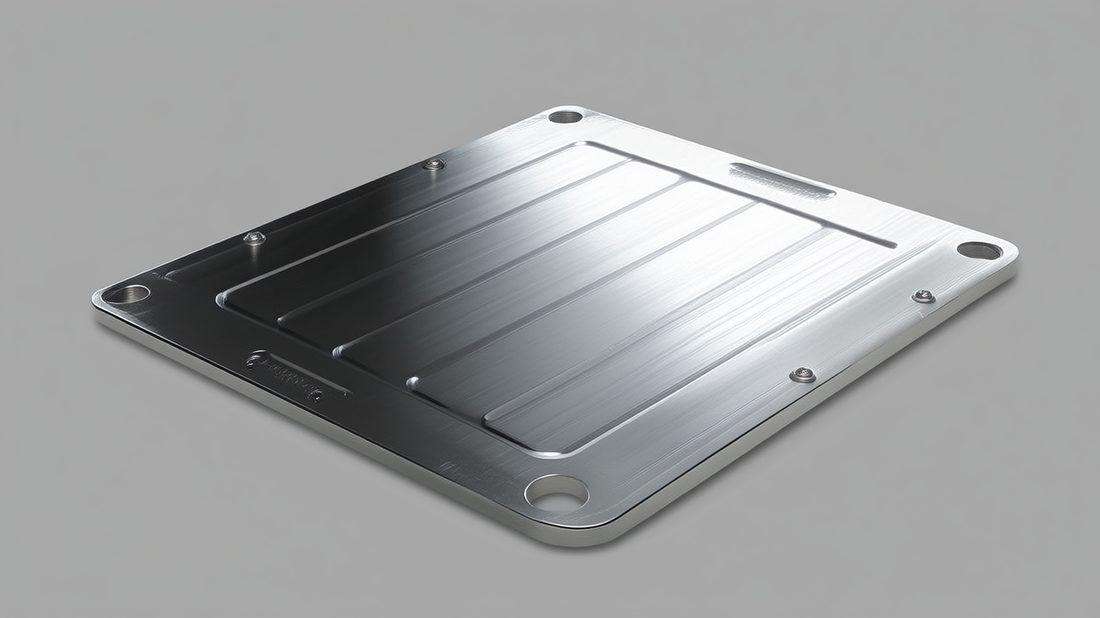
Aluminum CNC machining is the default for battery box parts because the enclosure already wants to be light, stiff, and corrosion-resistant, and aluminum delivers all three cheaply. For cooling plates we lean on 3003 or 6061: 3003 brazes beautifully in a vacuum furnace (it is the tube-and-plate brazing alloy of choice), while 6061 gives you more strength for frames and carriers that also carry structural load.
The trap is assuming 'aluminum' is one material. 6061's higher strength is great for the box, but its magnesium content makes vacuum brazing trickier than 3003. We decide the alloy per feature, not per pack, and we tell customers up front which faces will be brazed so the material call is right before the first blank is cut.
How we fixture thin plates without spring-back
A 4-6 mm cooling plate is a thin part. Clamp it wrong and it bows, you machine the bow, you release it, and it springs back out of flat. We use vacuum or tensioning fixtures and take the finishing pass at low engagement so the part stays on its true datum through the last cut - that is what lets us hold the face flat to 0.05 mm and the contour to +/-0.005 mm.
Pros
- 3003 brazes cleanly in vacuum furnace
- 6061 carries structural load in the box
- Aluminum is light, stiff, corrosion-resistant
- Cheap and fast to machine vs copper or steel
Cons
- 3003 is soft, dents in handling
- 6061 is harder to vacuum-braze than 3003
- Plates warp if fixtured poorly
- Anodize can close tight channels if untoleranced
Energy Storage AI part image
Flatness Specs That Make Energy Storage Components Reliable
A flatness number is only useful if it names the condition.
When we review a drawing for energy storage components, the flatness callout is where most ambiguity hides. 'Flat to 0.1' means nothing until you say over what area, in what condition (free state or bolted down), and referenced to which datum. A plate that is flat free but waves when you torque it to the box is a flat plate that still cooks cells.
We push customers to specify flatness in the bolted condition, because that is the state the cells actually see. We then machine to a tighter free-state number so that after clamp-up the working face lands inside the spec. It is a small discipline that removes the single biggest source of field hot spots.
- Flatness
- The deviation of a surface from a perfect plane, measured over a defined area and condition (free state or clamped).
- TIM
- Thermal Interface Material - the gap-filler squeezed between the cell baseplate and the cooling plate; it only works if the gap is uniform and thin.
- Datum
- The reference surface or axis from which all other dimensions are measured; on a plate it is usually the machined flow face.
| Spec condition | What it controls | Typical value we hold |
|---|---|---|
| Free-state flatness | Machining quality before assembly | 0.05 mm over face |
| Bolted flatness | Real contact the cells see | 0.08-0.1 mm over face |
| Channel wall thickness | Pressure rating, no burst | >= 1.0 mm |
| Surface Ra on flow face | TIM wet-out, no voids | Ra 0.8 micro m typical, Ra 0.2 micro m on demand |
Energy Storage Components: Choosing Plate Material and Finish
Finish is a thermal decision, not a looks decision.
For energy storage components the plate finish is about TIM wet-out, not shine. A rough face traps air under the gap-filler and leaves voids; a smoother face lets the TIM spread thin and uniform, which is exactly what pulls heat out of the cell. We typically machine the flow face to Ra 0.8 micro m, and we can take visible or contact faces to our mirror-ready Ra 0.2 micro m when the application earns it.
Material choice follows the coolant and the pressure. Stamped or brazed aluminum plates handle glycol-water loops at low pressure; higher-pressure or corrosive loops may push you to stainless or a coated aluminum. We machine stainless mirror finishes for fluid parts elsewhere in our plant (Ra 0.2 micro m, ASTM A967 passivation), so the same discipline carries to packs that need it.
- Define the coolant chemistry and loop pressure first
- Pick 3003 (brazed) or 6061 (structural) per feature
- Set flow-face Ra for TIM wet-out, not appearance
- Decide coatings: anodize for aluminum, passivation for stainless
- Tolerance the coated condition so bores and channels survive
| Material / finish | Use it when | Watch out for |
|---|---|---|
| 3003, brazed | Vacuum-brazed tube-and-plate plates | Soft; handle with care |
| 6061, anodized | Structural box + carrier | Coating can close channels |
| Stainless, passivated | Corrosive or high-pressure loops | Heavier, costlier to machine |
| Ra 0.2 micro m mirror | Premium TIM contact | Usually over-spec; use only where needed |
Energy Storage AI part image
Thermal Management Design: Flow Path and Wall Thickness
Uniform flow is what makes a flat plate actually cool.
A plate can be perfectly flat and still cook a corner if the coolant flows fast through one channel and barely through another. Thermal management design is therefore a flow problem as much as a flatness problem. We work with customers on channel count, cross-section, and inlet-outlet placement so that the pressure drop is balanced across the footprint and no cell sits downstream of a starved channel.
Wall thickness is the lever that sets both pressure rating and machinability. Too thin and the plate balloons or bursts at pressure; too thick and you waste material and slow the cut. We hold walls at 1.0 mm minimum on machined channels and verify burst margin with the customer's loop pressure before sign-off.
Pin-fin vs serpentine channels
- Serpentine: simple to machine, cheap, but can leave a hot tail at the outlet end
- Parallel channels: even flow if balanced, more machining
- Pin-fin: best heat transfer, hardest to machine and clean - reserve for high-density packs
Copper Bus Bars and CNC Power Parts: Tolerances That Matter
A bus bar fails electrically, usually at the edge.
Copper bus bars are the highest-current CNC power parts in the box, and their failure mode is electrical, not thermal in the plate sense. The risks are a burr that pierces the insulator, an edge that arcs under vibration, or a cross-section machined undersize so the bar runs hot. We hold the cross-section to +/-0.05 mm and put a controlled edge break on every cut so nothing can arc or short.
Plating is where bus bars quietly go wrong. A nickel or tin layer adds microns; if you machine the bar to nominal and then plate, the insulated collar or the crimp may no longer fit. We machine the plated condition, just like we do for anodized aluminum, so the finished bar seats as drawn.
| Parameter | Why it matters | Value we hold |
|---|---|---|
| Cross-section | Sets current capacity and self-heating | +/-0.05 mm |
| Edge break | Prevents arcing and insulator puncture | 0.2-0.5 mm controlled |
| Hole true-position | Bolt torque without eccentric load | +/-0.05 mm |
| Plating thickness | Must be tolerated into the final size | Machine plated condition |
Energy Storage AI part image
A Sourcing Checklist for Battery Box Parts and Cooling Plates
Hand this to a supplier and you will filter out the tire-kickers.
Sourcing battery box parts and cooling plates is less about finding a cheap machine and more about finding a shop that understands flatness-in-condition, brazing, and lot traceability. The checks below are the ones we are happy to answer with data, and the ones that separate a real precision source from a broker with a logo.
- Ask for the cert stack: ISO 9001 minimum, ISO 13485 a plus for medical-adjacent packs, IATF 16949 in application signals automotive discipline
- Request material certs traceable to the heat lot for both plate and bus bar
- Confirm they machine flatness in the bolted condition, not free-state only
- Get a CMM first-article report with full datum references, not just a photo
- Verify brazing or passivation spec (ASTM A967 for stainless) is agreed before quoting
- Demand lot traceability from raw bar to finished component and a real rework path
- Material certs (heat-lot traceable)
- CMM first-article, datum-referenced
- Flatness called out in bolted condition
- Brazing/passivation spec agreed (ASTM A967)
- Channel wall >= 1.0 mm, burst margin verified
- Lot traceability bar-to-part
The cheapest cooling plate is the one that passes qualification the first time - because the second time costs you a launch date and a field retrofit.
Energy Storage AI part image
Energy Storage AI part image
Energy Storage AI part image
Energy Storage AI part image
FAQ: battery box parts & Energy Storage Buyer Questions
A: Practical packs want the working face flat to 0.05-0.1 mm, but the number only means something if it names the condition. We hold free-state flatness to 0.05 mm so that after bolt-down the contact face lands at 0.08-0.1 mm - the state the cells actually see. Specifying free-state only hides a bolted-wave problem.
A: The plate is almost always aluminum (3003 for vacuum-brazed flow faces, 6061 for structural boxes), while copper is reserved for the bus bars that carry current. They are different jobs: the plate manages heat through flatness and flow, the bus bar manages current through cross-section and clean edges. Use copper for the plate only on corrosive or high-pressure loops.
A: Finish drives TIM wet-out. A rough flow face traps air under the gap-filler and leaves voids that become hot spots; a smoother face lets the thermal interface material spread thin and uniform. We machine the contact face to Ra 0.8 micro m typically and can reach Ra 0.2 micro m mirror when the application earns it - but only on faces the TIM touches.
A: Cross-section to +/-0.05 mm so the bar does not run hot, a controlled 0.2-0.5 mm edge break so nothing arcs or pierces the insulator, and hole true-position to +/-0.05 mm for even bolt load. Critically, machine the plated condition - a nickel or tin layer adds microns that can otherwise break the insulated collar fit.
A: Yes. We supply material certs traceable to the heat lot, a CMM first-article report with full datum references, in-process gauging for batch parts, and lot-level traceability from raw bar to finished component. Our cert stack is ISO 9001 certified, ISO 13485 completed, IATF 16949 in application.
A: Yes. Our floor runs 60 CNC machines on a 4,000 sqm plant with monthly output around 500k parts, built for both small custom batches and volume. A cooling-plate program typically qualifies at low volume with first-article CMM, then scales in the same cell so the datum stack never resets.
Send us your cooling-plate or battery-box drawing for a free DFM review - we will flag the flatness condition that should be on the drawing, the alloy call between 3003 and 6061, and the tolerances on your copper bus bars that are quietly costing you reliability. Reach out and let's cut the first article.
Request a Free CNC Quote