CNC EV Busbars: Machining & Tolerances for Electronics and Communication Applications (2026 Guide)
If you are designing the power backbone of an EV battery pack, a 5G base-station power shelf, or an outdoor telecom cabinet, the part that quietly decides whether your system runs cool and reliable is the busbar. Most engineers spend weeks on the cells and the BMS, then treat the busbar as a commodity strip of copper. That is the mistake we see most often: a busbar that is a few microns off at the contact face, or a few degrees too rough on the surface, is the difference between a connection that lasts ten years and one that creeps loose under thermal cycling.
In this guide we walk through how CNC precision machining earns its place in EV busbars, why tight tolerance CNC work on the contact surfaces is not optional, and where stainless steel mirror finishing actually pays off versus plain copper or aluminum. We cover the material trade-offs, the tolerances that protect your ampacity, a decision matrix you can use today, and a buyer's checklist for vetting a CNC shop before you send the drawing.
We are Dongguan Licun Technology Co., Ltd. (brand LusterControl), a Dongguan source factory focused on CNC stainless steel mirror finishing for 15 years since 2015. We run 60 CNC machines on a 4,000 sqm floor (expanded in 2026, the old 2,000 sqm plant is retired) with monthly output around 500,000 parts, certified to ISO 9001 and ISO 13485 with IATF 16949 in application. This is written from the shop floor, not a catalog, so the numbers and trade-offs are the ones we argue about with customers before the first chip is cut.
Table of Contents
- 1. Why EV Busbars Are the Hidden Bottleneck in Power Distribution
- 2. How CNC Precision Machining Shapes a Reliable Busbar
- 3. EV Busbars Materials: Copper, Aluminum, and Stainless Steel Options
- 4. Tight Tolerance CNC: Holding +/-0.005 mm on Busbar Contacts
- 5. Custom CNC Parts: Designing Busbars for Your Enclosure
- 6. Stainless Steel Mirror Finishing for Corrosion-Prone Busbar Environments
- 7. Electronics and Communication CNC Parts: Why Signal and Power Share the Board
- 8. A Buyer's Checklist for Sourcing EV Busbars from a CNC Shop
Electronics&Communication CNC precision component
Why EV Busbars Are the Hidden Bottleneck in Power Distribution
The busbar is the only part every amp has to pass through.
A busbar is a solid conductor that distributes current between high-power nodes: cell-to-pack links, the BMS feed, the inverter input, and the cooling-fan or compressor loads in an EV, or the rectifier and power-amplifier stages in a communication cabinet. Unlike a wiring harness, a busbar has a known, fixed geometry, so its resistance, inductance, and thermal rise are predictable at the design stage. That predictability is exactly why it becomes the bottleneck when it is made badly.
The failure mode is rarely a dramatic blowout. It is contact resistance creeping up as the plating micro-moves under hundreds of thermal cycles, local heating that accelerates oxidation, and oxidation that raises resistance further until a terminus hits its limit. Machining quality at the contact face is what sets the starting resistance, so it is where the whole reliability budget begins.
Three terms you should read off every busbar drawing
- Busbar
- A rigid bar (copper, aluminum, or stainless) that carries and distributes high current with a fixed, low-inductance path.
- Ampacity
- The maximum continuous current a conductor can carry without exceeding its rated temperature rise.
- Creep
- Slow plastic deformation of a fastened joint under sustained clamp load and thermal cycling, which loosens the connection over time.
| Factor | Busbar | Wiring harness |
|---|---|---|
| Space per amp | High (flat profile) | Lower (bundle volume) |
| System inductance | Very low | Higher, varies with routing |
| Thermal path | Predictable, easy to cool | Harder to model |
| Serviceability | Bolt-off, inspect, re-torque | Strip and re-crimp |
| Best use | High-current fixed nodes | Flexible routing, low current |
Electronics&Communication CNC precision component
How CNC Precision Machining Shapes a Reliable Busbar
A busbar is a precision part the moment it carries hundreds of amps.
CNC precision machining turns a raw bar or plate into a busbar with the contact pads, bolt holes, bending reliefs, and insulation standoffs all cut in controlled sequences. The value is not the cutting itself; it is the repeatability. A mill-turn or 5-axis center holds the contact face, the hole pattern, and the bend angle on one datum, so every part in a lot is interchangeable - which is what lets you torque a pack together without shimming each joint.
The machining sequence we use for a typical bar
- Rough the profile and pocket the weight-reduction windows to shift resonance away from the operating band
- Drill and ream the bolt holes to the true-position callout, not just the diameter
- Finish the contact face to the specified Ra so plating or direct metal contact is uniform
- Deburr every edge; a single burr under a washer becomes a hot spot
- Inspect the first article on a CMM, then gauge in-process for the batch
We apply the same discipline we use for automotive CNC parts and telecom hardware across the line, because the failure physics are identical: a loose joint is a loose joint whether it sits in a car or a base station. The difference is only the environment and the amp rating on the label.
| Capability | LusterControl | Typical job shop |
|---|---|---|
| Positioning accuracy | +/-0.005 mm | +/-0.02 mm |
| Mirror finish | Ra 0.2 micrometer / 8K | Ra 0.8 micrometer typical |
| CNC machines | 60 | 10-20 |
| Plant area | 4,000 sqm (2026 expansion) | <1,000 sqm |
| Monthly capacity | 500,000 parts | 50,000-100,000 |
| Quality certs | ISO 9001 + ISO 13485 | ISO 9001 only |
The cheapest busbar is the one that passes qualification the first time, because the second time costs you a launch date.
EV Busbars Materials: Copper, Aluminum, and Stainless Steel Options
Material choice is a conductivity-versus-environment trade, not a hierarchy.
Copper is the default for EV busbars because it conducts best and resists creep under clamp load. Aluminum is lighter and cheaper and is common in large stationary energy-storage racks where weight and cost dominate and the joints are managed with shaped contact washers. Stainless steel is the specialist: poor conductivity, but unbeatable when the bar lives in a corrosive, humid, or chemical environment such as a coastal telecom cabinet, a marine energy-storage unit, or a food-grade enclosure where washdown is routine.
The trick is to size for the material. A stainless bar must be physically larger to carry the same amps as copper, so it is only sensible where corrosion resistance genuinely drives the design. We machine all three and will tell you plainly when stainless is overspec and when it is the only safe call.
Pros
- Copper: highest conductivity, best creep resistance, easy to plate
- Aluminum: about 30 percent lighter and far cheaper for large racks
- Stainless: survives salt, washdown, and chemical exposure
Cons
- Copper: heavy and expensive per kilogram
- Aluminum: creeps and oxidizes at the joint if not managed
- Stainless: low conductivity needs a larger cross-section
Electronics&Communication CNC precision component
Tight Tolerance CNC: Holding +/-0.005 mm on Busbar Contacts
The contact face is where tolerance becomes temperature.
On a busbar the two surfaces that matter most are the contact face that meets the next conductor and the bolt-hole true position that decides whether the joint seats flat. A face that is 0.02 mm out of flat leaves a gap the clamp load has to crush; over thermal cycles that gap becomes micro-motion, and micro-motion becomes oxidation and heat. Tight tolerance CNC holds the face flat and the holes true so the joint starts life perfectly seated.
For high-reliability custom CNC parts with tight stacks we concentrate the tolerance budget on the contact relationships and relax the non-functional edges to commercial limits. This keeps cost sane while protecting the only dimensions that affect ampacity and service life.
- Contact-face flatness: 0.01 mm over the pad
- Bolt-hole true position: +/-0.03 mm
- Hole diameter: H7 reamed, not just drilled
- Edge break: R0.3 minimum to protect the washer seal
- Free-state vs clamped form agreed before quote
Custom CNC Parts: Designing Busbars for Your Enclosure
Design the bar to the box, not the box to the bar.
Every enclosure is a different puzzle: clearance to the housing wall, standoff height to clear the PCB, bend radius that clears the BMS, and weight windows that protect the structure. We treat custom CNC parts like the UAV structural components we build - map the constraints first, then machine to fit, rather than forcing a standard bar into a space it was never meant to occupy.
What to send us so we can quote in one pass
- The 3D model plus a 2D drawing with the critical dimensions called out
- The rated current and the expected thermal-cycle count
- The mating surface finish and plating spec, if any
- Clearance envelope and any standoff or insulation requirement
- Volume and target price so we pick the right process
| Project requirement | Recommended approach | Why it wins |
|---|---|---|
| High current, tight space | Copper, milled contact pads | Best conductivity per mm |
| Lightweight stationary rack | Aluminum, shaped washers | Cost and mass down |
| Corrosive or washdown site | Stainless, mirror-finished face | Survives the environment |
| Mixed signal and power board | Insulated standoffs, tight true-pos | No short, repeatable seat |
Electronics&Communication CNC precision component
Stainless Steel Mirror Finishing for Corrosion-Prone Busbar Environments
When the environment eats copper, finish is the defense.
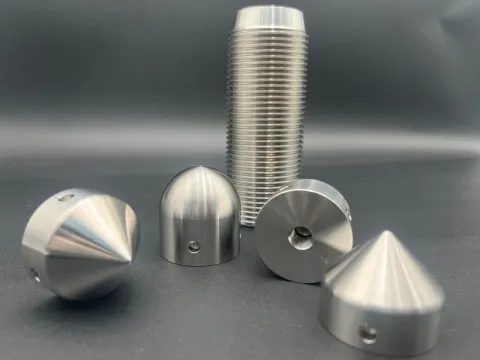
Stainless steel mirror finishing is not about looks on a busbar; it is about removing the micro-valleys where moisture and contaminants pool. A standard machined face at Ra 0.8 micrometer holds a film of electrolyte in its texture; our mirror line takes the contact zone down to Ra 0.2 micrometer (8K), shrinking that film and slowing the corrosion that would otherwise raise joint resistance in a humid or coastal site.
We reach the mirror finish by mill-turn and 5-axis roughing followed by progressive polishing, and where the spec calls for it we passivate per ASTM A967 so the surface resists fingerprint and handling corrosion. For most stainless busbars the visible and contact faces are mirror-finished while structural edges stay functional - you pay for the finish only where it protects the joint.
- Mirror finishing
- Progressive polishing to a very low roughness, here Ra 0.2 micrometer (8K), for clean contact and corrosion resistance.
- Electropolishing
- An electrochemical pass that smooths microscopic peaks and improves corrosion resistance on stainless.
- ASTM A967
- The US standard covering passivation of corrosion-resistant steels, the spec we follow for stainless parts.
Electronics and Communication CNC Parts: Why Signal and Power Share the Board
In a comms cabinet, the busbar sits next to the signal path.
In electronics and communication CNC parts the busbar rarely travels alone. It runs beside RF feeds, control boards, and sensors, so its geometry and finish affect more than ampacity: a poorly finished high-current bar radiates more, and a loose joint adds noise to a sensitive measurement. We machine the power path and the adjacent brackets on the same floor, which keeps the mechanical datum consistent between the high-current and the high-frequency worlds.
As we cover in our electronics and communication cnc parts resources, the same rules apply across the cabinet: hold the true position, finish the contact, trace the lot. When the power bar and the mounting hardware come from one controlled process, the assembly seats the same way every time and the signal side stays quiet.
- Keep the busbar edge break consistent so insulation clears
- Spec standoffs that separate power from signal by the designed gap
- Mind the thermal path so the bar does not heat the board
- Require lot traceability for field-serviceability
Electronics&Communication CNC precision component
A Buyer's Checklist for Sourcing EV Busbars from a CNC Shop
Hand this to a supplier and the tire-kickers filter themselves out.
Sourcing EV busbars is less about finding a cheap machine and more about finding a shop that understands current-carrying intent. The questions below are the ones we are happy to answer with data, and the ones that separate a real precision source from a broker with a logo.
- Ask for the cert stack: ISO 9001 minimum, ISO 13485 a strong plus for medical-adjacent work, IATF 16949 in application a good sign for automotive intent
- Request material certs traceable to the heat lot, not just a mill name
- Confirm true-position capability on the contact face, not just hole diameter
- Get a CMM first-article report, not just a photo of a good part
- Agree on the coated vs bare and mirror vs functional finish before quoting
- Verify lot traceability and a real rework path for field returns
- Material cert traceable to heat lot
- CMM first-article report with full datum references
- Contact-face flatness and true-position called out
- Finish spec: mirror Ra 0.2 micrometer where it protects the joint
- Red flag: shop quotes only diameter, never true position
- Red flag: no lot traceability or rework path
Electronics&Communication CNC precision component
Electronics&Communication CNC precision component
Electronics&Communication CNC precision component
Electronics&Communication CNC precision component
FAQ: EV busbars & Electronics&Communication Buyer Questions
A: We hold contact-face flatness to 0.01 mm and bolt-hole true position to +/-0.03 mm, with overall positioning accuracy of +/-0.005 mm across the part. The contact face is finished to the specified Ra, down to our mirror-ready Ra 0.2 micrometer, because flatness and finish - not just hole diameter - decide how the joint seats and how long it stays cool.
A: Use copper for EV packs where space and creep resistance matter most; it conducts best and holds the clamp load through thermal cycling. Choose aluminum for large stationary energy-storage racks where weight and cost dominate and the joints are managed with shaped contact washers. Size ampacity to the actual alloy, never assume one cross-section fits both.
A: Yes. We take the contact zone down to Ra 0.2 micrometer (8K) by mill-turn and 5-axis roughing plus progressive polishing, then passivate per ASTM A967. Mirror finishing shrinks the micro-valleys where moisture pools, slowing corrosion in coastal, marine, or washdown sites. Stainless conducts poorly, so the bar must be sized larger than an equivalent copper part.
A: Yes. We supply material certs traceable to the heat lot, a CMM first-article report with full datum references, in-process gauging for batch parts, and lot-level traceability from the raw bar to the finished component. ISO 9001 and ISO 13485 certified, with IATF 16949 in application.
A: Single prototypes are routine, and our floor is built for both small custom batches and volume - around 500,000 parts a month across 60 CNC machines. For a dedicated program we typically qualify at low volume with a CMM-locked first article, then scale once the data is confirmed.
A: Every bar is traceable from the incoming raw lot to the finished part. We record the material heat, the machine and program used, the inspection results, and the lot identity, so a field return can be traced to its exact production batch. That is what lets a shop offer a real rework path instead of a guess.
Send us your busbar drawing for a free DFM review - we will flag the features that should move to 5-axis, the tolerances that are costing you reliability, and the material call between copper, aluminum, and stainless. Reach out and let's cut the first article.
Request a Free CNC Quote