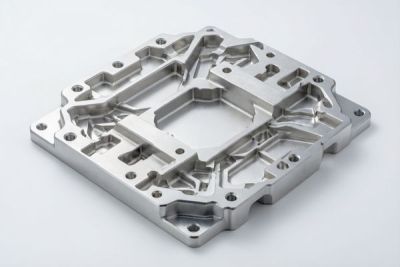
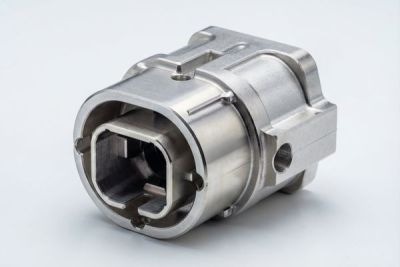
CNC Gripper Jaws: Machining & Tolerances for UAV/Drone Applications
If you design a drone that has to pick something up, the part you are really trusting is the gripper jaw. The airframe can be perfect, the flight controller flawless, and the camera stunning - but the moment the jaw relaxes a fraction of a millimeter, the payload drops, the mission fails, and you are explaining a lost unit to a customer. A gripper jaw is not a bracket you can bolt on and forget. It is the only thing between your expensive payload and the ground.
This guide is written the way an engineer would explain it to a colleague, not a catalog. We walk through what a gripper jaw actually does on a drone payload, how CNC precision machining builds one that holds its seat under vibration and shock, what tight tolerance CNC really demands, how stainless steel mirror finishing changes the grip and corrosion story, and the mistakes we see buyers make most often. The numbers and trade-offs are the ones we argue about with customers before the first chip is cut.
Whether you are building a one-off inspection drone or ramping a delivery-airframe program, the same rules apply: match the jaw material to the job, hold the tolerance where the grip depends on it, and verify everything you write on the drawing. By the end you will have a checklist you can send to any shop - including our own - and a clear sense of what a good answer sounds like.
Table of Contents
- 1. Why Gripper Jaws Decide Payload Reliability in UAV/Drone CNC Parts
- 2. What Gripper Jaws Actually Do on a Drone Payload
- 3. How CNC Precision Machining Builds a Gripper Jaw That Holds
- 4. Tight Tolerance CNC: Tolerances That Keep a Gripper Jaw Seating
- 5. Stainless Steel Mirror Finishing for Gripper Jaws
- 6. Custom CNC Parts: Designing Gripper Jaws for Drone Arms
- 7. Gripper Jaws vs Soft Pads: A Material and Grip Comparison
- 8. UAV/Drone CNC Parts: Where Gripper Jaws Fit in the Airframe
- 9. Common Mistakes When Specifying Tight Tolerance CNC for Gripper Jaws
- 10. A Buyer's Checklist for Custom CNC Parts: Sourcing Gripper Jaws
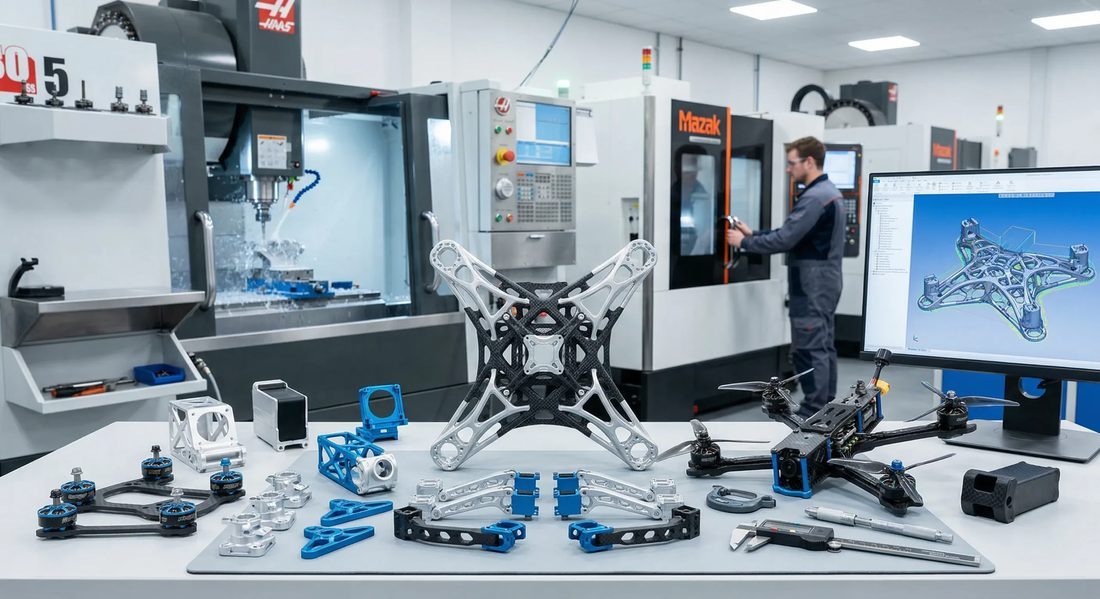
UAV/Drone CNC precision component
Why Gripper Jaws Decide Payload Reliability in UAV/Drone CNC Parts
The jaw is the last link in the payload chain - and the first to fail.
Most failures in a pickup drone are not glamorous. They are not a flyaway or a software fault. They are a gripper jaw that crept, fretted at the bolt circle, or lost its grip on a wet or painted surface. When the jaw is the only mechanical interface to the payload, its dimensional and surface behavior is the whole reliability story for UAV/drone CNC parts that actually handle objects.
The failure modes nobody budgets for
- Seat relaxation: a jaw cut to the wrong flatness lets the payload pivot a fraction of a degree and slowly walk off.
- Fretting at the bolt circle: vibration micro-slips the fasteners, and the grip loosens after a few hundred cycles.
- Surface slip: a rough or contaminated jaw face gives poor friction, so the clamp force has to be cranked up until it dents the payload.
- Corrosion pitting: a non-passivated steel jaw in coastal or humid flight loses bite and jams the actuation.
All four are decided at the drawing and the machining stage, not in the field. A jaw that is flat, hard, clean, and corrosion-resistant is boring in the best way - it just works every cycle. A jaw that is not is a recurring service call you will pay for long after the program shipped.
The rest of our work on UAV/drone CNC parts covers arms, motor mounts, and structural frames where the load path is continuous. The gripper jaw is different: it is a discontinuous, point-loading interface, and that is exactly why its precision is non-negotiable.
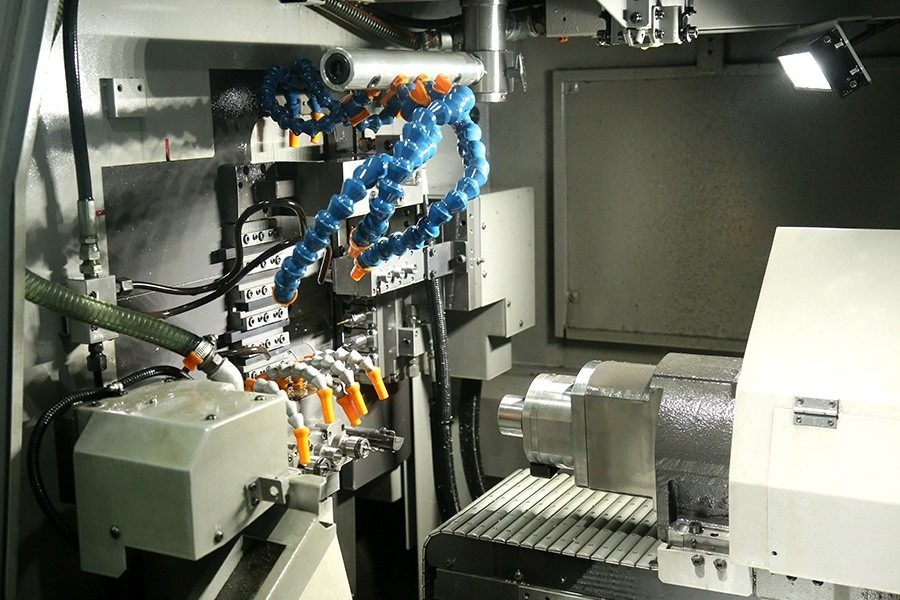
UAV/Drone CNC precision component
What Gripper Jaws Actually Do on a Drone Payload
A jaw is a friction-and-geometry interface, not just a clamp.
A gripper jaw on a drone does three jobs at once. First, it locates the payload: the jaw's locating face and pilot register the object so it sits in the same place every time, which matters because the flight controller and any onboard sensor assume a fixed pickup geometry. Second, it grips: the jaw face provides the friction and contact patch that the clamp force turns into holding torque. Third, it survives the environment: vibration, repeated actuation, temperature swings, and sometimes salt or dust.
Locating versus gripping - do not conflate them
- Gripper jaw
- The replaceable or integral contact element of a drone gripper that locates and clamps the payload.
- Locating feature
- A pilot, V-block, or datum edge on the jaw that registers the payload in a repeatable position.
- Seat flatness
- How true the contact plane is; it controls whether the payload rocks or sits solid.
- Grip torque
- The holding moment the friction patch resists before the payload slips.
The locating job wants geometry and flatness. The gripping job wants controlled surface texture and material hardness. Conflating them is the classic error: a designer specifies a super-smooth jaw to 'grip better' and ends up with less friction, so they over-clamp and dent the payload. The right answer is usually a flat, hard locating plane plus a deliberately textured or coated grip patch.
This matters for the buyer because the same jaw for a smooth aluminum sample box is a different precision problem from a jaw for a painted, irregular inspection target. Specifying the job correctly is the first step to a jaw that holds.
How CNC Precision Machining Builds a Gripper Jaw That Holds
Precision is manufactured in the process chain, not added at inspection.
A gripper jaw looks simple - a small block with a pocket and a bolt hole - but CNC precision machining of a jaw that holds its seat is a controlled chain, not a quick cut. The geometry is small, the locating features are tight, and the surface condition of the grip patch drives the whole function. Here is how we run a jaw program.
Stage 1 - Material and roughing
- Certify the incoming bar with a mill certificate confirming the alloy (stainless 303/304/17-4PH, aluminum 7075, or TC4 as the design dictates).
- Rough with moderate feeds, leaving even stock so the part does not build residual stress that later relaxes.
- For 17-4PH or TC4, plan a stress-relief or aging step before the finish pass so the jaw does not move after shipment.
- Hold the part on a true datum face so every later op references the same surface.
Stage 2 - Semi-finish and verify the datum
- Semi-finish all faces, leaving a thin, even allowance on the locating plane and pilot.
- Verify flatness and the datum relationship with a surface plate or CMM before the final pass.
- Lock the setup so the finish op removes the same amount everywhere - uneven cuts invite warpage.
- For stainless, stage the passivation to ASTM A967 so the final part is corrosion-ready.
Stage 3 - Finish, inspect, and document
- Finish the locating face to the target Ra, measured with a profilometer rather than guessed by eye.
- Texture or coat the grip patch per the design (bead blast, knurl, or rubber-bonded insert seat).
- Inspect critical dimensions on a CMM and record the readings against the drawing.
- Tie the lot to its material cert, machine, inspection record, and Certificate of Conformance.
The point is simple: a jaw only holds if the process respected the material and the datum at every stage. A shop that skips stress relief or final verification is handing you a jaw that will move after it leaves the building. Ask to see the process, not just the price.
UAV/Drone CNC precision component
Tight Tolerance CNC: Tolerances That Keep a Gripper Jaw Seating
Spend the tight tolerance where the grip depends on it - nowhere else.
Tight tolerance CNC on a gripper jaw is about priorities, not a single magic number. The locating plane, the pilot that registers the payload, and the bolt-circle position are the features that earn a tight callout. The outer envelope and decorative edges do not. Specifying everything tight is the fastest way to inflate cost with zero benefit to the grip.
Typical tolerances we hold by feature
| Feature | Typical tolerance | Why it matters on a gripper jaw |
|---|---|---|
| Locating (seat) face flatness | +/- 0.005 mm | The payload reads off this plane directly; rock here becomes slip later. |
| Pilot / locating bore | +/- 0.005 mm | Sets where the payload sits relative to the datum. |
| Bolt-circle position | +/- 0.02 mm | Fixes the jaw to the actuator without binding. |
| Overall length / width | +/- 0.05 mm | Envelope control; rarely functionally critical. |
| Thread form / engagement | ISO 2 / 3A | Repeatable, torque-able attachment to the gripper body. |
We routinely hold +/- 0.005 mm on the critical locating faces and bores of precision jaws, verified by CMM and profilometry rather than trusted to the machine. The number only means something because it is measured and recorded.
Pros
- Predictable payload seating
- Lower drop and re-grip scrap
- Easier to validate the gripper system
Cons
- Tight features cost more to hold
- Not every feature needs them
- CMM inspection time grows with the tight callouts
The right answer from a vendor is specificity: which features are tight, why, and how each is checked. That honesty is a stronger qualification signal than any brochure claim about precision.
Stainless Steel Mirror Finishing for Gripper Jaws
The finish is a function on a jaw, not a beauty pass.
On a gripper jaw, surface finish is a functional requirement in two opposite ways. The locating plane often wants to be smooth and hard so the payload seats true; the grip patch often wants to be rougher or coated so it bites. Stainless steel mirror finishing enters the story when the locating face or a corrosion-exposed surface needs to be both smooth and passive.
Finish grades and where they belong on a jaw
| Finish grade | Typical Ra | Where it is used on a gripper jaw |
|---|---|---|
| Standard machined | 0.8 um | Non-critical structural features on the jaw body |
| Fine turned | 0.4 um | Decorative edges, light-reference areas |
| Mirror (8K) | 0.2 um | The locating plane that registers the payload |
| Bead-blasted grip patch | 1.6-3.2 um | The textured area that provides friction |
Reaching a true mirror on stainless means controlled machining followed by careful mechanical or chemical leveling, then verification with a profilometer. Pairing that with passivation to ASTM A967 gives you both the smooth, hard locating surface and the corrosion resistance a drone flying in humidity or near coast needs.
- Ra
- Arithmetic average roughness - lower means smoother. Ra 0.2 um is our 8K mirror target.
- 8K finish
- A mirror-grade surface we reach at Ra 0.2 um, smooth enough to read as a near-perfect reflection.
- ASTM A967
- The standard for passivating stainless steel - restoring the chromium-oxide layer that makes it corrosion resistant.
Write the Ra target and the passivation requirement on the drawing. 'Smooth' is not a tolerance; 'Ra 0.2 um max, passivated per ASTM A967, verified' is. The same discipline applies whether the jaw is stainless or a mixed-material build.
UAV/Drone CNC precision component
Custom CNC Parts: Designing Gripper Jaws for Drone Arms
Good jaws are designed for the drone, not ported from a catalog block.
Because a gripper jaw lives at the end of a drone arm and fights vibration, mass, and actuation force, treating it as a true custom CNC parts problem - geometry, material, and tolerances chosen for the drone - is what makes it hold up. A jaw copied from a bench vise will be too heavy, too hard to actuate, or simply the wrong grip geometry for an aerial pickup.
Material decision for jaw bodies
| Material | Mass | Grip/durability | Best use on a drone jaw |
|---|---|---|---|
| Aluminum 7075-T6 | Lowest | Good, anodize for wear | Lightweight arms where mass dominates |
| Stainless 303/304 | Medium | Excellent, corrosion-proof | Coastal, humid, or food-adjacent payloads |
| Stainless 17-4PH | Medium-high | Best hardness, age-hardenable | High-cycle, hard-use grippers |
| TC4 titanium | High | Excellent, light for strength | Corrosion-critical, strength-limited designs |
Design rules that keep a jaw reliable
- Symmetric wall sections so the jaw cools and stress-relieves evenly under actuation load.
- Generous radii at transitions to avoid stress cracks at the bolt circle.
- Datum faces called out explicitly, with the locating plane referenced to a single true datum.
- A planned grip patch - textured or insert-seated - not a hope that smooth steel will bite.
- Mass kept low at the jaw so it does not raise the arm's inertia and drain flight time.
A short design-to-order flow
- Send the drawing, the payload mass, and the actuation force and environment (humid? coastal? dusty?).
- We return a DFM note: which features need tight callouts and which are waste.
- Agree the material against mass, corrosion, and cycle-life budgets.
- Prototype first, measure the jaw hot and loaded, then lock the production process.
Designing for the drone is also where cost is won or lost. A jaw that respects mass, actuation, and corrosion is cheaper to make right than a heavy catalog copy fighting the airframe at every takeoff.
Gripper Jaws vs Soft Pads: A Material and Grip Comparison
The choice is rarely about which is 'better' - it is about what you are grabbing.
The most common fork buyers face is a machined gripper jaw versus a soft silicone or urethane pad. Soft pads are gentle, conformal, and cheap. Machined jaws are precise, repeatable, and traceable. Neither is 'better' in the abstract - the right call depends on payload fragility, repeatability needs, and how many cycles the gripper must survive.
| Factor | Machined gripper jaw | Soft pad |
|---|---|---|
| Seat repeatability | +/- 0.005 mm locating plane | +/- 0.2 mm or worse, pad deforms |
| Cycle life | 100k+ cycles, hard surface | Hundreds to low thousands, degrades |
| Payload protection | Needs textured patch to avoid denting | Naturally gentle on fragile items |
| Mass | Low to medium by material | Very low |
| Traceability | Full CMM, cert, CoC | Often none, molded generic |
| Best use | Precise, high-cycle, valuable payloads | Fragile, irregular, one-off grabs |
Choose machined gripper jaws if
- The payload is valuable and you cannot afford a drop from seat creep.
- You need the same pickup pose on cycle 10,000 as on cycle 1.
- The program is high-volume and must be documented for QA.
- The environment is humid, coastal, or dusty and eats soft materials.
Choose soft pads if
- The payload is fragile, irregular, and low-value enough that a pad swap is cheap.
- You grab a wide variety of shapes and need conformal contact.
- Volume is low and cycle life is not a concern.
- Mass is the only constraint and precision seating is irrelevant.
Frame the decision as a reliability budget, not a material contest. The jaw that meets the budget at the lowest total cost - including re-grip scrap and pad replacement - is the right one. We will help you build that budget rather than push the precise option by default.
UAV/Drone CNC precision component
UAV/Drone CNC Parts: Where Gripper Jaws Fit in the Airframe
A jaw is an airframe part too - it adds mass at the worst place.
It is easy to treat a gripper jaw as a payload accessory and forget it is load-bearing UAV/drone CNC parts that hang off the end of an arm. Mass added at the gripper raises the arm's inertia, which the flight controller fights every millisecond and which shortens hover time. The jaw has to be precise and light, and those two goals pull against each other.
Where jaw mass is paid for most
- At the gripper tip - every gram here raises the arm's rotational inertia the most.
- Near the rotor plane - mass here changes handling more than mass at the frame center.
- On long-reach arms - a heavy jaw turns a stable arm into a whip.
We map mass against precision with customers before machining: keep the locating and grip features tight, but hollow or lighten the non-functional jaw body, and pick the lightest material that still meets the corrosion and cycle-life budget. A 7075 aluminum jaw with a stainless or TC4 insert at the locating face is a common compromise that buys precision where it matters and saves grams elsewhere.
Because we run both small custom batches and volume, the same documented jaw process scales from a first prototype to a production airframe without re-qualifying the source - the traceability and CMM discipline carry straight through.
Common Mistakes When Specifying Tight Tolerance CNC for Gripper Jaws
Most jaw failures are decided at the drawing stage, not on the shop floor.
- Polishing the whole jaw to 'grip better' and accidentally removing the friction the payload needed.
- Calling out 'smooth' instead of a real Ra target, then arguing about it after shipment.
- Skipping stress relief on 17-4PH or TC4, so the jaw moves after it leaves the building.
- Tightening every dimension to save worry, inflating cost and lead time with no benefit.
- Forgetting to ask how tolerances will be proven - a number with no CMM report is a wish.
- Ignoring corrosion on a coastal or humid program and specifying raw steel with no passivation.
- Adding jaw mass at the tip without checking the hit to hover time and handling.
None of these are subtle, and all of them are avoidable at the sourcing stage. The disciplined supplier makes the right habit the easy default: ask for the environment, prove the finish, verify the tolerance, and tell you honestly when mirror finishing is overkill.
For deeper background on process choices, our CNC precision machining guides cover tolerances, finishes, and material trade-offs across the industries we serve, including other UAV/drone CNC parts.
UAV/Drone CNC precision component
A Buyer's Checklist for Custom CNC Parts: Sourcing Gripper Jaws
Copy this and send it to every shop on your shortlist. The answers sort them fast.
- Can they show a material mill certificate confirming the alloy (303/304/17-4PH/7075/TC4) and grade?
- Do they stress-relieve or age hardenable alloys, or just cut them like mild steel and hope?
- Can they state a finish target (Ra) and verify the locating plane with a profilometer, not by eye?
- Will they hold and prove +/- 0.005 mm on the locating features with a CMM report?
- Do they passivate stainless to ASTM A967 when the program is coastal, humid, or food-adjacent?
- Do they provide FAI, batch traceability, and a Certificate of Conformance on every lot?
- Can they keep jaw mass low while holding the precision where the grip depends on it?
- Are tolerances quoted against your drawing, with a DFM opinion on which ones matter?
A supplier that clears all eight is rare and worth keeping. One that stumbles on material certification, stress relief, or finish verification should not be on a precision-jaw program - those are exactly the controls that keep the payload from dropping after it ships.
UAV/Drone CNC precision component
UAV/Drone CNC precision component
UAV/Drone CNC precision component
FAQ: gripper jaws & UAV/Drone Buyer Questions
A: It is the contact element of a drone gripper that locates and clamps the payload. It registers the object on a flat, hard locating plane and provides the friction patch that clamp force turns into holding torque. Because it is the only mechanical interface to the payload, its flatness, surface, and corrosion behavior decide whether the payload stays put through vibration, shock, and repeated actuation.
A: Machined jaws seat repeatably to about +/- 0.005 mm and survive 100,000+ cycles with full traceability, while soft pads can drift past 0.2 mm as they compress and typically last only hundreds to low thousands of cycles. Choose machined jaws when the payload is valuable, the program is high-volume, or the environment eats soft materials. Choose soft pads for fragile, irregular, low-value one-off grabs.
A: We routinely hold +/- 0.005 mm on the locating face and pilot, and +/- 0.02 mm on bolt-circle position, verified by CMM and profilometry rather than estimated. Non-functional envelope dimensions are kept looser on purpose to control cost. Every tight callout ships with a measurement record.
A: Yes. When a jaw's locating plane or a corrosion-exposed surface needs to be both smooth and passive, we reach a mirror (8K) finish at Ra 0.2 um and pair it with passivation to ASTM A967 for corrosion resistance. The grip patch is usually left textured or coated for bite - we specify each face rather than polishing the whole jaw blindly.
A: We hold ISO 9001 and have completed ISO 13485, and IATF 16949 is currently in application rather than certified - we are transparent about that. The documented discipline behind those standards (traceability, FAI, SPC, controlled processes) is exactly what a precision gripper-jaw program relies on, and we apply it consistently whether or not a given cert is on the wall yet.
A: Yes. We run first-article inspection on new designs, support low-volume custom runs, and scale to monthly volume (500,000+ parts across the plant) while keeping the same documented process and batch traceability. A gripper-jaw program can grow from first prototype to production without re-qualifying the source.
Designing gripper jaws for a drone that has to actually hold its payload? Send us your drawing and we will return a free DFM review with material, tolerance, and finish recommendations - an honest engineering answer, whether 7075, 17-4PH, or TC4 is the right call.
Request a Free CNC Quote