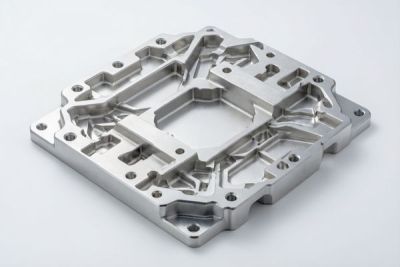
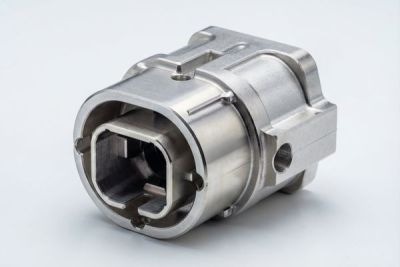
CNC Pivot Arms: Machining, Tolerances & DFM for Robotics (2026 Guide)
If your robot repeats a position off by even 20 microns at the wrist, that error compounds down the kinematic chain and shows up as drift in the end-effector - or as a part that will not seat. In most articulated robots, the link that quietly decides that repeatability is the pivot arm: the load-bearing joint member that carries torque, supports the next axis, and sets how true the whole assembly stays over millions of cycles. Most sourcing specs skim past it. They should not.
This guide walks through how CNC precision machining earns its place in pivot arms, the tolerance budget that actually protects your repeatability, where stainless steel mirror finishing matters (and where it is waste), how to choose between stainless, aluminum, and titanium, and the DFM moves that keep yield high. We close with a buyer's sourcing checklist you can hand a supplier today.
We have been a Dongguan source factory for precision CNC work since 2015, with 60 CNC machines, a 4,000 sqm floor (expanded in 2026 from the old 2,000 sqm plant), and monthly output around 500,000 parts. The numbers and trade-offs below are the ones we argue about with customers - appliance brands like De'Longhi, Donlim, and Breville, and a drone customer whose first production order with us reached 1.2 million RMB - before a single chip is cut.
Table of Contents
- 1. Why CNC Precision Machining Defines Pivot Arm Performance
- 2. Pivot Arms 101: Anatomy and the Loads They Carry
- 3. Stainless Steel Mirror Finishing for Robotics Pivot Arms
- 4. Tight Tolerance CNC Requirements for Pivot Arms
- 5. Robotics CNC Parts: Material Choices for Pivot Arms
- 6. Custom CNC Parts: Designing Pivot Arms That Last
- 7. Pivot Arms vs Cast Housings: A Buyer's Comparison
- 8. A Buyer's Sourcing Checklist for Robotics CNC Parts
Robotics CNC precision component
Why CNC Precision Machining Defines Pivot Arm Performance
A pivot arm is a three-dimensional stack of bores, faces, and pin bosses that must stay mutually true - that is the whole game.
A pivot arm transfers torque from one joint to the next while carrying the mass of everything downstream. Its performance is set less by the motor than by how true the bearing seats, pin bores, and mounting faces are to one another. The moment those features drift out of relationship, the joint binds, wears unevenly, or develops backlash - and your robot loses repeatability long before any component fails.
CNC precision machining is the natural way to hold that relationship because a pivot arm is not a flat plate. It has a bore on one axis, a face at 90 degrees, a pin boss at an angle, and often a counterbore on the back. Cut it on a 3-axis machine and you re-fixture two or three times. Every re-clamp is a chance to introduce a datum shift of 0.02 to 0.05 mm, and on a part this size that is the difference between a silent joint and a visibly sloppy one.
The single-datum principle
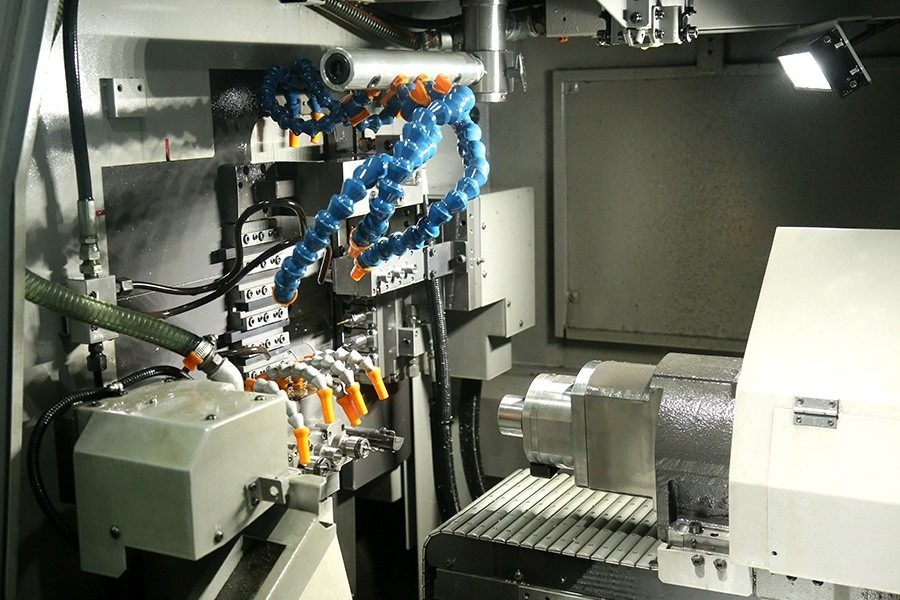
On our 5-axis and turn-mill composite centers we cut a pivot arm in a single setup, holding it on one datum while the table and head rotate. Because the coordinate system never moves, we hold positional accuracy to +/-0.005 mm across every feature. That single-datum consistency is what lets a customer skip the hand-lapping or selective-fit step they used to do after machining - and it is the reason a robot built around a poorly fixtured arm never meets its spec sheet.
| Factor | 3-axis (multi-setup) | 5-axis / turn-mill (single setup) |
|---|---|---|
| Datum shift | 0.02-0.05 mm per re-clamp | None after first clamp |
| Positional accuracy | +/-0.01 mm | +/-0.005 mm |
| Cycle time | Longer (re-fixturing) | Shorter per part |
| Best for | Flat plates, simple brackets | Arms, yokes, angled bosses |
| Post-machining fix | Hand-lap / selective fit | None needed |
Robotics CNC precision component
Pivot Arms 101: Anatomy and the Loads They Carry
Before you tolerance anything, know which feature actually carries the load - and which one fails first.
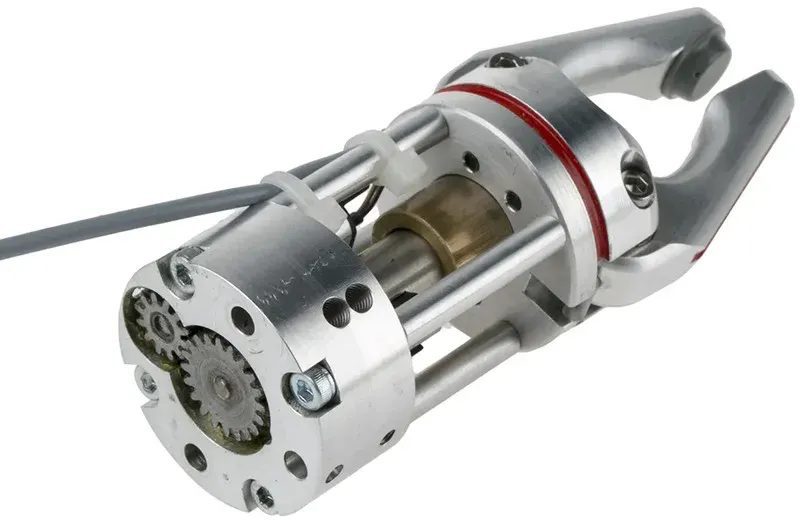
A pivot arm looks simple on a drawing and is unforgiving in service. It is the short structural link between two rotating axes, and every force the robot generates passes through it. Treat it like a structural member, not a bracket, and the rest of the design gets easier.
- Pivot arm
- The load-bearing joint link between two rotating axes in an articulated robot; it carries torque and the mass of the downstream assembly.
- Bearing / bushing seat
- The machined bore or counterbore that locates the rotary bearing; its roundness and perpendicularity set joint smoothness.
- Clearance
- The intentional gap between a pin and its bore; too tight binds, too loose develops backlash.
- Preload
- The clamping force that removes play in the joint; it depends on seat flatness being held across the face.
The loads you must design for
Four load cases dominate pivot-arm life. Bending moment from the cantilevered mass downstream. Torsion from the motor trying to rotate the next axis. Fatigue from millions of direction reversals. And shock from the occasional hard stop or collision. A part that looks over-built for static load can still crack at a stress raiser after a few million cycles.
- Bending moment at the root radius - size the section, not just the bore
- Torsion through the pin - keep the pin-bore fit honest
- Fatigue at sharp internal corners - radius everything that carries load
- Shock on the seat face - hold flatness so preload is even
- Corrosion at the bearing seat - stainless or a certified coating
- Mark every load-carrying feature on the drawing
- Radius or fillet every internal corner that sees stress
- Specify the bore fit (h7/h6) and which feature is the datum
- Call out seating flatness, not just the bore diameter
- Decide corrosion requirement before choosing material
Stainless Steel Mirror Finishing for Robotics Pivot Arms
Mirror finishing is not vanity - on a pivot arm it is often friction, corrosion, and cleanroom compliance.
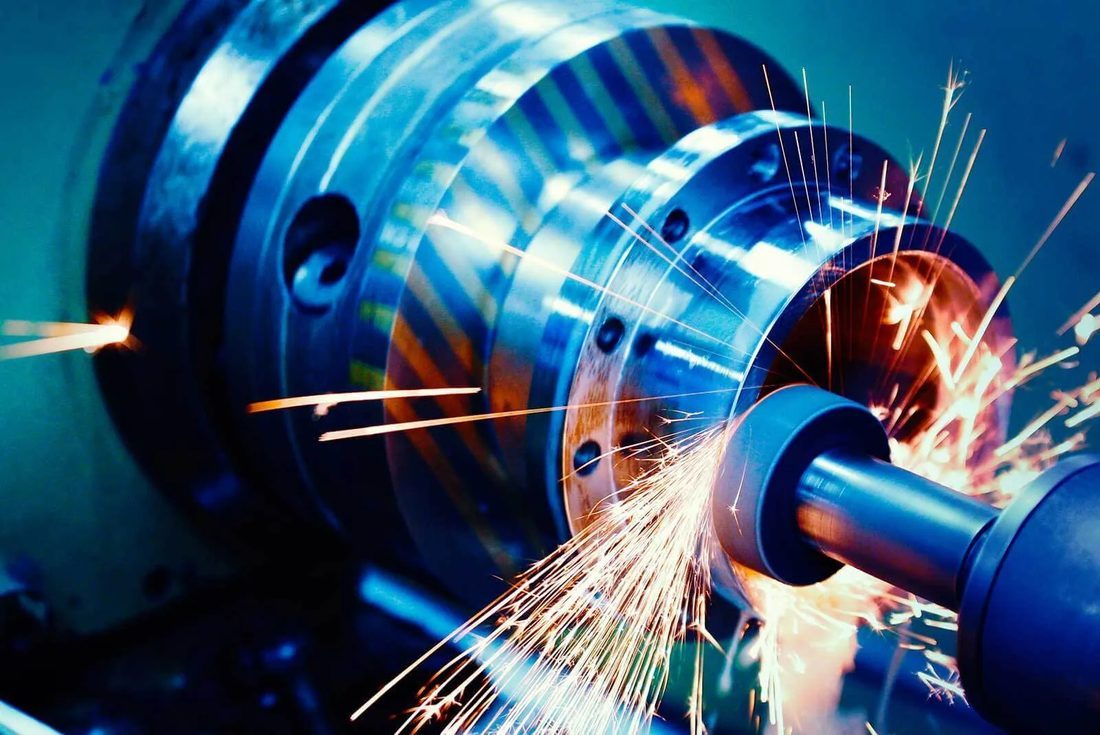
When we talk about stainless steel mirror finishing on a pivot arm, we are usually solving one of three problems. First, friction: a smoother bearing seat reduces microwelding and stick-slip at low speed, which is exactly where a robot's repeatability is tested. Second, corrosion: in food, medical, or outdoor robotics the seat must survive cleaning and humidity without pitting. Third, particulate control: a mirror-finished surface sheds fewer particles, which matters in cleanroom and semiconductor-handling robots.
What mirror finishing actually buys you
Our standard mirror line holds Ra 0.6 micrometers, and our top 8K line reaches Ra 0.2 micrometers. For most pivot arms a seat finished to Ra 0.6 micrometers is plenty; we reserve Ra 0.2 micrometers for the visible or friction-critical faces where the few tenths of a micron genuinely change behavior. Specifying 8K everywhere is a common way to add cost without adding function.
Passivation per ASTM A967
Mirror finishing alone does not stop corrosion. After machining we passivate stainless per ASTM A967 so the surface resists fingerprint and handling corrosion, and where the application calls for it we apply electropolish to both smooth and decontaminate the part. For the same reason we supply custom CNC parts to appliance brands like De'Longhi, Donlim, and Breville where a flawless, food-contact-grade surface is the spec, not a bonus.
Robotics CNC precision component
Tight Tolerance CNC Requirements for Pivot Arms
Tolerance is a budget - spend it where the joint's repeatability depends on it, relax it everywhere else.
Tight tolerance CNC work is only 'tight' where it matters. We concentrate the tolerance budget on three relationships: the bearing-seat roundness, the seat-to-bore perpendicularity, and the pin-boss true position. Everything non-functional gets a commercial tolerance so the cost stays sane. Over-tolerancing the whole part is the fastest way to inflate price without improving the robot.
| Feature | Target (our shop) | Why it matters |
|---|---|---|
| Bearing-seat roundness | 0.003 mm | Smooth rotation, no bind |
| Seat perpendicularity to bore | 0.01 mm | Even preload, no tilt |
| Pin-boss true position | +/-0.005 mm | Joint repeatability |
| Seating face flatness | 0.02 mm | Clamp load even |
| Non-functional faces | commercial | Cost control |
Common tolerance mistakes
- Calling out R0 internal corners - end mills leave a radius; you get a scrap part or an undocumented one
- Tolerancing the bare condition when a coating or anodize will grow the bore
- Over-tightening flatness where parallelism to a distant face is what actually matters
- Forgetting positional tolerance and giving only a diameter, which leaves the bore free to float
Robotics CNC Parts: Material Choices for Pivot Arms
Stainless is the default for a reason, but titanium and aluminum each win a specific fight.
For robotics CNC parts like pivot arms, material choice is a stiffness-per-gram and corrosion decision more than a raw strength one. We run 304 and 316 stainless for the majority of arms because they are stable, corrosion-resistant, and easy to hold to tight tolerances. When yield strength or weight drives the design, 17-4PH stainless, 7075 aluminum, or TC4 titanium enter the conversation.
| Material | Density (g/cc) | Modulus (GPa) | Corrosion | When to pick it |
|---|---|---|---|---|
| 304 / 316 stainless | 7.9 | 193 | Excellent | Default; food, medical, outdoor |
| 17-4PH stainless | 7.8 | 197 | Good | High strength + corrosion |
| 7075 aluminum | 2.8 | 71 | Fair (anodize) | Lightweight, cost-sensitive |
| TC4 titanium | 4.43 | 114 | Excellent | Strength-to-weight, corrosion |
Pros
- Stainless is stable, corrosion-proof, and easy to tolerance
- Titanium beats aluminum on stiffness-per-gram for bending-limited arms
- Aluminum is cheapest and fastest to machine
- 17-4PH adds strength without leaving stainless
Cons
- Titanium runs 2-3x the cycle time of aluminum
- Aluminum needs anodize to resist corrosion
- Stainless is heavier than aluminum or titanium
- High-strength alloys cost more in blanks and tooling
Choose A if / Choose B if
- Choose 316 stainless if the arm sees food, medical, or outdoor corrosion
- Choose 7075 aluminum if mass budget dominates and the environment is benign
- Choose TC4 titanium if bending stiffness per gram is the constraint (arms at the robot's end)
- Choose 17-4PH if you need stainless corrosion plus higher yield strength
- Choose 304 if cost is tight and the load is moderate
Robotics CNC precision component
Custom CNC Parts: Designing Pivot Arms That Last
Most pivot-arm failures are designed in - here is how to design them out before the first article.
When we review a new custom CNC parts drawing for a pivot arm, the same issues surface again and again. They are almost all fixable on the CAD, not the shop floor. A short DFM pass before quoting saves more money than any negotiation on unit price.
- Mark the datum and the three tolerance-critical relationships
- Radius every load-carrying internal corner (R0.5 minimum)
- Keep wall thickness >= 0.8 mm in aluminum, >= 1.0 mm in steel
- Specify coated vs bare tolerance if any coating is planned
- Add a lightening pocket only where it raises first resonance
- Confirm material cert and traceability requirements up front
Features that quietly kill yield
The two silent yield-killers are thin walls and long overhangs. A thin-walled steel arm springs during the finishing pass and then relaxes to a form the assembly never sees on the drawing; we counter it with a tensioning fixture and measure the free-state form. A long overhang chatters and leaves a poor finish on the very seat that needs to be smooth. Both are solved by a small geometry change, not a better machine.
Pivot Arms vs Cast Housings: A Buyer's Comparison
Casting looks cheaper per part - until you add the machining it still needs to be a real joint.
Buyers often ask whether a pivot arm should be cast and then lightly machined, or fully CNC machined from solid. Casting wins on raw per-part cost at very high volumes and on complex organic shapes. But a pivot arm's value is in its precision seats, and a casting still needs those machined to +/-0.005 mm anyway - so you pay for the casting plus the machining, and you inherit porosity risk at the worst possible place.
| Factor | Cast + machine | Fully CNC machined |
|---|---|---|
| Per-part cost at volume | Lower (high volume) | Higher but predictable |
| Dimensional truth | Depends on machining allowance | +/-0.005 mm single setup |
| Porosity risk at seat | Real risk | None (solid stock) |
| Lead time | Tooling + casting | No tooling, fast first article |
| Best for | 10k+ identical parts | Prototypes to 500k/month |
Pros
- Casting is cheaper per part at very high volumes
- CNC gives immediate first articles with no tooling
- CNC has zero porosity risk at the bearing seat
- CNC scales from one prototype to 500k/month
Cons
- Casting needs tooling and a longer lead time
- Casting still needs precision machining on the seats
- CNC costs more per part than cast at huge volumes
- Casting porosity can appear exactly where you cannot afford it
Choose A if / Choose B if
- Choose casting if you need 10,000+ identical arms and can absorb tooling lead time
- Choose full CNC if you need a first article this month or volumes under ~5,000
- Choose CNC if the seat cannot tolerate any porosity risk
- Choose casting only after a CNC pilot has locked the geometry
Robotics CNC precision component
A Buyer's Sourcing Checklist for Robotics CNC Parts
Hand this to a supplier and you will filter out the brokers from the shops that understand joint-critical intent.
Sourcing robotics CNC parts is less about finding the cheapest machine and more about finding a shop that understands joint-critical intent. The questions below are the ones we are happy to answer with data, and they are the ones that separate a real precision source from a logo with a broker behind it.
- Ask for the cert stack: ISO 9001 minimum, ISO 13485 and IATF 16949 a plus (we hold ISO 9001, completed ISO 13485, IATF 16949 in application)
- Request material certs traceable to the heat lot
- Confirm single-setup 5-axis or turn-mill capability, not 3-axis with re-fixturing
- Get a CMM first-article report with full datum references, not just a photo
- Agree on coated vs bare tolerances before the quote
- Verify incoming-batch traceability from raw bar to finished part
The cheapest pivot arm is the one that passes qualification the first time - because the second time costs you a launch date, not just a part.
Robotics CNC precision component
Robotics CNC precision component
Robotics CNC precision component
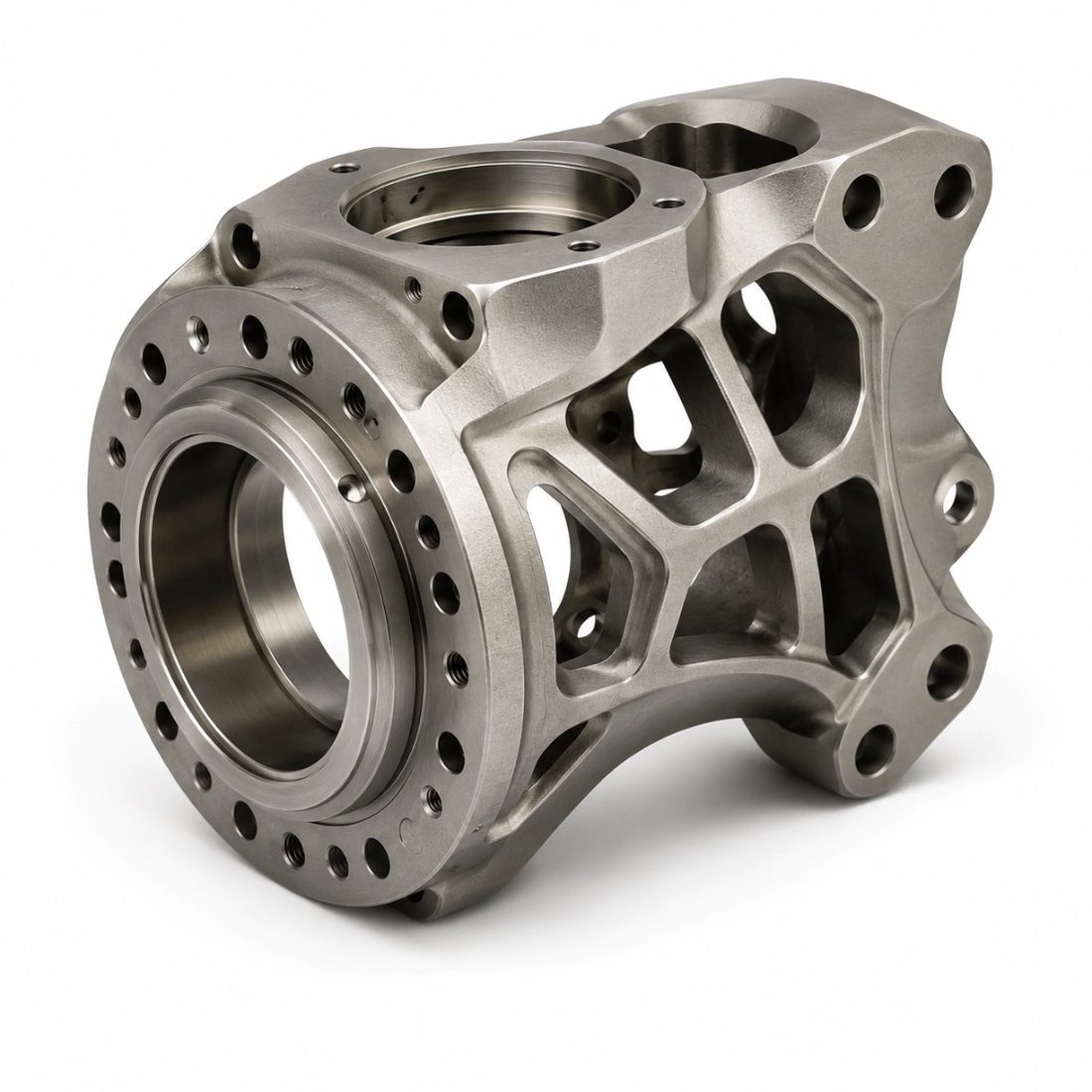
Robotics CNC precision component
FAQ: pivot arms & Robotics Buyer Questions
A: In a single setup on 5-axis or turn-mill composite equipment we hold positional accuracy to +/-0.005 mm across all features, with bearing-seat roundness near 0.003 mm and seating-face flatness 0.02 mm. The key is never releasing the datum, so the bore, seat, and pin boss stay mutually true without re-fixturing.
A: Stainless (304/316) gives excellent corrosion resistance with no coating, stays dimensionally stable, and is easy to hold to tight tolerances - ideal for food, medical, outdoor, or cleanroom robots. Choose aluminum only when mass budget dominates and the environment is benign; choose titanium when stiffness-per-gram is the constraint.
A: It is functional, not cosmetic, on the friction- and corrosion-critical faces. A smoother bearing seat reduces stick-slip at low speed where repeatability is tested, and a mirror finish sheds fewer particles in cleanrooms. Our standard line holds Ra 0.6 micrometers and the 8K line reaches Ra 0.2 micrometers; spec 8K only where the tenths of a micron matter.
A: Only if the arm has more than two angled feature groups that must stay mutually true. Flat or simple arms are cheaper and faster on 3-axis or 2.5-axis work. For arms with a bore, a 90-degree face, and an angled pin boss, 5-axis in a single setup avoids the 0.02-0.05 mm datum shift of re-fixturing.
A: Yes. We supply material certs traceable to the heat lot, a CMM first-article report with full datum references, in-process gauging for batch parts, and incoming-batch traceability from raw bar to finished component. We are ISO 9001 certified, with ISO 13485 completed and IATF 16949 in application.
A: Single prototypes are routine, and our floor is built for both small custom batches and volume - around 500,000 parts a month across 60 machines. For a dedicated program we typically qualify at low volume, lock the CMM data, then scale, so you are not committed to tooling before the geometry is proven.
Send us your pivot-arm or joint-link drawing for a free DFM review. We will flag the features that should move to 5-axis, the tolerances that are quietly costing you yield, and the material call between stainless, aluminum, and titanium. Reach out and let's cut the first article.
Request a Free CNC Quote