CNC Pump Shafts: Machining, Tolerances & DFM for Industrial Automation (2026 Guide)
A pump shaft is the one rotating part in your fluid system that you cannot afford to get wrong. When it runs true, the mechanical seal stays seated and the bearing sees only clean radial load. When it does not, you get the three failures every maintenance manager fears: seal leakage, bearing hammering, and vibration that walks the coupling apart - usually at 2 a.m. on a 24/7 industrial automation line.
This guide walks through how CNC precision machining holds pump shaft geometry true, which tolerances actually buy reliability, how stainless steel mirror finishing stops both leaks and corrosion, and which materials and standards (ASTM A967, ISO 9001, ISO 13485) you should see on the cert. We finish with a buyer's sourcing checklist you can hand to a supplier today.
We are Dongguan Licun Technology Co., Ltd. (brand LusterControl), a Dongguan source factory since 2015 with 15 years in stainless mirror machining - 60 CNC machines, a 4,000 m2 plant after our 2026 expansion, and monthly output around 500,000 parts. This is written from the shop floor, not a catalog: the numbers and trade-offs are the ones we argue about with customers before a single chip is cut.
Table of Contents
- 1. Why Pump Shafts Decide the Life of Industrial Automation Lines
- 2. How CNC Precision Machining Holds Pump Shaft Geometry True
- 3. Tight Tolerance CNC: The Numbers Behind a Leak-Free Shaft
- 4. Stainless Steel Mirror Finishing for Pump Shafts That Resist Corrosion
- 5. Pump Shafts vs Turned Stock: Which Path Keeps Your Line Running
- 6. Industrial Automation CNC Parts: A Buyer's Sourcing Checklist
- 7. Custom CNC Parts: DFM Rules That Keep Pump Shafts Affordable
- 8. Pump Shafts Materials and Standards: From ASTM A967 to ISO 13485
Industrial Automation CNC precision component
Why Pump Shafts Decide the Life of Industrial Automation Lines
The shaft fails last - and takes the whole line down with it.
A pump shafts is the rotating backbone of every centrifugal, gear, and rotary pump on your industrial automation line. It carries the impeller, spins inside the seal, and loads the bearing. When its geometry is right, the seal lip tracks a true circle and the bearing runs cool for years. When the geometry drifts, the same shaft quietly sets the mean time between failures for the entire skid.
We see this most often in fluid control and industrial automation cells that run continuously. The shaft is not a glamorous part, but it is the one whose concentricity, runout, and straightness quietly decide whether a line runs for years or you are changing seals every quarter. Get the shaft right and everything downstream behaves; get it wrong and no seal specification saves you.
What 'running true' actually means
- Runout
- The total indicator variation (TIR) of a surface as the shaft rotates about its axis - the gap a seal lip chases every revolution.
- Concentricity
- How closely a feature's axis lines up with the shaft's primary datum axis; poor concentricity forces the seal to flex.
- Journal
- The precision diameter where a bearing or seal rides - usually the tightest-tolerance surface on the shaft.
Industrial Automation CNC precision component
How CNC Precision Machining Holds Pump Shaft Geometry True
One datum, one setup, one true axis - that is the whole secret.
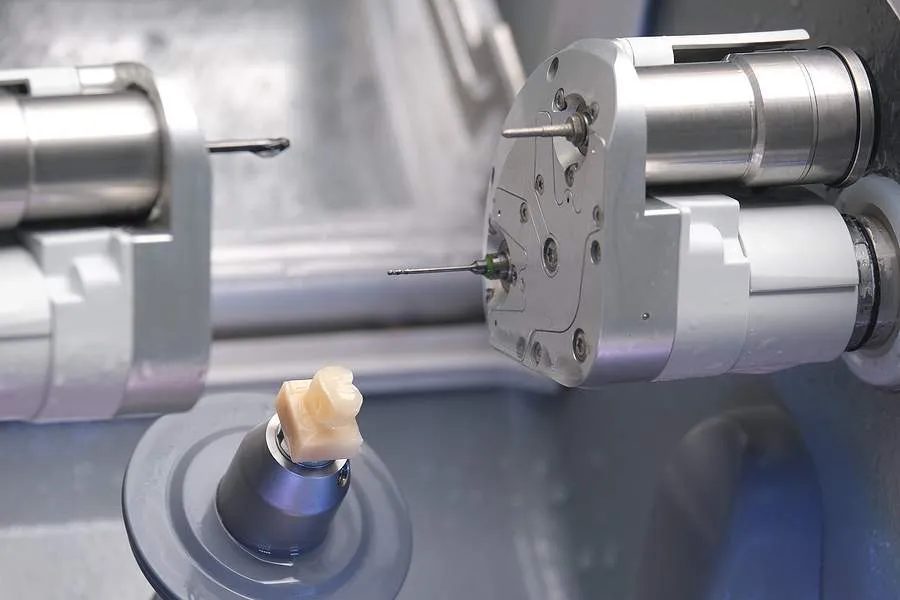
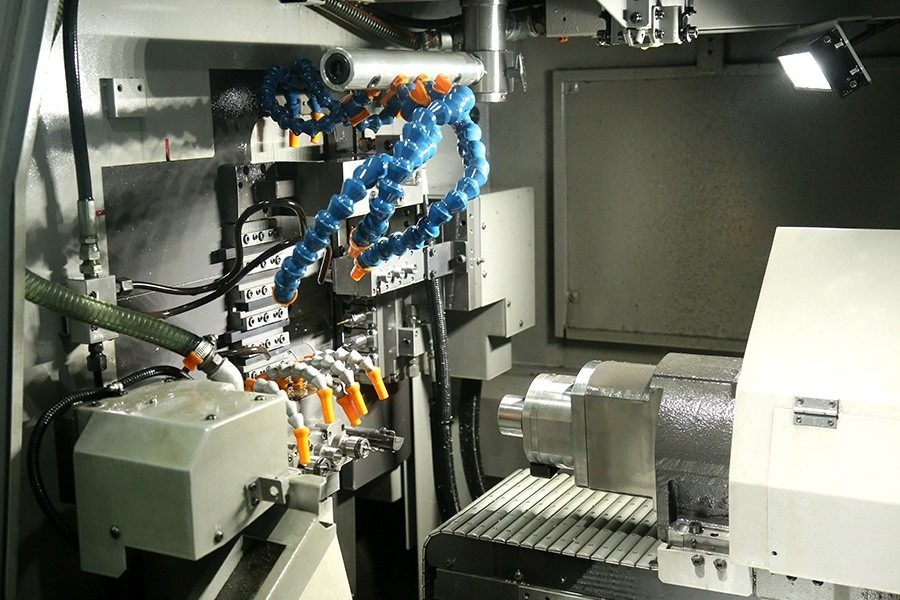
CNC precision machining earns its place on a pump shaft because the part is mostly cylindrical with several diameters that must all share one axis: the bearing journals, the seal seat, the impeller fit, and the coupling stub. The moment you re-clamp it, you risk shifting that axis. Machining complete on a turn-mill or Swiss-type lathe keeps the part on a single datum and cuts every feature in one chucking, so concentricity is built in rather than measured in afterward.
Our floor runs 60 CNC machines including turn-mill composite and Swiss-type sliding-headstock lathes. For a typical stainless pump shaft we leave 0.1 mm for a finishing pass and hold the critical diameters to +/-0.005 mm, with the journal and seal seat concentric within 0.01 mm TIR. That is the level of truth a mechanical seal needs to survive a long duty cycle.
Turn-mill vs Swiss-type for long, thin shafts
Long slender shafts (length-to-diameter above roughly 12) tend to deflect under the cut. A Swiss-type lathe supports the bar right at the tool, killing deflection; a turn-mill needs a steadyrest or a tensioning fixture. We pick the process by the geometry, not by habit - which is exactly why we keep both on the floor.
| Factor | Turn-mill composite | Swiss-type lathe |
|---|---|---|
| Best shaft length | Short to medium (L/D < 12) | Long, slender (L/D up to 20+) |
| Setup | Single chuck, single datum | Bar-fed, supported at cut |
| Typical dia tolerance | +/-0.005 mm | +/-0.005 mm |
| Concentricity (TIR) | 0.01 mm | 0.008 mm |
| Our floor | 60 CNC machines total | Included in the 60 |
Tight Tolerance CNC: The Numbers Behind a Leak-Free Shaft
Tolerance is a budget - spend it where the seal lives.
A mechanical seal does not leak because the shaft is slightly smaller; it leaks because the shaft surface the seal rides on is out of round, too rough, or not concentric with the rotation axis. That is why tight tolerance CNC on a pump shaft is concentrated on two zones - the seal seat and the bearing journal - and relaxed everywhere else to keep cost sane.
Here is the budget we recommend for a standard industrial pump shaft in stainless: +/-0.005 mm on the seal and bearing diameters, 0.008 mm concentricity (TIR) between them, a journal finish of Ra 0.2 to 0.4 um for a contacting seal, and a straightness of 0.02 mm over the length. Everything non-functional - the impeller hub, the coupling stub - can run at +/-0.02 mm without affecting performance.
Where tolerances actually buy reliability
- Seal seat diameter: +/-0.005 mm and Ra <= 0.4 um (Ra 0.2 um for contacting seals)
- Bearing journal: h6/h7 fit, runout <= 0.008 mm TIR
- Impeller fit: light press or keyed, +/-0.01 mm is plenty
- Thread major diameter: commercial +/-0.05 mm, it only has to start
- Overall straightness: 0.02 mm/m so the coupling does not fight the motor
| Feature | Recommended tol | Why it matters |
|---|---|---|
| Seal seat dia. | +/-0.005 mm | Seal lip tracks a true circle, no chatter |
| Seal seat finish | Ra 0.2-0.4 um | Smooth track = less lip wear, no leaks |
| Bearing journal | h6/h7, TIR <=0.008 | Bearing sees clean radial load |
| Impeller fit | +/-0.01 mm | Holds the wheel, not the seal |
| Coupling stub | +/-0.02 mm | Only needs to start and seat |
Industrial Automation CNC precision component
Stainless Steel Mirror Finishing for Pump Shafts That Resist Corrosion
A smooth surface is a sealed surface - and a corrosion-resistant one.
Most pump shafts we make are stainless - 304, 316, or precipitation-hardened 17-4PH for higher strength. The finish on the wetted, sealed zone decides two things at once: how well the mechanical seal tracks, and how slowly the surface corrodes in the fluid. Stainless steel mirror finishing takes the seal journal down to Ra 0.2 um (our 8K mirror standard) so the lip rides on a glass-like track and crevice corrosion has nowhere to start.
After machining we typically passivate the part per ASTM A967 so the free iron on the surface is removed and the chromium oxide layer is restored - this is the step that keeps a 316 shaft from rusting in a humid duty cycle. For food-, beverage-, or medical-adjacent pumps we go further and can electropolish to a near-specular finish.
Mirror finish tiers we hold
- Standard mirror
- Ra <= 0.6 um - our baseline for most sealed shafts
- 8K mirror
- Ra 0.2 um - our top tier for contacting seals and hygienic duty
- Electropolished
- Ra 0.1-0.2 um plus passivation - for sanitary and medical pumps
Pros
- Crevice corrosion has no rough anchor to start in
- Mechanical seal lip wears evenly, no chatter marks
- Easier to clean for food/medical duty
- Lower friction at the seal = less heat
Cons
- Extra finishing pass adds cycle time
- Mirror finishing long thin shafts needs care to avoid deflection
- Not every zone needs it - pay only where the seal rides
Pump Shafts vs Turned Stock: Which Path Keeps Your Line Running
Buy the geometry you need, not the round bar you hope to fix later.
Some buyers spec a pump shaft as 'just turned stock' and plan to grind or fit it in-house. That works only when your in-house process can hold the concentricity a seal needs. For most industrial automation cells, machining the finished shaft complete - journals, seal seat, threads, keyway, all in one setup - is the cheaper path once you count scrap, handling, and the seal failures you avoid.
The decision really comes down to volume, tolerance, and whether you have a qualified finishing cell. Use the decision table below to pick, then confirm with a DFM review before you release the program.
| If your situation is... | Then choose | Why |
|---|---|---|
| Low volume, tight seal tol (+/-0.005 mm) | Complete CNC shaft | Avoids a second setup that re-introduces runout |
| High volume, simple geometry | Turned + in-house grind | Economies of scale on a mature line |
| Long thin shaft, no steadyrest | Swiss-type complete | Deflection kills in-house grinding |
| Prototype / DFM proving | Complete custom CNC | One source, one datum, fast iteration |
- Choose complete CNC pump shafts if you run a 24/7 automation line and cannot afford a seal failure taking the cell down.
- Choose turned stock plus in-house finish if you already hold +/-0.005 mm grinding and the geometry is short and stiff.
- Choose custom CNC parts when the shaft carries off-axis features (keyways, flats, cross-holes) that must stay true to the axis.
Industrial Automation CNC precision component
Industrial Automation CNC Parts: A Buyer's Sourcing Checklist
Hand this to a supplier and the tire-kickers disappear.
Sourcing industrial automation cnc parts is less about finding the cheapest lathe and more about finding a shop that understands sealed, rotating-intent geometry. The questions below are the ones we are happy to answer with data, and the ones that separate a real precision source from a broker with a logo.
As a Dongguan source factory since 2015 with 15 years in stainless mirror machining, we built this checklist from the audits our own customers run before they release a pump program.
What to ask before you release a pump shaft program
- Cert stack: ISO 9001 minimum; ISO 13485 completed and IATF 16949 in application are strong signals
- Material certs traceable to the heat lot (304 / 316 / 17-4PH)
- Single-setup turn-mill or Swiss capability, not 3-axis with re-fixturing
- CMM first-article report with full datum references, not just a photo
- Agreed finish spec: Ra target and passivation per ASTM A967
- Lot-level traceability from raw bar to finished shaft
- Request the cert stack (ISO 9001 / ISO 13485 / IATF 16949 in application)
- Ask for material certs tied to the heat lot
- Demand a CMM first-article report, not a picture
- Confirm single-setup capability so concentricity is built in
- Agree the Ra target and ASTM A967 passivation up front
- Verify lot traceability and a real rework path
Custom CNC Parts: DFM Rules That Keep Pump Shafts Affordable
Good DFM is the cheapest tolerance you will ever buy.
The fastest way to overspend on custom CNC parts like pump shafts is to over-tolerance features the seal never touches and to forget that long thin shafts need support. Design for manufacture and the same reliability costs less.
We run a free DFM review on every new automotive CNC parts and pump program. The rules below are the ones that move cost without moving risk.
Five DFM moves that pay back fast
- Relax non-seal diameters to +/-0.02 mm - you save inspection, not safety
- Specify the coated or bare condition for any plated zone so the fit lands at nominal
- Add a 0.5 mm minimum radius on internal pockets so the end mill does not fight a corner
- Put the tightest tolerance only on the seal seat and bearing journal
- Design the shaft stiff enough (L/D < 12) to machine without a steadyrest if possible
The cheapest pump shaft is the one that passes qualification the first time - because the second time costs you a launch date.
Industrial Automation CNC precision component
Pump Shafts Materials and Standards: From ASTM A967 to ISO 13485
The standard on the cert is the promise you can audit.
Material and standard choices are where Dongguan Licun Technology (brand LusterControl) earns trust on pump shafts. We machine 304 and 316 stainless for general and corrosive duty, 17-4PH when strength and hardness matter, and we passivate every stainless part per ASTM A967 so the chromium layer that fights corrosion is fully restored.
On the quality side, our system runs under ISO 9001, with ISO 13485 completed for medical-adjacent pump work and IATF 16949 in application for automotive and EV fluid systems. That paperwork is not decoration - it is the auditable proof that the +/-0.005 mm on your drawing is the +/-0.005 mm you receive.
Which standard matters for your pump
| Standard | What it governs | When you need it |
|---|---|---|
| ASTM A967 | Passivation of stainless | Always, for any wetted stainless shaft |
| ISO 9001 | General quality system | Baseline for any industrial order |
| ISO 13485 | Medical device quality | Pumps in medical / food contact |
| IATF 16949 | Automotive quality | EV and automotive fluid pumps (in application) |
- Passivation
- A citric or nitric acid treatment (ASTM A967) that removes free iron and restores the passive chromium-oxide layer on stainless.
- Heat lot traceability
- Linking the finished shaft back to the specific melt of raw bar, so a material issue is isolatable to a lot.
Industrial Automation CNC precision component
Industrial Automation CNC precision component
Industrial Automation CNC precision component
Industrial Automation CNC precision component
FAQ: pump shafts & Industrial Automation Buyer Questions
A: For a contacting mechanical seal, hold the seal seat diameter to +/-0.005 mm with a finish of Ra 0.2 to 0.4 um, and keep it concentric with the bearing journal within 0.008 mm TIR. Non-seal diameters can relax to +/-0.02 mm without affecting reliability.
A: Choose a complete CNC shaft when you run a 24/7 automation line and cannot afford a seal failure, or when the shaft is long and thin and your in-house cell cannot hold the concentricity. Choose turned stock plus in-house grinding only if you already hold +/-0.005 mm and the geometry is short and stiff.
A: Passivation per ASTM A967 removes free iron from machining and restores the passive chromium-oxide layer, which is what stops a 316 shaft from corroding in service. We passivate every stainless shaft we ship, and it is a standard we are happy to document on the cert.
A: Yes, on our 8K mirror line, provided the shaft is fixtured against deflection. We hold Ra 0.2 um on seal journals and concentricity within 0.008-0.01 mm TIR by machining complete in a single setup. Very long, slender shafts may need a steadyrest or Swiss-type support, which we also run.
A: Yes. We supply material certs traceable to the heat lot, a CMM first-article report with full datum references, in-process gauging for batch parts, and lot-level traceability from raw bar to finished shaft. Our quality system runs under ISO 9001, with ISO 13485 completed and IATF 16949 in application.
A: Single prototypes are routine - our floor is built for both small custom batches and volume, around 500,000 parts a month across 60 CNC machines. We typically qualify a pump program at low volume with a CMM first article, then scale once the data is locked.
Send us your pump shaft drawing for a free DFM review. We will flag the tolerances that should move to +/-0.005 mm, the diameters you can safely relax, and whether a single setup or Swiss-type path will hold your seal true. Reach out and let's cut the first article.
Request a Free CNC Quote