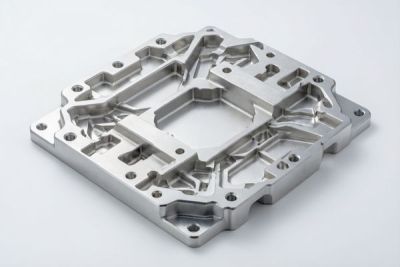
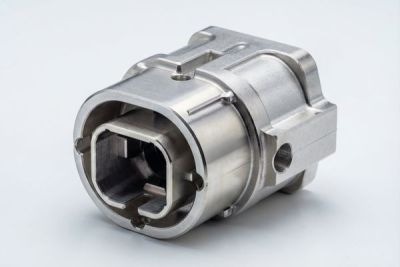
CNC Threaded Inserts: Machining & Tolerances for Automotive & EV (2026 Guide)
If you design battery enclosures, motor housings, or lightweight aluminum brackets for an EV, the threads you rely on to hold a busbar, a sensor, or a cover are often not in the base material at all - they are in a machined threaded insert. And when that insert's seat is 0.03 mm off, or its internal thread is cut to a loose class, the joint either strips on assembly or walks loose after 50,000 thermal cycles. The part is a few millimeters of turned metal and a stack of tolerances - and it decides whether your assembly survives qualification.
This guide is written for the engineers and procurement leads who specify and buy these parts, not for a catalog. We walk through what a CNC threaded insert actually is, how CNC precision machining holds its seat and thread within +/- 0.005 mm, why material and finish decide corrosion and sealing, a threaded-inserts-vs-tapped-hole comparison, the mistakes we see buyers make most often, and a sourcing checklist you can send to any machine shop - including our own.
We have been a Dongguan source factory for precision CNC work since 2015, with 60+ machines, a 4,000 m2 floor, and monthly output around 500,000 parts; we hold ISO 9001, have completed ISO 13485, and are pursuing IATF 16949. We have supplied precision parts to appliance brands such as De'Longhi, Donlim, and Breville, a drone customer's first order with us reached 1.2 million RMB, and our annual output runs past 20 million RMB. This is written from the shop floor, not a brochure - the numbers and trade-offs are the ones we argue about with customers before a single chip is cut.
Table of Contents
- 1. What Are CNC Threaded Inserts and Why They Matter in Automotive & EV Assemblies
- 2. How CNC Precision Machining Builds Reliable Threaded Inserts
- 3. Tight Tolerance CNC: Holding Insert Seats Within +/- 0.005 mm
- 4. Threaded Inserts vs Tapped Holes: Which Should You Spec for EV Parts?
- 5. Stainless Steel Mirror Finishing for Insert Seats and Faces
- 6. Custom CNC Parts: Designing Inserts for Your EV Bracket or Housing
- 7. Automotive and EV CNC Parts: Material Choices for Threaded Inserts
- 8. Common Mistakes When Specifying Tight Tolerance CNC Threaded Inserts
- 9. A Buyer's Checklist for Sourcing Automotive and EV CNC Parts Like Threaded Inserts
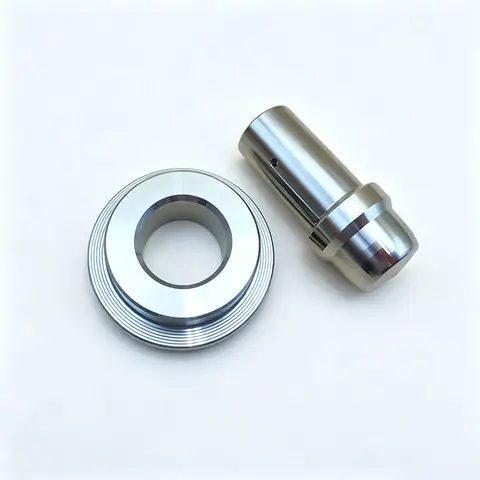
Automotive&EV CNC precision component
What Are CNC Threaded Inserts and Why They Matter in Automotive & EV Assemblies
An insert is a thread you can trust inside a material that cannot hold one.
A CNC threaded insert is a precision-machined fastener element - usually a small turned bushing or boss - that carries a durable internal thread and is pressed, screwed, molded, or welded into a softer host (aluminum, magnesium, plastic, or a composite) so the joint can be assembled and re-assembled many times without stripping. In an EV, where a battery enclosure is a thin-wall aluminum casting and a motor housing is die-cast magnesium, the base material simply cannot survive hundreds of bolt cycles - so the thread lives in the insert, not the casting.
Where you actually find them in a vehicle
- Battery module and pack enclosures - standoffs and inserts that carry busbar mounts, module clamps, and cover bolts into thin aluminum lids.
- Motor and inverter housings - inserts that locate sensors, resolver brackets, and water-line flanges.
- ADAS and lidar brackets - small precision inserts that hold camera and radar mounts to lightweight arms.
- Charging-port and connector housings - face-sealing inserts that also must resist corrosion and creep.
- Seat, door, and interior structural clips where a plastic or magnesium part needs a steel thread.
- Cooling-plate and thermal-loop mounts where the insert doubles as a locating pilot.
Every one of those is a torque-and-cycle problem and a seat-tolerance problem at once. An insert whose seat diameter is 0.03 mm oversize will spin or pull out under clamp load; an internal thread cut to a loose class will gall or cross-thread on the line. The insert is the quiet member of the joint; when it is right, nobody notices.
- Threaded insert / bushing
- A turned element carrying an internal thread, set into a host material to give a durable, repeatable joint.
- Seat (boss / spotface)
- The machined face or diameter that locates the insert and takes the clamp load.
- Thread class (e.g., 6H / 5H)
- The tolerance band of the internal thread; tighter classes hold fastener engagement but cost more.
- Pull-out / torque-out
- The load at which an insert spins or pulls from the host - the joint's real strength limit.
- Knurl / hex drive
- External features that resist rotation once set, often CNC-turned on the body.
Our broader work on automotive components machining guides covers brackets, housings, and structural parts where the same seat and traceability discipline applies. The threaded insert is simply the joint where mechanical and assembly tolerances meet.
Automotive&EV CNC precision component
How CNC Precision Machining Builds Reliable Threaded Inserts
Precision is manufactured into the process chain, not added at inspection.
A threaded insert is a deceptively small part - a few millimeters of turned metal with a thread, a knurl, and a seat - but holding its geometry after heat-set, press-in, or molding is a controlled chain. Here is how we run an insert program so it meets spec after it leaves the building.
Stage 1 - Bar stock, turning, and the external body
- Certify the incoming bar with a mill certificate confirming the alloy (303 / 304 / 316L stainless, brass, or alloy steel as the design dictates).
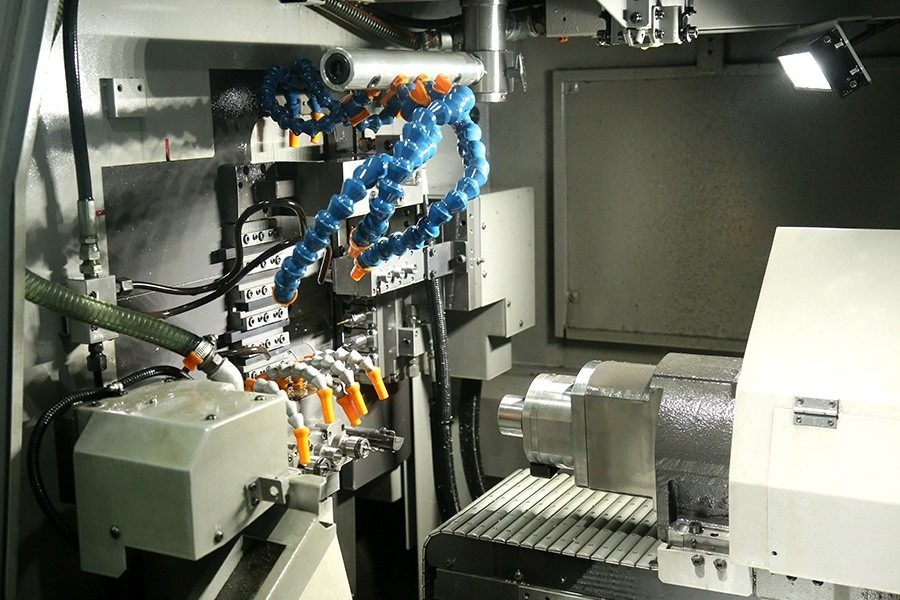
- Turn the body on Swiss-type or fixed-headstock CNC lathes, holding the seat and knurl in one setup so the datum never moves.
- Cut the external drive features - hex, tri-lobular, or knurl - with sharp tooling so they actually grip the host.
- Leave an even finish allowance so the body does not build residual stress that later relaxes and ovals the thread.
Stage 2 - Internal thread and seat finishing
- Tap or single-point the internal thread to the target class (6H commercial, 5H / 4H precision) with thread gauges checked per lot.
- Semi-finish the seat face, leaving a thin, even allowance for the final pass.
- Verify seat diameter, perpendicularity of the thread axis to the seat, and thread class on a thread gauge and CMM before the finish cut.
- Deburr both ends so no burr becomes a gall or a particle in the assembly.
Stage 3 - Finish, passivate, inspect, and document
- Finish the seat or sealing face to the target Ra, measured with a profilometer rather than judged by eye.
- Passivate stainless to ASTM A967 so the insert resists fingerprint and crevice corrosion during handling and service.
- Inspect critical dimensions on a CMM and tie the lot to its material cert, machine log, and Certificate of Conformance.
- Clean and package to the customer's contamination spec so a pristine insert does not pick up particles on the way to the line.
The point is simple: an insert only stays true if the process respected the datum and the thread class at every stage. A shop that taps a loose thread or skips passivation is handing you an insert that will gall or corrode after it ships. Ask to see the process, not just the price.
Tight Tolerance CNC: Holding Insert Seats Within +/- 0.005 mm
Spend the tight tolerance where the joint depends on it - nowhere else.
Tight tolerance CNC on a threaded insert is about priorities, not a single magic number. The seat diameter, the thread class, and the perpendicularity of the thread axis to the seat are the features that earn a tight callout. The overall length and the cosmetic knurl do not. Specifying everything tight is the fastest way to inflate cost with zero benefit to the joint.
Typical tolerances we hold by feature
| Feature | Typical tolerance | Why it matters on a threaded insert |
|---|---|---|
| Seat / boss diameter | +/- 0.005 mm | Locates the insert; oversize means spin-out, undersize means crack the host. |
| Thread class (internal) | 5H / 4H precision | Holds fastener engagement and resists cross-thread on the line. |
| Thread-axis perpendicularity to seat | 0.02 mm | A tilted thread loads the fastener unevenly and strips early. |
| Seat-face flatness | 0.02 mm | Even clamp load; no rocking that works the joint loose. |
| Knurl / hex drive | +/- 0.03 mm | Grip in the host; loose means the insert rotates under torque. |
| Overall length | +/- 0.1 mm | Envelope control; rarely functionally critical. |
We routinely hold +/- 0.005 mm on the critical seating and locating features of precision inserts where the application demands it, and we measure rather than trust. The number only means something because it is measured, recorded, and tied to the lot.
Pros
- Predictable pull-out and torque-out strength
- Repeatable assembly on the line
- Fewer stripped or galled joints
- Easier, faster qualification
Cons
- Tight features cost more to hold
- Thread-gauging and CMM time grows with the callouts
- Not every feature needs them - only the ones that touch the joint
The right answer from a vendor is specificity: which features are tight, why, and how each is checked. That honesty is a stronger qualification signal than any brochure claim about precision.
Automotive&EV CNC precision component
Threaded Inserts vs Tapped Holes: Which Should You Spec for EV Parts?
The choice is rarely about which is 'better' - it is about what the host material is.
The most common fork buyers face is whether to machine a tapped hole straight into the casting or to set a CNC threaded insert. Neither is 'better' in the abstract; the right call depends on whether the host is a soft aluminum or magnesium die-cast, a plastic, or a steel part that can hold its own thread.
| Factor | Threaded insert | Tapped hole in host |
|---|---|---|
| Best host material | Aluminum, magnesium, plastic, composite | Steel, forged alloy, thick-wall metal |
| Re-assembly cycles | Hundreds without wear | Limited; threads wear or strip |
| Thread strength | Steel thread in a soft host | Limited by host hardness |
| Joint reliability | High, repeatable | Drops with each cycle on soft metal |
| Extra process | Insert set (press / heat / mold) | Just tap the hole |
| Cost at volume | Slightly higher piece | Lower piece, higher field-failure risk |
Choose threaded inserts if
- The host is aluminum, magnesium, or plastic and must survive hundreds of bolt cycles.
- The joint is safety- or torque-critical on an EV pack, motor, or sensor mount.
- You need a steel thread in a non-ferrous housing for corrosion or strength.
- The assembly is field-serviceable and will be opened many times.
Choose tapped holes if
- The host is steel or a thick forged alloy that holds its own thread.
- The joint is non-critical and rarely re-opened.
- Cost dominates and the part lives in a benign, dry environment.
- There is no thermal-cycle or vibration load to worry about.
Stainless Steel Mirror Finishing for Insert Seats and Faces
The finish is a function on an insert, not a beauty pass.
On a threaded insert, surface finish pulls in two directions at once. The seat or sealing face often wants to be smooth so it wets a gasket or sheds no particles; internal or drive faces want to be left as-machined to save cost. Stainless steel mirror finishing enters the story when the insert also seals - a face-sealing insert in a coolant-adjacent or clean loop - and needs to be both smooth and passive.
Finish grades and where they belong on an insert
| Finish grade | Typical Ra | Where it is used on a threaded insert |
|---|---|---|
| Standard machined | 0.8 um | Knurl, body, non-contact faces |
| Fine turned | 0.4 um | Secondary reference faces |
| Mirror (8K) | 0.2 um | The sealing face that wets a gasket or O-ring |
| Bead-blasted | 1.6-3.2 um | Non-sealing faces prepared for bonding |
- Ra
- Arithmetic average roughness; lower means smoother. Ra 0.2 um is our 8K mirror target.
- 8K finish
- A mirror-grade surface we reach at Ra 0.2 um, smooth enough to read as a near-perfect reflection.
- Passivation (ASTM A967)
- A chemical treatment that restores stainless chromium-oxide so it resists corrosion.
- Gall
- Two metal surfaces seizing under load; a smooth, passive face avoids it on assembly.
Reaching a true mirror on stainless means controlled machining followed by careful leveling and verification with a profilometer. Pairing that with passivation to ASTM A967 gives you both the smooth, hard sealing surface and the corrosion resistance an insert sees against glycol, salt spray, or a cabin environment.
Automotive&EV CNC precision component
Custom CNC Parts: Designing Inserts for Your EV Bracket or Housing
Good inserts are designed for the joint, not ported from a catalog.
Because a threaded insert lives at the interface of a fastener, a host material, and a clamp load, treating it as a true custom CNC parts problem - geometry, material, and tolerances chosen for your joint - is what makes it hold up. An insert copied from a catalog will be the wrong seat, the wrong thread class, or the wrong drive for your host.
Design rules that keep an insert reliable
- Symmetric stock and a true datum so the body does not oval the thread after stress relief.
- Generous corner radii at the seat so the host does not crack on set.
- Drive feature (knurl / hex) sized to the host hardness, not to a drawing habit.
- A planned seat diameter referenced to a single datum, not a hope it fits.
- Material chosen against corrosion and the service environment - not just availability.
A short design-to-order flow
- Send the drawing, the host material, the bolt size / class, and the cycle and torque target.
- We return a DFM note: which features need tight callouts and which are waste.
- Agree the material and finish against your corrosion and sealing budget.
- Prototype first, measure pull-out and torque-out, then lock the production process.
Automotive and EV CNC Parts: Material Choices for Threaded Inserts
Material is the first lever on strength, corrosion, and cost.
Material is the first thing that decides how an insert behaves in its environment. EV and automotive loops usually balance three or four candidates, and the 'best' one is the one that meets your torque, corrosion, and cost budget at the same time - not the one with the highest number on a data sheet.
Material decision for insert bodies
| Material | Behavior | Best use on an automotive / EV insert |
|---|---|---|
| Stainless 303 / 304 | Easy to machine, good corrosion resistance | General interior and non-sealing inserts |
| Stainless 316L | Best corrosion resistance, passivatable | Coolant-adjacent, underbody, marine-exposed |
| Brass | Soft, conductive, corrosion-friendly | Electrical grounds, low-torque joints |
| Alloy steel (hardened) | Highest strength, wears slowly | High-torque structural joints |
We machine all four and will tell you when 316L's corrosion resistance is worth its cost and when brass is the right call for a ground point. The honest answer is a strength-and-environment trade, not a default - and it is the kind of call that should be made against your actual service condition, not a catalog rule.
Automotive&EV CNC precision component
Common Mistakes When Specifying Tight Tolerance CNC Threaded Inserts
Most insert failures are decided at the drawing stage, not on the shop floor.
- Calling out 'smooth' instead of a real Ra target, then arguing about it after shipment.
- Skipping the thread class, so a loose tap strips on the third assembly cycle.
- Forgetting perpendicularity of the thread to the seat, loading the fastener unevenly.
- Tightening every dimension to save worry, inflating cost with no benefit to the joint.
- Ignoring the host hardness when sizing the knurl, so the insert spins under torque.
- Forgetting to ask how the seat will be proven - a number with no CMM report is a wish.
- Specifying a tapped hole in soft aluminum, paying later in field pull-outs.
- Neglecting passivation on stainless, so crevice corrosion starts at the seam.
None of these are subtle, and all of them are avoidable at the sourcing stage. The disciplined supplier makes the right habit the easy default: ask for the environment, prove the seat, gauge the thread, and tell you honestly when a mirror finish is overkill.
A Buyer's Checklist for Sourcing Automotive and EV CNC Parts Like Threaded Inserts
Copy this and send it to every shop on your shortlist. The answers sort them fast.
- Can they show a mill certificate confirming the alloy (303 / 304 / 316L, brass, or steel) and grade?
- Do they cut the internal thread to a stated class (6H / 5H / 4H) and gauge it per lot?
- Can they state a seat tolerance and verify it with a CMM report, not by eye?
- Will they hold and prove +/- 0.005 mm critical features with records tied to the lot?
- Do they measure thread-axis perpendicularity to the seat, not just the diameter?
- Do they passivate stainless to ASTM A967 and document it per lot?
- Can they clean and package the insert to your contamination and cleanliness spec?
- Do they provide first-article inspection, batch traceability, and a Certificate of Conformance on every lot?
- Are tolerances quoted against your drawing, with a DFM opinion on which ones actually matter?
A supplier that clears all nine is rare and worth keeping. One that stumbles on material certification, thread gauging, seat verification, or passivation should not be on an insert program - those are exactly the controls that keep a joint holding after it ships.
Automotive&EV CNC precision component
Automotive&EV CNC precision component
Automotive&EV CNC precision component
Automotive&EV CNC precision component
FAQ: threaded inserts & Automotive&EV Buyer Questions
A: It is a precision-turned element with an internal thread that is set into a softer host - aluminum, magnesium, plastic, or composite - so the joint can be assembled and re-assembled many times without stripping. In automotive and EV CNC parts like battery-pack lids, motor housings, and ADAS brackets, the base material cannot survive hundreds of bolt cycles, so the durable thread lives in the insert.
A: We routinely hold the external seat diameter to +/- 0.005 mm, cut the internal thread to a 5H / 4H precision class (gauged per lot), and hold thread-axis perpendicularity to the seat at 0.02 mm, all verified by CMM and thread gauges with records tied to the lot. The measured number is what qualification accepts, not the drawing promise.
A: Soft die-cast aluminum and magnesium strip or pull out after a limited number of bolt cycles, while a steel insert survives hundreds. For safety- or torque-critical EV joints - pack lids, motor mounts, sensor brackets - an insert gives repeatable pull-out and torque-out strength and field serviceability. A tapped hole only wins when the host is steel or a thick forged alloy.
A: A mirror (8K) finish at Ra 0.2 um on a sealing face improves gasket wetting and reduces particle generation, and paired with passivation to ASTM A967 it resists corrosion from glycol, salt spray, or a cabin environment. We leave the knurl and body as-machined to control cost; the finish is a function, not a beauty pass.
A: We hold ISO 9001 and have completed ISO 13485, and IATF 16949 is currently in application rather than certified - we are transparent about that. We are not claiming a cert we do not yet hold; we apply the documented traceability, first-article inspection, and SPC discipline of our ISO 9001 / ISO 13485 / IATF 16949 (in application) system, which maps to the automotive quality expectations buyers ask about.
A: Yes. We run first-article inspection on new designs, support low-volume custom runs, and scale to monthly volume (500,000+ parts across the plant) while keeping the same documented process and batch traceability. An insert program can grow from first prototype to a qualified platform without re-qualifying the source.
Designing an insert that has to stay seated, gauged, and corrosion-resistant through hundreds of bolt cycles? Send us your drawing and we will return a free DFM review with material, thread class, seat tolerance, and passivation recommendations - an honest engineering answer, whether 303, 316L, brass, or hardened steel is right for your joint.
Request a Free CNC Quote