Sourcing CNC Brake Caliper Brackets: An Automotive CNC Parts Buyer's Checklist
If you are specifying brake caliper brackets for a new EV platform, you are not buying a bracket - you are buying a safety margin. The bracket holds the caliper in a fixed geometric relationship to the rotor through thousands of thermal cycles, potholes, and hard stops. A few microns of drift in the mounting face is the difference between even pad wear and a brake that pulls. So the first question is not 'who is cheapest', it is 'who can hold the geometry, prove it, and trace it back to the raw bar'.
This guide is written from the shop floor of a Dongguan precision source factory that has machined safety-relevant components since 2015, with 60+ CNC centers, a 4,000 sqm floor, and monthly output around 500,000 parts. We walk through what actually matters when you send a caliper bracket drawing for a free DFM review: the materials, the tolerances that earn their cost, the quality discipline behind IATF 16949 machining, and the corrosion finish that keeps the part alive in wet service.
We will also give you a practical sourcing checklist you can hand to any supplier tomorrow. The goal is not to make you a machinist - it is to help you ask the five questions that separate a real precision source from a broker with a logo and a laser pointer.
Table of Contents
- 1. Why Brake Caliper Brackets Are Safety-Critical Automotive CNC Parts
- 2. How EV Motor Parts and Caliper Brackets Share a Structural Language
- 3. Aluminum CNC Machining for Lightweight Caliper Brackets
- 4. What IATF 16949 Machining Means for Your Caliper Bracket Supply
- 5. Tight Tolerance CNC Requirements for Brake Caliper Brackets
- 6. Specifying Custom CNC Parts: Caliper Brackets vs Off-the-Shelf Forgings
- 7. Surface Finish and Passivation for Automotive CNC Parts in Wet Service
- 8. A Practical Buyer's Checklist for Custom CNC Parts and Caliper Brackets
Automotive&EV AI part image
Why Brake Caliper Brackets Are Safety-Critical Automotive CNC Parts
The bracket is the quietest part of the braking system - and the one you cannot afford to get wrong.
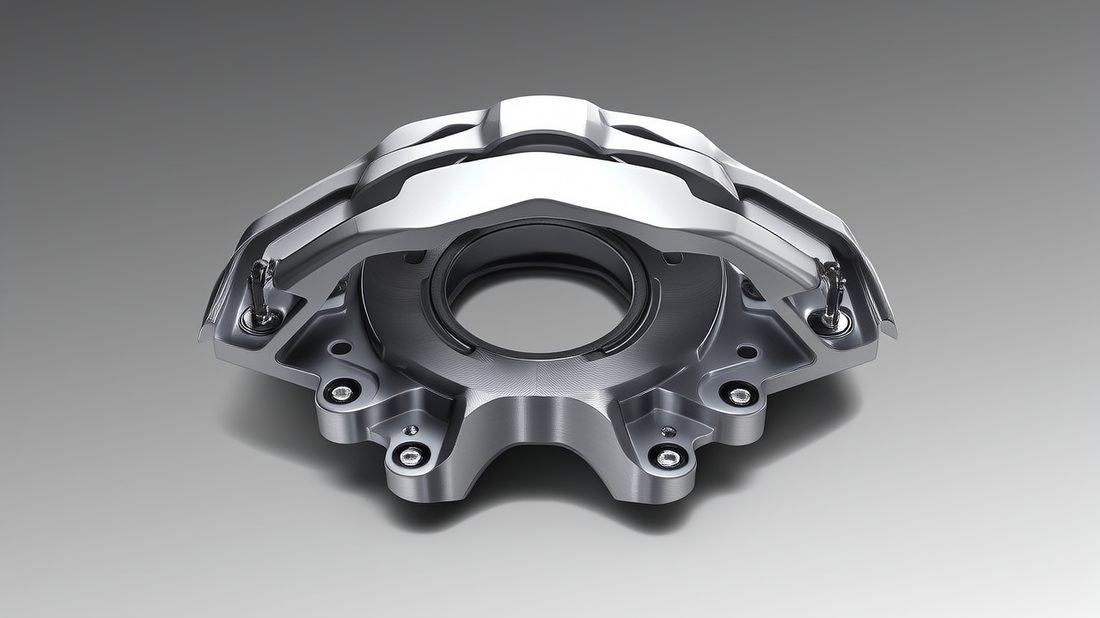
A caliper bracket does one job that sounds simple and is not: keep the caliper aligned to the rotor's friction plane under load. Every time you brake, the caliper pushes with hundreds to thousands of newtons of clamp force; the bracket must return that force into the knuckle without flexing, creeping, or shifting its datum. When the mounting face moves, the pad contact pattern moves with it, and uneven wear follows within a few thousand kilometers.
That is why caliper brackets belong in the same conversation as other safety-critical automotive CNC parts - steering knuckles, hub carriers, and suspension pickups. They are low on drama and high on consequence. A cosmetic cover can be a little off and nobody dies; a bracket that is a little off can change how the car stops.
What the bracket actually carries
- Clamp reaction force from the caliper fingers
- Bolt preload from the mounting hardware (typically M10-M12 class 10.9)
- Braking torque reaction into the knuckle
- Road-input vibration and thermal growth from the disc
- Repeated stress reversals across the part's life
| Load path | What it demands from the part | Where machining matters |
|---|---|---|
| Clamp reaction | Stiff, stable mounting face | Flatness and perpendicularity of the seat |
| Bolt preload | True bolt circle, no induced bend | True-position of holes to datum |
| Thermal growth | Predictable, symmetric expansion | Symmetric wall and pocket layout |
| Vibration | No resonance in service band | First-mode frequency vs mass removal |
Automotive&EV AI part image
How EV Motor Parts and Caliper Brackets Share a Structural Language
An EV does not change the physics - it changes where the mass and the loads land.
EV motor parts and caliper brackets live in the same engineering world even though one spins and one clamps. Both must manage mass, both must survive thermal and vibrational service, and both are judged by how well they hold a datum under repeated load. The EV simply makes the bracket's job harder: battery mass adds unsprung and sprung load, and regenerative braking shifts the thermal and duty profile without removing the need for a rock-solid mechanical stop.
We see the same design habits win in both. Symmetry in the load path, generous fillets at stress risers, and a tolerance budget spent on the relationships that affect function rather than on every feature equally. A motor housing and a caliper bracket are both 'datum discipline' problems at heart.
Where the two parts pull in different directions
| Design axis | EV motor parts | Caliper brackets |
|---|---|---|
| Primary goal | Thermal path + shaft concentricity | Geometric stability under clamp load |
| Dominant tolerance | Bore/SHCS true position | Mounting-face flatness & perpendicularity |
| Mass priority | Lighten the rotating assembly | Lighten without losing stiffness |
| Finish driver | Sealing and heat transfer | Corrosion resistance in wet service |
Aluminum CNC Machining for Lightweight Caliper Brackets
Most brackets should be aluminum. The question is which aluminum, and what you do to it after the cut.
Aluminum CNC machining is the default for caliper brackets because the part wants to be light and stiff, and aluminum delivers both at low cost. We run 6061-T6 for the bulk of brackets and step up to 7075-T6 where yield strength earns its premium. The trade is corrosion sensitivity: 7075 needs a proper anodize, and you must tolerance the coated condition or your bolt circle will not seat.
For brackets that see road salt and wash water, we anodize - Type II for a durable matte finish that hides handling marks, Type III hard coat where the surface sees abrasion. Anodize adds a few microns and can close a 0.005 mm slot, so we machine bores undersize and let the coating bring them to nominal. That single habit removes an entire class of 'it won't go together' line stops.
Choosing the alloy for your bracket
| Alloy | Use it for | Watch out for |
|---|---|---|
| 6061-T6 | Standard brackets, low-stress arms | Lower strength vs 7075 |
| 7075-T6 | High-stress, thin-wall brackets | Corrosion; anodize required |
| 6082-T6 | EU-spec brackets, good general use | Slightly lower machinability than 6061 |
Pros
- Light, stiff, cheap to machine
- Stable to tight tolerances
- Anodize gives corrosion + wear in one step
- Recycles cleanly, easy to source
Cons
- 7075 needs coating to resist corrosion
- Soft compared with steel - not for high-wear faces
- Coating thickness must be tolerated into the part
- Thermal growth higher than steel
Automotive&EV AI part image
What IATF 16949 Machining Means for Your Caliper Bracket Supply
IATF 16949 is not a machining trick - it is the discipline that keeps the machining honest across 50,000 parts.
- IATF 16949
- The global Quality Management System standard for automotive production and relevant service parts organizations - the backbone of how tier suppliers control variation, traceability, and continuous improvement.
- PPAP
- Production Part Approval Process: the structured evidence package (design record, process flow, FMEA, control plan, MSA, CMM report) that proves a process is capable before volume ships.
- APQP
- Advanced Product Quality Planning: the front-loaded development flow that catches risk before the first production part, not after a recall.
Here is the honest position: Dongguan Licun Technology (brand LusterControl) holds ISO 9001 certification and has completed ISO 13485, with IATF 16949 currently in application. We are not claiming an IATF 16949 certificate we do not yet hold. What we do claim is that the IATF 16949 machining discipline - controlled processes, documented PFMEA, lot-level traceability, and CMM-verified first articles - is already how we run safety-relevant work today.
For you as a buyer, the practical question is whether the shop can show the same evidence an IATF auditor would demand: a control plan tied to the drawing, measurement system analysis on the gauges, and a rework path that does not quietly ship. If a supplier cannot produce a PPAP-style package for a caliper bracket, that is a red flag regardless of what certificate hangs on the wall.
| Requirement | What it protects | What we provide today |
|---|---|---|
| Material cert to heat lot | Chemistry & origin | Full mill cert, lot-traced |
| CMM first-article report | Datum & feature truth | Datum-referenced CMM report |
| In-process gauging | Batch stability | Gauge + SPC on key features |
| Lot traceability | Recall containment | Bar-to-finish lot record |
| IATF 16949 cert | Audited QMS | In application |
Tight Tolerance CNC Requirements for Brake Caliper Brackets
Tolerance is a budget. Spend it on the three relationships that decide whether the pad wears evenly.
Tight tolerance CNC work on a caliper bracket is not about making every number small - it is about making the right numbers small. We concentrate the budget on three relationships: the flatness of the caliper seat, the perpendicularity of that seat to the rotor axis (expressed through the bolt-circle datum), and the true position of the mounting holes. Everything cosmetic gets a commercial tolerance so the part stays affordable.
Concretely, we hold seat flatness around 0.02 mm, perpendicularity of the seat to the primary datum near 0.03 mm, and positional tolerance on the bolt holes at ±0.05 mm with the pattern locked to a single datum. Our standard precision centers hold ±0.005 mm positioning, so these brackets are well within capability with margin to spare.
Where to spend the tolerance budget
| Feature | Recommended tolerance | Why it earns the cost |
|---|---|---|
| Caliper seat flatness | 0.02 mm | Even pad contact, no pull |
| Seat perpendicularity to datum | 0.03 mm | Rotor-aligned clamp |
| Bolt-circle true position | ±0.05 mm | No induced bolt bend |
| Non-functional faces | Commercial (±0.2 mm) | Cost control, no function loss |
- Lock a single primary datum and reference all critical features to it
- Get a CMM first-article report before releasing volume
- Agree coating-thickness allowance if you anodize
- Gauge the bolt pattern in-process, not just at final inspection
- Keep lot traceability from raw bar to finished bracket
Automotive&EV AI part image
Specifying Custom CNC Parts: Caliper Brackets vs Off-the-Shelf Forgings
Buy the bracket that fits your volume and your risk profile - not the one with the lowest unit price.
Custom CNC parts give you the geometry your knuckle actually needs, with no compromise to a catalog shape, and they let you fold in weight-saving pockets and integrated features that a forging cannot. The cost is tooling-free but slower per part than a high-volume forging once you are past low-to-mid volumes. Off-the-shelf forgings are cheap at scale but lock you into someone else's envelope and usually need extra machining anyway.
| Axis | Custom CNC bracket | Off-the-shelf forging |
|---|---|---|
| Design freedom | Full - your geometry | Locked to catalog shape |
| Low-volume cost | Strong, no tooling | Weak unless buying tons |
| Lead time | Short (no tooling) | Long if tooling needed |
| Best volume | Prototypes to mid-volume | High-volume only |
| Integration | Pockets/features in one part | Usually needs secondary ops |
Pros
- Exact fit to your knuckle
- Faster to first article
- Easy to revise between revisions
- No minimum tonnage
Cons
- Higher unit cost at very high volume
- You own the design responsibility
- Need a capable CNC source
- Choose custom CNC parts if your platform is new, low-volume, or still changing revision
- Choose custom CNC parts if the bracket needs integrated pockets or non-standard bolt patterns
- Choose a forging if annual volume is high and the geometry is frozen for years
- Choose a forging only if you already own or share the tooling cost
Surface Finish and Passivation for Automotive CNC Parts in Wet Service
A bracket that machines perfectly but rusts in year two is a failed bracket.
Caliper brackets live in the wheel arch - salt, water, brake dust, and heat. Surface finish is not cosmetic here; it is the difference between a part that sheds corrosion and one that pits at a stress riser. For aluminum we anodize; for any stainless or mixed-metal interface we control galvanic risk. And whenever the part is stainless, we passivate per ASTM A967 so the free iron from machining is removed and the chromium oxide layer is restored.
Our mirror line reaches Ra 0.2 µm (8K finish) for parts where surface cleanliness or sealing matters, with a standard precision finish around Ra 0.6 µm. Most brackets do not need 8K, but the capability matters when a seal face or a bearing seat is in play. Specifying the right finish tier - and confirming it was actually achieved - is part of a serious sourcing checklist.
Finish tiers and when to use them
| Finish tier | Roughness | Use it for |
|---|---|---|
| Standard precision | Ra 0.6 µm | Structural faces, general brackets |
| Fine machined | Ra 0.4 µm | Bearing or pilot seats |
| Mirror / 8K | Ra 0.2 µm | Seal faces, cosmetic + clean surfaces |
| Anodized aluminum | Type II / III | Corrosion + wear in wet service |
Automotive&EV AI part image
A Practical Buyer's Checklist for Custom CNC Parts and Caliper Brackets
Hand this to a supplier and you will know within one email whether they are a real precision source.
Sourcing custom CNC parts for a safety-relevant bracket should feel like an audit, not a purchase. The questions below are the ones we are happy to answer with data, and the ones that separate a shop that understands caliper-bracket intent from a broker quoting a pretty drawing.
- Ask for the cert stack: ISO 9001 minimum; IATF 16949 (or a credible in-application roadmap) for automotive
- Request material certs traceable to the heat lot - not a generic 'aluminum 6061' line
- Get a CMM first-article report with a full datum tree, not a photo of the part
- Confirm single-setup 5-axis or turn-mill capability for angled features
- Agree on coated vs bare tolerances before the quote if you anodize
- Verify lot traceability and a real, documented rework path
- Drawing with a single coherent datum tree
- Material cert to heat lot included in the quote
- PPAP-style first-article package offered
- Coating thickness tolerance called out
- Lot traceability from bar to bracket confirmed
- Red-flag answer: 'we'll just make it to the numbers' with no datum scheme
The cheapest caliper bracket is the one that passes qualification the first time - because the second time costs you a launch date.
Automotive&EV AI part image
Automotive&EV AI part image
Automotive&EV AI part image
Automotive&EV AI part image
FAQ: automotive CNC parts & Automotive&EV Buyer Questions
A: Not a certificate on the wall - but you do need the discipline behind it. A bracket is safety-relevant, so demand PPAP-style evidence: material cert to heat lot, a datum-referenced CMM first-article report, in-process gauging, and lot traceability. LusterControl holds ISO 9001, has completed ISO 13485, and runs IATF 16949-aligned process control with the certificate currently in application.
A: 6061-T6 covers most brackets cost-effectively; step up to 7075-T6 where yield strength justifies the premium. Either way, anodize for corrosion - Type II for general service, Type III hard coat for abrasion - and machine bores to the coated dimension so the part seats after finishing.
A: Spend the budget on three relationships: caliper-seat flatness (~0.02 mm), seat perpendicularity to the primary datum (~0.03 mm), and bolt-circle true position (±0.05 mm). Relax every non-functional face to commercial tolerance. Our standard centers hold ±0.005 mm positioning, so these are comfortably within capability.
A: Choose custom CNC parts if your platform is new, low-to-mid volume (below roughly 200,000/year), or still changing revision - you get exact fit and fast first articles with no tooling. Choose a forging only at high, stable volume where the shape is frozen for years and you can share the tooling cost.
A: Anodize aluminum (Type II/III), control galvanic mismatch at mixed-metal interfaces, and for any stainless feature passivate per ASTM A967 to remove free iron and restore the chromium oxide layer. Spec the finish on the final as-served condition - bare or coated - not on the raw machined surface.
A: Yes. Send your drawing for a free DFM review and we return a datum-referenced CMM first-article report, material cert to heat lot, and a lot-traceability record from raw bar to finished bracket. We run 60+ CNC centers on a 4,000 sqm Dongguan floor at ~500,000 parts a month, with ISO 9001 certified and ISO 13485 completed.
Send us your caliper bracket or EV structural drawing for a free DFM review. We will flag the features that should move to 5-axis, the tolerances that are costing you money, and the coating you need for wet-service life - then quote a first article with a full CMM report. Let's cut the bracket that passes qualification the first time.
Request a Free CNC Quote