Sourcing Lightweight UAV Structural Components: A Drone Buyer's Guide 2026
Sourcing parts for an unmanned aerial vehicle is not like filling a catalog. In a drone, mass is destiny - every gram you leave on a bracket is a gram stolen from battery, payload, or flight time. The arms, frames, and mounts that make up your UAV structural components are not decoration; they are the load paths that decide whether your aircraft flies straight, lands intact, and keeps flying past warranty.
So the useful question is not 'who quotes the lowest price per part?' It is 'who can hold the tolerance, the weight, and the finish batch after batch, and prove it?' This guide walks through exactly how we, as a CNC shop that already builds drone parts, would qualify ourselves - and how you should qualify any supplier you are considering. We keep it plain, the way an engineer explains it to a colleague.
We cover what lightweight CNC machining actually buys you, why drone motor mounts fail in the field, how 5-axis CNC machining beats 3-axis for multi-face parts, when TC4 titanium machining is worth the premium, how to pick aerospace-grade aluminum, a sourcing checklist you can copy, and the mistakes we see buyers make most often.
Table of Contents
- 1. Why UAV Structural Components Decide Your Drone's Range and Payload
- 2. What Lightweight CNC Machining Actually Delivers for Drone Frames
- 3. How Drone Motor Mounts Carry Vibration, Heat, and Thrust
- 4. Why 5-Axis CNC Machining Beats 3-Axis for UAV Parts
- 5. TC4 Titanium Machining: When It Is Worth the Cost in Drones
- 6. Choosing Aerospace-Grade Aluminum for UAV Structural Components
- 7. A Sourcing Checklist for Lightweight CNC Machining of Drone Parts
- 8. Common Mistakes Engineers Make When Sourcing Drone Motor Mounts
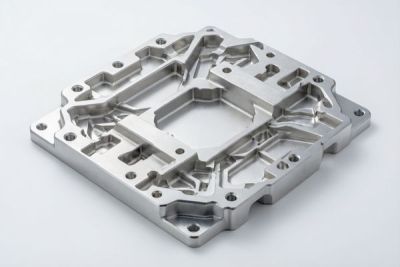
UAV/Drone CNC precision component
Why UAV Structural Components Decide Your Drone's Range and Payload
In a drone, every gram you save on structure is a gram you can spend on battery, sensor, or flight time.
Every UAV is a weight budget. The frame, arms, and brackets that make up your UAV structural components do not just hold the drone together - they define how much payload you can lift, how long you can stay airborne, and how the aircraft behaves the moment a gust hits. Trim mass from the wrong place and you trade stiffness for grams you did not need; add mass in the wrong place and your center of gravity drifts, your motors work harder, and your flight time collapses.
The three jobs structure has to do at once
- Carry static loads - the airframe has to survive its own weight plus payload at every takeoff.
- Absorb dynamic loads - vibration from rotors, hard landings, and wind gusts are constant, not occasional.
- Stay light and stiff - low mass keeps inertia down, but you cannot let rigidity fall with it.
This is why off-the-shelf extrusions and rough 3D prints rarely survive past a prototype. A real UAV structural component is a load path, not a shape. When we machine one, we are controlling where stress flows, not just removing material.
The takeaway for a buyer: treat structural parts as performance parts. The shop you choose is part of your flight-envelope calculation, not just a vendor filling a BOM line.
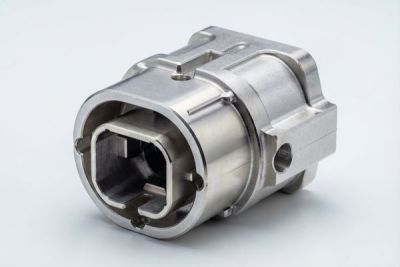
UAV/Drone CNC precision component
What Lightweight CNC Machining Actually Delivers for Drone Frames
Lightweight is not a material - it is a process decision, and CNC earns its place by holding tolerance while removing mass.
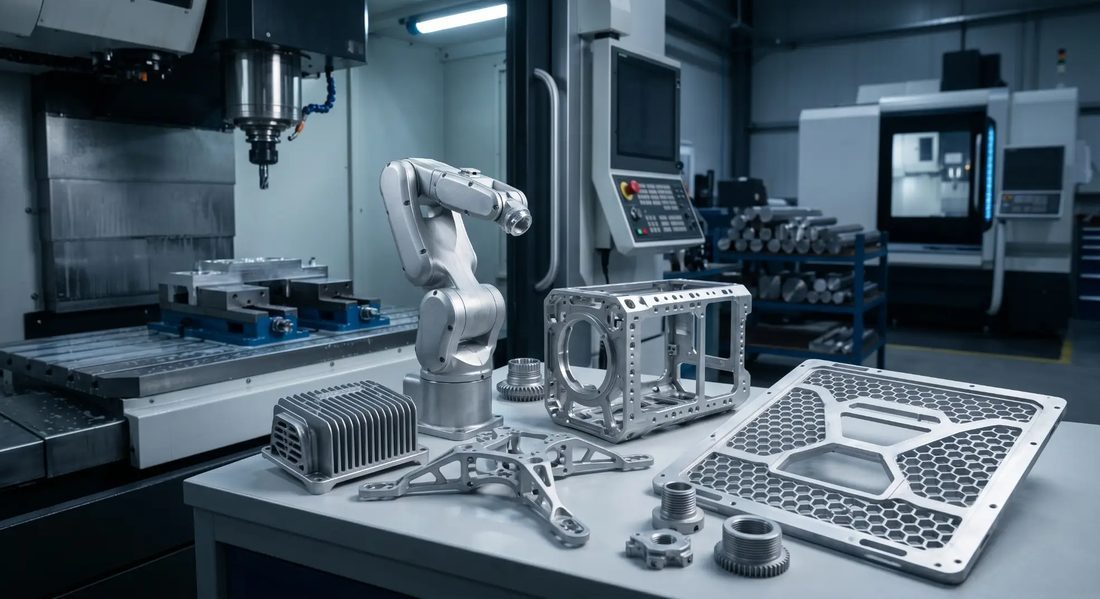
Lightweight CNC machining is the workhorse behind most production drones. Unlike casting, it starts from solid stock and removes only what the load path does not need, so you keep grain integrity that a molded part loses. Unlike 3D printing, it lands at finished tolerances without a long post-machine step. For a frame that has to be both light and repeatable across thousands of units, that combination is hard to beat.
Where CNC wins over the alternatives
| Method | Best for | Tolerance | Mass control | Volume fit |
|---|---|---|---|---|
| CNC machining | Production frames, mounts, arms | ±0.005 mm | Excellent (near-net) | Low to high |
| Die casting | High-volume shells | ±0.1 mm | Good | Very high only |
| 3D printing | Rapid prototypes, low load | ±0.2 mm | Fair | Prototype |
| Extrusion + bend | Simple rails | ±0.05 mm | Limited shapes | Mid |
Notice the tolerance column. A mount that seats a motor has to sit square to within a few hundredths of a millimeter or you induce runout, vibration, and bearing wear on day one. That is exactly the window lightweight CNC machining holds every day in our plant.
Pros
- Near-net mass removal keeps parts light
- Finished tolerances, little post-work
- Same process scales from 10 to 500k/month
- Full material cert and batch traceability
Cons
- Higher piece cost than casting at very high volume
- Long thin features need careful fixturing
- Material buy-out lead time on exotic grades
For buyers, the practical rule is simple: if the part carries load and you need it the same every time, lightweight CNC machining is the default. If it is a cosmetic cover, cheaper methods may do.
How Drone Motor Mounts Carry Vibration, Heat, and Thrust
The motor mount is the smallest part doing the biggest job - it is where electrical power becomes flight.
Drone motor mounts look simple: a plate, a few holes, maybe a boss. In service they are brutal. They transfer every newton of thrust from the rotor to the frame, they sit next to a motor that runs hot, and they inherit the full vibration spectrum of an unbalanced prop. Get one wrong and you feel it as buzzing footage, premature bearing failure, or a cracked arm.
What a good motor mount controls
- Flatness and squareness so the motor spins true - runout here becomes vibration everywhere.
- Bolt-circle position so the rotor seats concentrically, every unit, no shimming.
- Local stiffness around the hub so thrust does not deflect the plate under load.
- Thermal path so heat from the motor does not soften an adjacent thin wall.
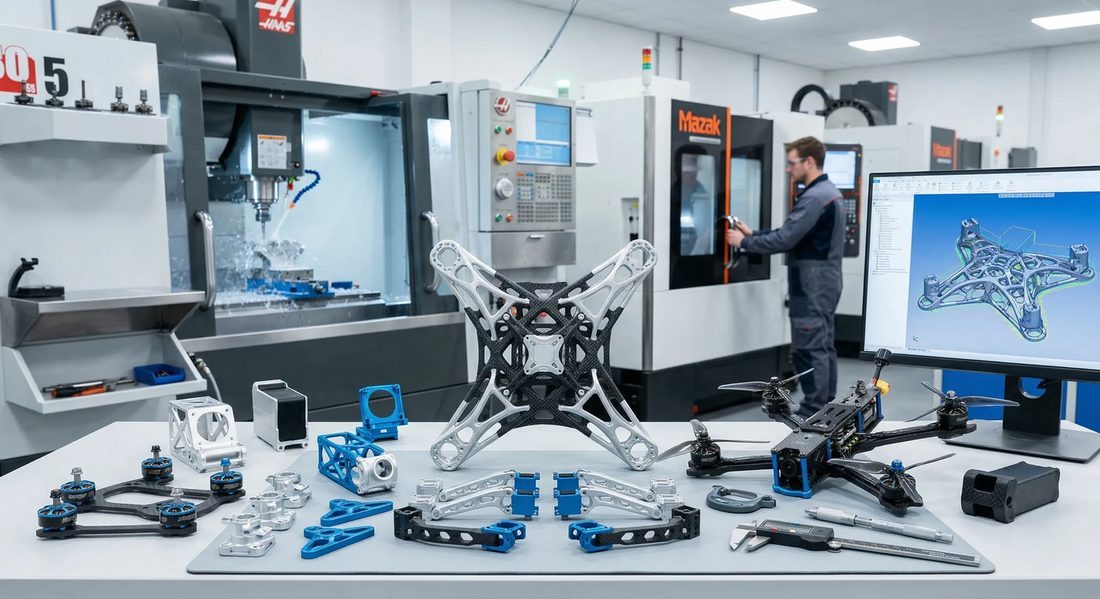
We machine drone motor mounts on turn-mill and 5-axis centers so the hub face, the bolt circle, and the frame interface are cut in one clamp - no stack-up from moving the part between ops. That is how we hold the ±0.005 mm that keeps a motor spinning true.
Motor mount design quick guide
- Specify flatness on the motor face, not just thickness - flatness is what the rotor sees.
- Give the hub local wall thickness; a thin plate around a hot motor is where cracks start.
- Call out the bolt-circle position tolerance; let the shop verify it, do not assume.
- Decide threaded inserts vs tapped holes early - it changes fixturing and cycle time.
A motor mount is not a bracket. It is the handshake between your motor and your airframe - make it a firm one.
When you source drone motor mounts, you are really specifying a vibration and heat interface. Write those requirements down and the shop can hold them; leave them vague and you will find out in the field.
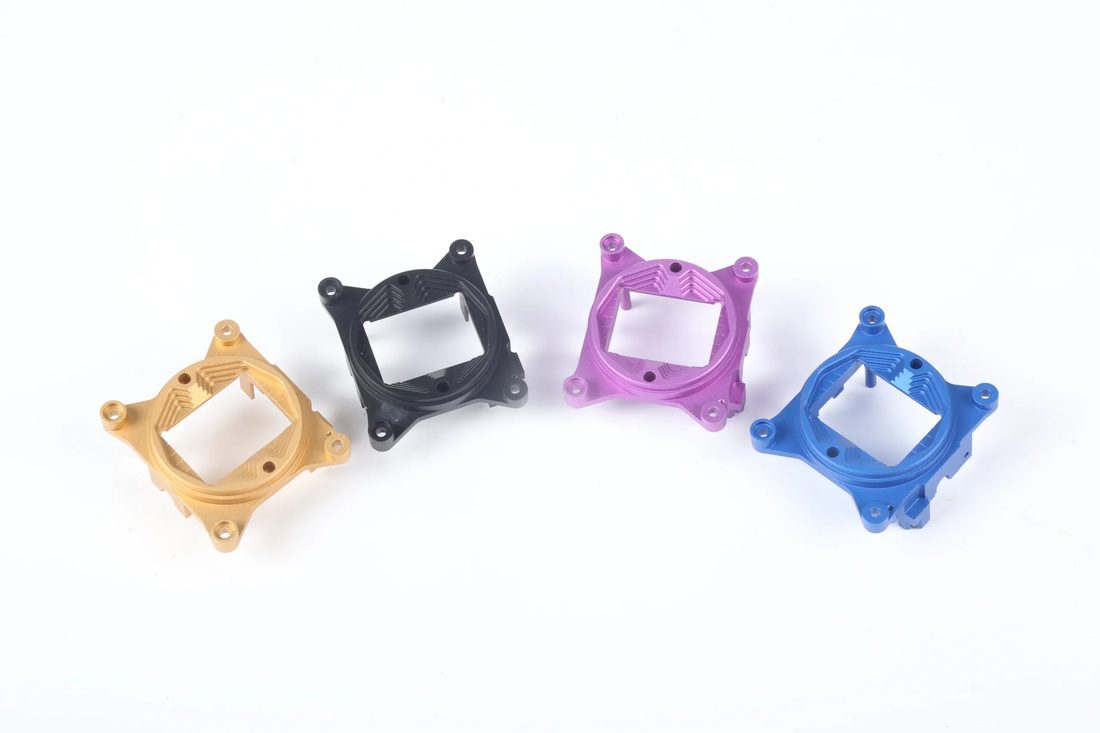
UAV/Drone CNC precision component
Why 5-Axis CNC Machining Beats 3-Axis for UAV Parts
Most drone parts have features on more than one face. 3-axis makes you pay for that in setups; 5-axis does not.
5-axis CNC machining moves the tool or the part on five axes at once, so a complex UAV structural component can be cut from almost any angle in a single setup. A 3-axis machine can make the same part, but only by reclamping it two or three times - and every re-clamp is a chance to shift the datum and stack a new error on top of the last.
What you gain with 5-axis
| Factor | 3-axis | 5-axis |
|---|---|---|
| Setups per part | 2-3 | 1 |
| Datum stack-up | Adds each clamp | None within setup |
| Undercut or angled features | Secondary op needed | Cut directly |
| Surface finish on curves | Stepped | Continuous |
| Lead time | Longer | Shorter |
For a curved arm or an angled mount, 5-axis also delivers a cleaner surface because the tool follows the contour instead of stair-stepping down it. That finish matters for both looks and for parts that see airflow.
We run 5-axis centers alongside turn-mill and Swiss-type machines, so a UAV structural component can move from raw bar to finished, polished part while keeping the datum that protects your tolerance.
The buyer's angle: if your part has three or more machined faces, 5-axis CNC machining is usually cheaper in total than 3-axis once you count setup, scrap, and lead time - not just technically better.
TC4 Titanium Machining: When It Is Worth the Cost in Drones
TC4 (Ti-6Al-4V) is the material engineers love and buyers fear - here is the honest break-even.
TC4 titanium machining is its own discipline. TC4 (Ti-6Al-4V) gives you the best strength-to-weight ratio of the common aerospace metals, shrugs off corrosion, and stays strong when warm - which is why it shows up in real aircraft. In a drone it is gold for arms, brackets, and anything that must be both light and tough. The catch is cost: titanium is expensive to buy and slow to cut, and it work-hardens if your tool and coolant are wrong.
Terms you will hear
- TC4 / Ti-6Al-4V
- The workhorse alpha-beta titanium alloy: about 90 percent of aerospace titanium use.
- Strength-to-weight
- A material's strength divided by its density - the number that matters for flight.
- Work hardening
- Titanium's surface gets harder as you cut it; wrong speeds bury the tool.
- Anneal
- A heat treatment that relieves stress and restores machinability after roughing.
Done right, TC4 titanium machining yields parts that are dramatically lighter than steel for the same strength and far tougher than aluminum at temperature. Done wrong, you burn tools, miss tolerance, and blow the budget.
| Property | TC4 Titanium | 7075 Aluminum | 304 Stainless |
|---|---|---|---|
| Density (g/cm3) | 4.43 | 2.81 | 7.93 |
| Tensile (MPa) | ~950 | ~570 | ~515 |
| Strength-to-weight | High | Very high | Low |
| Corrosion | Excellent | Good | Good |
| Machinability cost | High | Low | Medium |
Pros
- Best strength-to-weight among common alloys
- Excellent corrosion resistance
- Stable at elevated temperature
- Premium, defensible spec for high-end UAV
Cons
- High material and cycle cost
- Work-hardens; needs right tool and coolant
- Slower to prototype
- Harder to source in small lots
For most buyers the question is not 'is titanium good' - it is 'on which parts does titanium pay back?' Spend it where mass and load meet, save it where they do not.
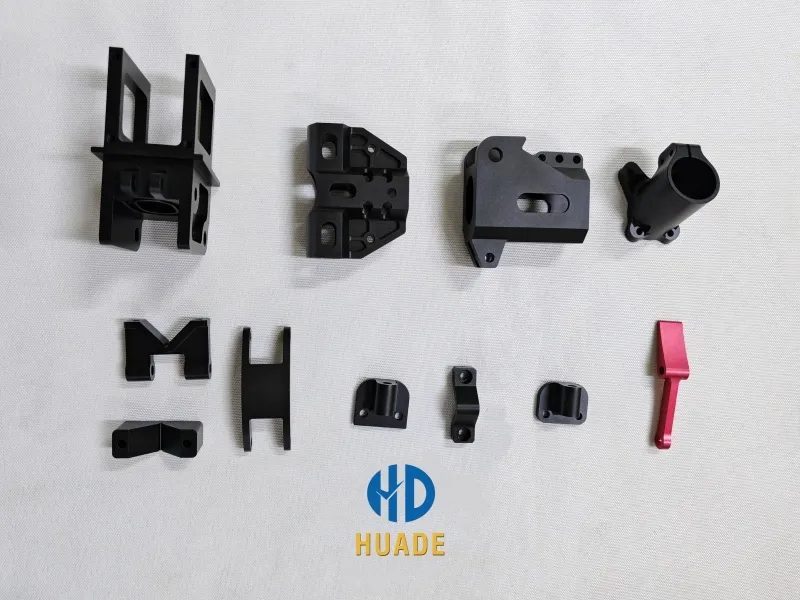
UAV/Drone CNC precision component
Choosing Aerospace-Grade Aluminum for UAV Structural Components
Aluminum is the default drone metal for a reason - pick the right grade and it carries the load at a fraction of titanium's cost.
Aerospace-grade aluminum is where most production drones start. It is light, easy to machine, and - in the right tempers - strong enough for frames, arms, and housings. The trick is picking the grade, because the term aircraft aluminum covers very different materials; 2024, 6061, and 7075 behave very differently under load and corrosion.
The three grades buyers actually choose
| Grade | Strength | Corrosion | Machining | Typical UAV use |
|---|---|---|---|---|
| 6061-T6 | Medium | Excellent | Easy | Frames, brackets, housings |
| 7075-T6 | Very high | Fair (needs coating) | Medium | Arms, high-load parts |
| 2024-T3 | High | Poor (clad needed) | Medium | Skin, stiffeners |
For most UAV structural components, 6061-T6 is the safe, corrosion-friendly default, while 7075-T6 earns its place on arms and high-load members where every gram of stiffness counts. 2024 is excellent in thin aircraft skin but needs cladding to survive weather - less common on a consumer or prosumer drone.
Spec it right the first time
- Name the temper (T6, T651) on the drawing - aluminum alone is not a spec.
- Call out the anodize or coating if the part sees weather; 7075 needs protection.
- State flatness and hole position, not just overall size.
- Ask for material mill certs so the grade is verified, not assumed.
Aerospace-grade aluminum keeps your drone light and your BOM sane - as long as you tell the shop exactly which grade and temper you mean.
A Sourcing Checklist for Lightweight CNC Machining of Drone Parts
Copy this and send it to every shop on your shortlist. The answers will sort them in one call.
- Do they machine UAV structural components regularly, not as a one-off hobby job?
- Can they show 5-axis or turn-mill capability and explain 3+2 versus simultaneous?
- Will they state a tolerance and verify it with CMM, not just claim they are precise?
- Do they handle TC4 titanium machining and aerospace-grade aluminum in-house?
- Can they provide material mill certs and batch traceability on every lot?
- Do they quote against your drawing, including flatness and bolt-circle position?
- Are finish and anodize handled in-house or via a controlled partner?
- Can they scale from prototype to 500k/month without re-qualifying the process?
- Do they answer engineering questions with specifics, not sales talk?
A supplier that clears most of these is worth keeping. One that stumbles on tolerance verification or traceability should not be on a flight-critical program.
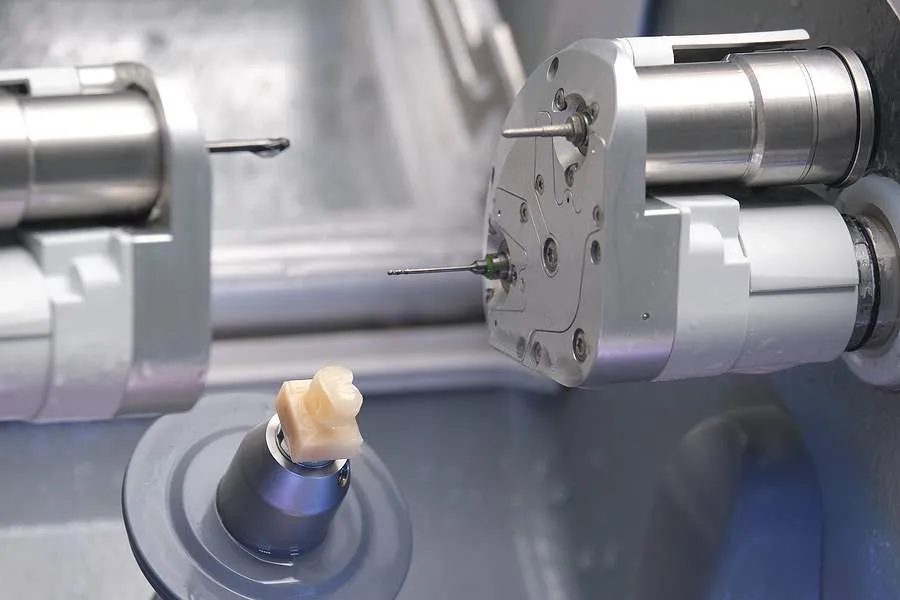
UAV/Drone CNC precision component
Common Mistakes Engineers Make When Sourcing Drone Motor Mounts
Most drone failures we see were decided at the sourcing stage, not on the shop floor.
- Specifying only thickness and skipping flatness - the motor sees the face, not the caliper.
- Leaving the bolt-circle position untoleranced, then shimming every unit by hand.
- Chasing the lowest bid and discovering the saving evaporates in rework and delays.
- Treating TC4 titanium machining as a default instead of a targeted upgrade.
- Forgetting batch traceability - without it, one bad lot becomes a full recall.
- Ignoring communication - a vague shop stays vague after the purchase order is signed.
- Mixing suppliers for mount and frame, then fighting fit-up that is nobody's fault but yours.
None of these are exotic problems. They are habits - and the right supplier makes the good habit the easy default.
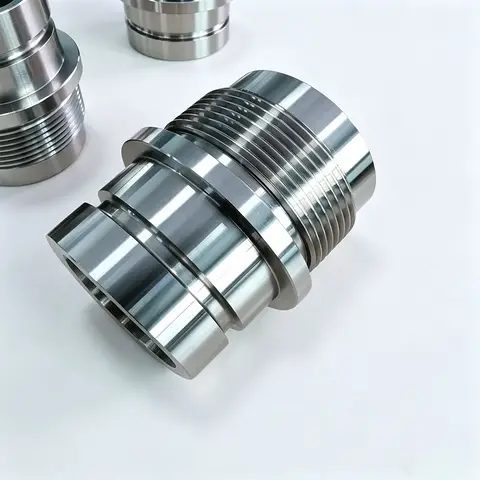
UAV/Drone CNC precision component
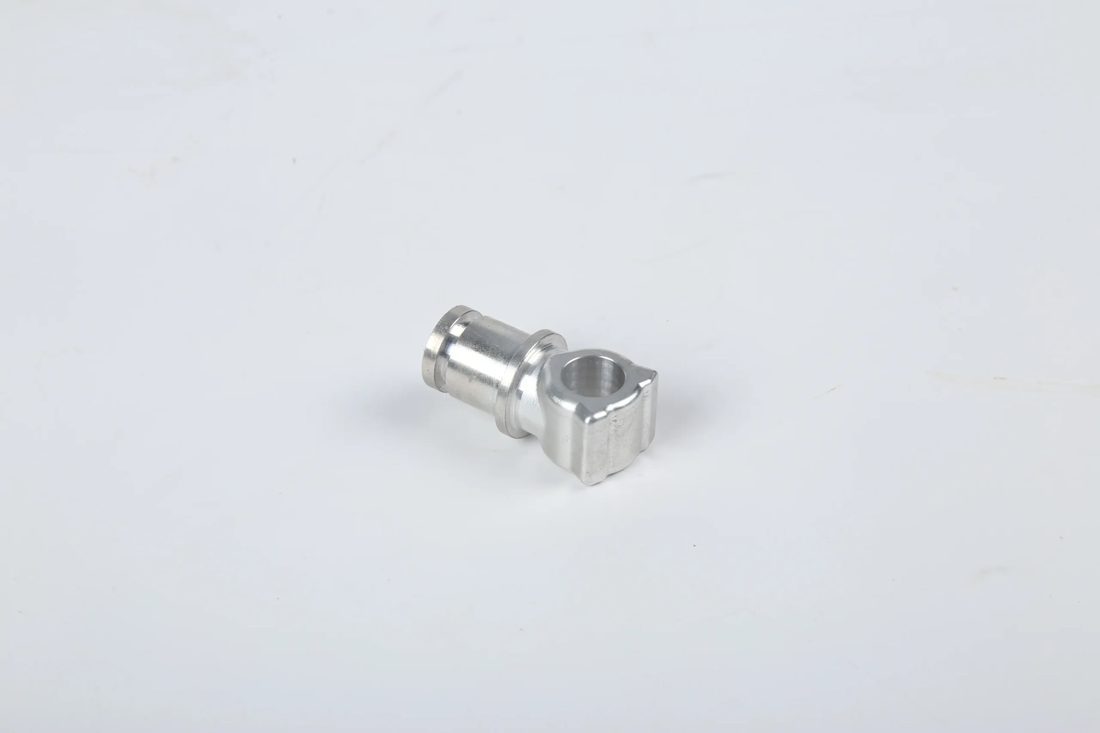
UAV/Drone CNC precision component
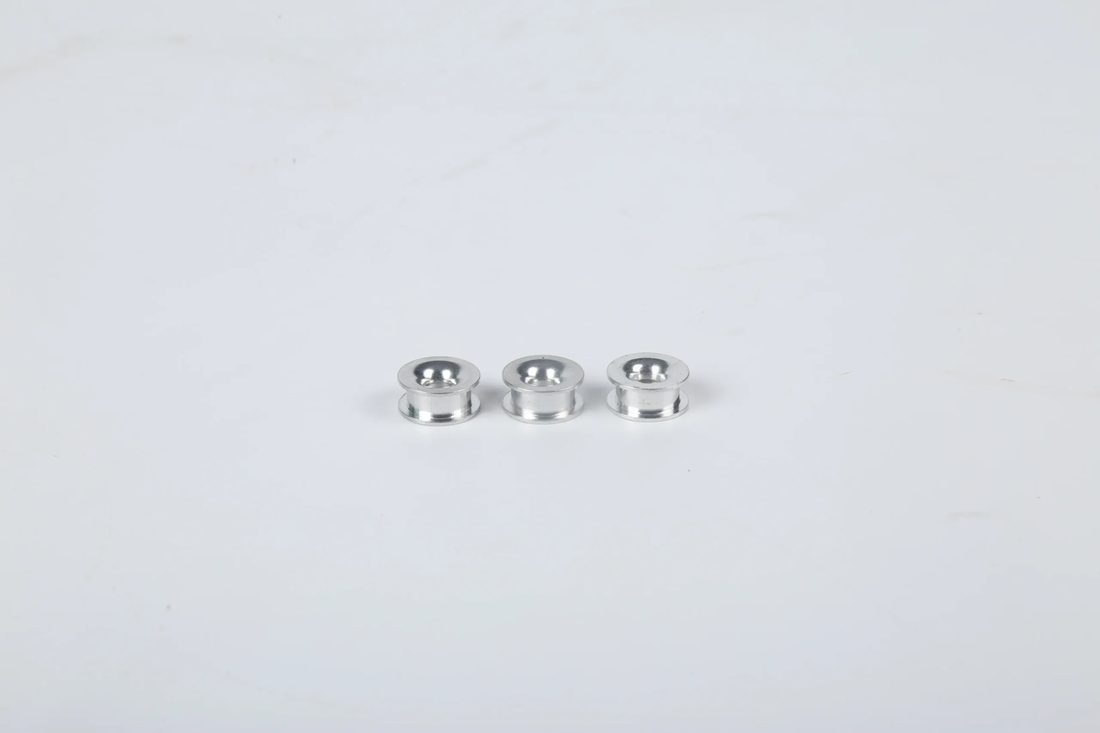
UAV/Drone CNC precision component
UAV/Drone CNC precision component
FAQ: UAV structural components & UAV/Drone Buyer Questions
A: We routinely hold ±0.005 mm on critical diameters and ±0.01 mm on flatness and position features for UAV structural components, verified by CMM rather than estimated. For most drone frames and mounts that window is more than enough.
A: Yes more often than buyers expect. Even at low volume, 5-axis CNC machining removes the re-clamps that cause datum stack-up, so you get better true-position and shorter lead time. The setup saving alone often pays for the process on any part with three or more machined faces.
A: Use TC4 titanium where weight and strength both matter - arms, load-bearing brackets, hinges - and aluminum (6061 or 7075) where the load is moderate. Titanium can cost a third more to make; spend it only where mass and stress meet, and save it elsewhere.
A: 6061-T6 is the safe, corrosion-friendly default for frames and housings; 7075-T6 is the choice for arms and high-load members where stiffness per gram counts, provided you add anodize or coating for weather resistance. Always name the temper on the drawing.
A: Every lot is tied to its material mill certificate, machine, operator, inspection records, and a Certificate of Conformance, so any shipped part can be traced back to its full history - the same discipline our ISO 13485 and IATF 16949 work demands.
A: Yes. We run first-article inspection on new designs, support low-volume custom runs, and scale to 500k-plus parts per month while keeping the same documented process and traceability - so your program can grow without re-qualifying the source.
Ready to source lightweight UAV structural components you can trust in the air? Send us your drawing and we will return a free DFM review with material, tolerance, and finish recommendations - no obligation, just a clear engineering answer.
Request a Free CNC Quote