Why Medical Buyers Choose Small-Batch Titanium Machining for Implant Screws (2026 Guide)
If you source orthopedic or dental implant screws, you already know the uncomfortable truth: the part you need is almost never a catalog item. It is a low-volume, high-mix component where every new lot is effectively a qualification event, and a single out-of-spec thread crest can pull an entire surgical system off the market. That is why more procurement and R&D teams are abandoning the 'find a big stamping house' reflex and specifying small-batch titanium machining instead.
In this 2026 guide we walk through what small-batch really buys you, why Ti-6Al-4V (Grade 5 / TC4) behaves the way it does on the spindle, the tight tolerance CNC thread requirements that actually matter, and how an ISO 13485 machining discipline protects your supply when volumes are tiny but stakes are absolute. We also give you a verification checklist you can hand to any supplier tomorrow.
Everything below is written from the shop floor of Dongguan Licun Technology (brand LusterControl), a Dongguan source factory that has run precision CNC work since 2015. We are not a finished medical-device maker and we do not hold device-level FDA, CE, or MDR registrations - we are the contract precision-machining partner that holds the parts to the tolerance, finish, and traceability your own regulatory file requires.
Table of Contents
- 1. What Small-Batch Titanium Implant Screws Demand from CNC Precision Machining
- 2. Titanium Machining for Implant Screws: Material Behavior and Pitfalls
- 3. How ISO 13485 Machining Discipline Protects Your Implant Supply
- 4. Tight Tolerance CNC Requirements for Bone-Screw Threads
- 5. Why Surgical Instruments and Implant Screws Share One Shop Floor
- 6. Choosing a Medical Device Components Supplier: Buyer's Verification Checklist
- 7. Small-Batch vs Volume: When CNC Precision Machining Beats Scale
- 8. Common Mistakes Buyers Make in Titanium Machining of Implants
- 9. Sourcing Surgical Instruments and Implant Screws: A Decision Matrix
Medical AI part image
What Small-Batch Titanium Implant Screws Demand from CNC Precision Machining
Low volume is not a compromise here - it is the whole point of the design.
An implant screw is rarely made by the million. A trauma plate system might need 200 of one length and 80 of another; a spinal or dental line might carry 40 active SKUs at low annual volume each, with design revisions landing every quarter. Hard tooling and progressive dies cannot absorb that mix without bleeding money on obsolete tooling. This is where CNC precision machining earns its keep: you machine 50 to 500 pieces economically, with no dedicated die, and you change the program - not the factory - when the drawing revises.
Why small-batch is the default, not the exception
When you source through a partner who runs both Swiss-type lathes and turn-mill centers, the same floor that cuts a 5,000-piece appliance order can also run a 120-piece implant pilot the same week. That flexibility is what lets a startup orthopedic brand reach first-in-human readiness without committing to volume tooling it does not yet deserve. The discipline that matters is not the machine count - it is whether the shop can hold the same tolerance on lot 1 and lot 50.
The tolerance budget that actually protects the patient
On an implant screw the functional surfaces are the thread form, the drive recess, and the seated shoulder - not the outer cosmetic diameter. We concentrate the tolerance budget there: thread pitch held to +/-0.005 mm, the root radius controlled to avoid stress risers, and the pilot seat finished to a mirror-ready surface. Everything non-functional gets commercial tolerance so the part stays affordable without gambling on the surfaces that matter.
| Driver | Small-batch CNC | Hard-tooling volume |
|---|---|---|
| Lot size that makes sense | 50 - 500 pcs | 10,000+ pcs |
| New SKU / revision cost | Edit program, re-cut | New die, long lead |
| Time to first article | Days | Weeks to months |
| Best fit | Implants, pilots, low-mix | Commodity, stable design |
Medical AI part image
Titanium Machining for Implant Screws: Material Behavior and Pitfalls
Titanium is not 'expensive stainless' - it is a different physics at the cut.
The workhorse for implant screws is Ti-6Al-4V (ASTM F136 Grade 5 / TC4). It is chosen because it is biocompatible, its modulus is far closer to cortical bone than stainless or cobalt-chrome, and it forms no toxic nickel ions. But the same properties that make it ideal in the body make it miserable on the spindle if you treat it like steel.
Why this grade, and why it fights back
Titanium has low thermal conductivity, so the heat of cutting stays at the tool edge instead of flowing into the chip. It also work-hardens: let the cutter rub instead of cut and the surface turns to armor plate that destroys the next tool. Our recipe for titanium machining is unremarkable but non-negotiable - sharp inserts, low radial engagement (around 0.5 mm or 8% of cutter diameter), through-spindle coolant, and conservative surface speeds near 30-50 m/min.
The three failure modes we watch for
- Work-hardening from a dull or rubbing tool, which then eats the replacement tool
- Heat concentration that welds chips to the flute and ruins the thread root
- Springback and thin-wall deflection that hides until the part is released from the fixture
| Property | Ti-6Al-4V (Grade 5) | 316L Stainless | CoCr Alloy |
|---|---|---|---|
| Density (g/cc) | 4.43 | 8.0 | 8.3 |
| Elastic modulus (GPa) | 114 | 193 | 210 |
| Corrosion resistance | Excellent | Good | Excellent |
| Machinability | Poor (work-hardens) | Fair | Poor |
| Typical use | Implant screws | Instruments | Wear surfaces |
Pros
- Modulus closer to bone reduces stress shielding
- No nickel, excellent biocompatibility
- Strong and light for the same strength
- Corrodes only under extreme abuse
Cons
- 2-3x cycle time vs stainless
- Work-hardens and runs hot
- Needs sharp tools and disciplined cooling
- Low Ra needs an extra finishing pass
How ISO 13485 Machining Discipline Protects Your Implant Supply
A certificate on the wall means nothing if the floor cannot prove the last lot.
ISO 13485 is the quality-management standard written specifically for organizations in the medical-device supply chain. We have completed ISO 13485, and it changes far more than a logo on the quote. It forces document control, risk-based process controls, calibrated equipment records, and - most important for you - full material and process traceability from the raw bar to the finished screw.
What ISO 13485 actually changes on the floor
- Every lot is tied to a material cert and a heat number you can request at any time
- Deviations are documented and dispositioned, never quietly reworked
- Calibration of measuring equipment is scheduled, not hoped for
- First-article inspection uses a controlled plan, not a good photo
- Training and competency of the operator are recorded
Traceability from bar to batch
When a regulator or your own QA team asks 'which heat of titanium is in lot B-2207?', the answer must be one lookup, not a week of email. We lot-number raw stock, log the machine and program version used, and retain the CMM report against that lot. For implant work that paper trail is the product as much as the chip.
| Standard | What it governs | Our status |
|---|---|---|
| ISO 9001 | General quality management system | Certified |
| ISO 13485 | Medical-device quality management | Completed |
| IATF 16949 | Automotive QMS (discipline transfer) | In application |
| ASTM A967 | Chemical passivation of stainless | In-house process |
Medical AI part image
Tight Tolerance CNC Requirements for Bone-Screw Threads
The thread is the product. Everything else is a handle.
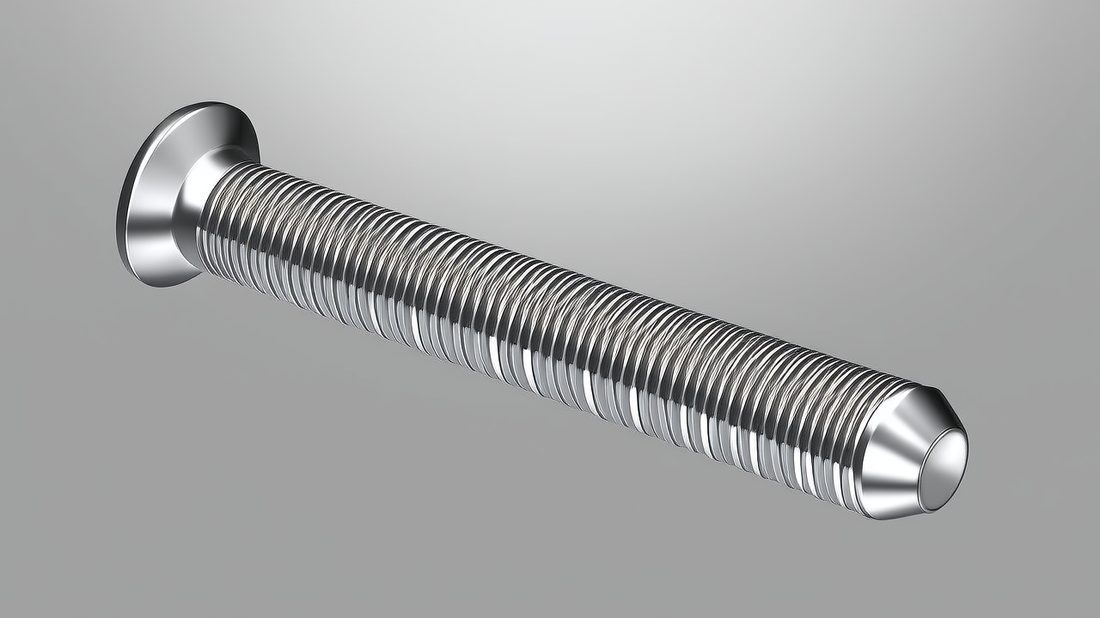
On a bone screw the thread does the mechanical work: it engages cortical or cancellous bone, sets the pull-out strength, and determines whether the surgeon can drive it without torsional failure at the drive recess. Tight tolerance CNC control of that thread form is therefore the single most scrutinized feature on the part.
Thread form and where the tolerance lives
We hold the functional thread pitch to +/-0.005 mm and control the root radius to avoid the stress concentration that starts a fatigue crack. The major diameter can sit at a looser commercial band because it is not the load path; spending the tolerance budget there instead of on the pitch is the classic amateur error. Drive-recess location matters too - if the recess is off-axis the surgeon's driver cams out and strips the head.
| Feature | Typical target | Why it matters |
|---|---|---|
| Thread pitch | +/-0.005 mm | Engagement and pull-out |
| Root radius | R0.1 min | Fatigue stress riser |
| Major diameter | +/-0.01 mm | Mostly cosmetic |
| Drive recess pos. | +/-0.02 mm | Torque transfer |
| Seat surface Ra | <=0.4 µm | Biotolerance, sealing |
Finish and passivation after the cut
After machining we can take functional seats down to Ra 0.2 µm (our 8K mirror line) where the application calls for it, and we passivate stainless and titanium surfaces per ASTM A967 so the part resists fingerprint and handling corrosion during assembly. Passivation is not decoration - on an implant it is part of the biocompatibility file.
- Confirm the thread standard on the drawing (ISO metric, UT, or custom)
- Agree on coated vs bare tolerances before quoting
- Define free-state vs clamped measurement condition
- Request CMM first-article with full datum references
- Specify Ra target and passivation spec up front
Why Surgical Instruments and Implant Screws Share One Shop Floor
Same tolerances, same traceability, same unforgiving QA - just different shapes.
A common misconception is that surgical instruments and implant screws come from different supply chains. In practice the demanding ones come from the same kind of floor, because both need the same things: tight tolerance CNC control, full material traceability, and a quality system that treats a deviation as a recorded event rather than a quiet rework. A forceps jaw and a locking screw may look nothing alike, but the discipline underneath is identical.
Where the process requirements overlap
- Both demand lot-level material certification to the heat
- Both need CMM first-article evidence, not a sample photo
- Both benefit from single-setup turn-mill work to kill datum shift
- Both are low-volume, high-mix by nature
| Requirement | Surgical instruments | Implant screws |
|---|---|---|
| Tolerance intent | Fit and feel | Load and engagement |
| Typical material | 420/440C, 316L | Ti-6Al-4V, 316L |
| Key risk | Hinge play, burrs | Thread strip, fatigue |
| Shared control | ISO 13485, traceability | ISO 13485, traceability |
Medical AI part image
Choosing a Medical Device Components Supplier: Buyer's Verification Checklist
Hand this list to a supplier and the brokers sort themselves out.
Sourcing medical device components is less about finding the cheapest spindle and more about finding a shop that understands that a missing heat cert is a line-stop, not a footnote. The checklist below is the one we are happy to satisfy with data, and it is the fastest filter between a real precision source and a logo with a reseller behind it.
- Confirm the cert stack: ISO 9001 at minimum, ISO 13485 completed for device work
- Request material certs traceable to the heat lot - not just 'ti grade 5'
- Verify single-setup turn-mill capability, not 3-axis with re-fixturing
- Get a CMM first-article report with full datum references, not a photo
- Agree on coated vs bare tolerances and passivation spec before quoting
- Confirm lot traceability and a real documented deviation path
- Material cert to heat number on file
- CMM first-article report supplied
- ISO 13485 documentation available
- Lot traceability from bar to box
- Passivation per ASTM A967 where specified
- Deviation process documented, not ad hoc
Small-Batch vs Volume: When CNC Precision Machining Beats Scale
Scale wins on unit price. It loses the moment your design moves.
There is a real case for volume production of a stable, mature implant screw: unit cost drops, and a qualified die is a beautiful thing. But the moment your design revises, your volume mix fragments, or your annual need stays under a few thousand pieces, CNC precision machining beats scale on total cost of ownership - because the cost you avoid is obsolete tooling and a stalled regulatory timeline.
| Factor | Small-batch CNC | Volume / hard tooling |
|---|---|---|
| Setup lead time | Days | Weeks to months |
| Revision cost | Reprogram and re-cut | New die, requalify |
| Minimum order | 50 - 500 pcs | 10,000+ pcs |
| Unit cost | Higher | Lower |
| Best for | Implants, pilots, low-mix | Stable commodity design |
Choose small-batch if / choose volume if
- Choose small-batch if: annual need < 5,000 pcs, SKU count is high, or design is still moving
- Choose volume if: design is frozen, annual need is six figures, and tooling cost is already justified
- Choose CNC precision machining if: you need ISO 13485 traceability without committing to a die you may retire next year
Medical AI part image
Common Mistakes Buyers Make in Titanium Machining of Implants
Most scrap on an implant screw is designed in the drawing, not the shop.
- Specifying sharp internal corners the cutter cannot reach, forcing scrap or undocumented radii
- Tolerancing the major diameter tight while leaving the functional thread pitch loose
- Forgetting passivation and assuming the machined surface is biocompatible as-cut
- Asking for Ra 0.2 µm everywhere instead of only on the functional seat - paying for finish you cannot use
- Treating coated and bare tolerances as the same, so anodize or coating blows the fit
- Choosing a supplier on price alone and discovering the heat cert is 'coming later'
Sourcing Surgical Instruments and Implant Screws: A Decision Matrix
Stop shopping on price. Shop on the three variables that actually change your risk.
When you sit down to qualify a supplier for surgical instruments or implant screws, the decision comes down to three questions: how many do you really need per year, how stable is the design, and how hard is your traceability requirement. Answer those and the right process picks itself.
| Your situation | Recommended path | Why it wins |
|---|---|---|
| < 5,000/yr, frequent revs | Small-batch CNC precision machining | No tooling risk, fast re-qual |
| Frozen design, 6-figure/yr | Volume / hard tooling | Lowest unit cost |
| Need ISO 13485 traceability | Contract CNC under ISO 13485 | Heat-to-lot proof on file |
| Prototype to first-in-human | Turn-mill small batch | Days to first article |
A note on where to start
If you are still reading this wondering which box you are in, the safe default is small-batch CNC under an ISO 13485 system. It keeps your options open, your regulatory file clean, and your first article days away instead of months. You can always move to volume once the design and the submission are locked - and a good shop will tell you when that day arrives instead of pushing tooling you do not need.
The cheapest implant screw is the one that passes qualification the first time - because the second time costs you a launch date, not just a part.
Medical AI part image
Medical AI part image
Medical AI part image
Medical AI part image
FAQ: medical device components & Medical Buyer Questions
A: Implant screws are low-volume and high-mix, with frequent design revisions. Small-batch CNC precision machining produces 50-500 pieces economically with no hard tooling, so a new SKU or a drawing revision only means editing a program - not retiring an expensive die. That speed to first article matters more than unit price when volumes are tiny and stakes are absolute.
A: We hold the functional thread pitch to +/-0.005 mm and control the root radius (R0.1 minimum) to avoid fatigue stress risers, while the non-functional major diameter sits at a looser commercial band. Drive-recess position is held to +/-0.02 mm so the surgeon's driver does not cam out. Tolerances are concentrated on the load path, not the cosmetic diameter.
A: ISO 13485 completed is the right quality-system signal, but it is not a device-level regulatory authorization. We machine implant and instrument components to your drawing and quality plan under our ISO 13485 system, with full heat-to-lot traceability; you own the design and the FDA/CE/MDR submission. A contract precision shop should be clear about that boundary.
A: Ti-6Al-4V has low thermal conductivity, so cutting heat stays at the tool edge, and it work-hardens if the cutter rubs instead of cutting. That demands sharp inserts, low radial engagement, and strong coolant - roughly 2-3x the cycle time of 316L stainless. The payoff is a modulus closer to bone and excellent biocompatibility with no nickel.
A: Yes. Every medical lot ships with a material cert traceable to the heat number, a CMM first-article report with full datum references, in-process gauging for batch parts, and lot-level traceability from raw bar to finished component. Passivation is performed per ASTM A967 where the drawing specifies it.
A: Move to hard tooling only when the design is frozen, annual need reaches six figures, and the tooling cost is already justified by volume. Until then, small-batch CNC under ISO 13485 keeps your regulatory file clean and your re-qualification fast. A good shop will tell you when you have crossed that line rather than pushing tooling early.
Send us your implant-screw or surgical-instrument drawing for a free DFM review. We will flag the features that should move to single-setup turn-mill work, the tolerances that are costing you money, and the passivation call that belongs on the drawing from day one. Reach out and let's cut the first article under ISO 13485 traceability.
Request a Free CNC Quote