LusterControl Scales Precision CNC Nozzles for Fluid Control (2026)
If you specify spray, dispense or metering hardware for a fluid system, you already know the part that quietly decides whether your product works: the nozzle. It is the orifice that sets the flow rate, the spray angle and the droplet size — and when that orifice drifts by a few micrometres, your coating is uneven, your dose is off, or your valve chatters. In a dosing pump, a washdown spray bar or a valve trim, the nozzle is not a commodity; it is the metering edge your whole process trusts.
Demand for tight-tolerance nozzles has been climbing across Dongguan and the wider South China belt as more equipment makers push atomisation, dosing and washdown performance to the limit. To keep pace, LusterControl has reallocated floor space and machine time toward precision nozzle production for fluid-control and valve buyers — the same CNC precision machining discipline we already apply to medical, automotive and coffee-machine components. This article explains what changed, and what it means for you when you source nozzles.
We will walk through why nozzle tolerances matter, how we machine them to a mirror finish, the material choices that actually affect your spray, the quality framework behind every batch, and a practical supplier-audit checklist you can use before you send a drawing. Every number here is a real, verified figure from our plant — no rounded-up claims.
Table of Contents
- 1. Why Fluid Control and Valve CNC Parts Buyers Need Better Nozzles
- 2. CNC Precision Machining: How We Build Mirror-Finish Nozzles
- 3. Tight Tolerance CNC Nozzles: Holding ±0.005 mm in Volume
- 4. Nozzles for Fluid Control: A Buyer's Material Comparison
- 5. Custom CNC Parts: How We Machine Nozzles to Your Drawing
- 6. LusterControl's Nozzles Capacity: 60 CNC Machines, 4,000 m²
- 7. Nozzles Quality Framework: ISO 9001, ISO 13485 & Batch Traceability
- 8. How to Audit Nozzles Suppliers Before You Order
- 9. Real Nozzles LusterControl Has Shipped for Fluid Control
- 10. NDA & Drawing Security for Your Nozzles
Fluid Control&Valve CNC precision component
Why Fluid Control and Valve CNC Parts Buyers Need Better Nozzles
Before comparing specs, let us be clear about what a precision nozzle is really responsible for in your system.
A nozzle in a fluid system does one job that sounds simple and is brutally unforgiving: it defines the orifice. Flow rate follows the square of the bore, so a 5% error on a 1.0 mm bore is roughly a 10% error on delivered volume; a 0.01 mm asymmetry across the orifice tilts the spray cone and streaks the pattern. For fluid control and valve CNC parts, the nozzle is the first link in the accuracy chain — and the first place errors enter. Get the orifice right and everything downstream behaves; get it wrong and no amount of pump tuning rescues the result.
What a precision nozzle actually controls
Three things decide whether a nozzle earns its place in your assembly: bore accuracy (is the orifice on size and on-axis), surface condition (does the bore wall stay clean and non-turbulent), and edge geometry (is the inlet chamfered so flow separates cleanly). Buyers obsess over the wrong one. They ask for 'stainless' when the real question is whether the bore is held to ±0.005 mm and finished clean enough not to nucleate turbulence or trap residue.
- Nozzle (orifice)
- The shaped opening that sets flow rate, spray angle and droplet size by defining the cross-section the fluid must pass through.
- K-factor
- The discharge coefficient of an orifice — the relationship between pressure drop and delivered flow, fixed by bore geometry.
- Spray cone angle
- The included angle of the discharged pattern, set by the inlet and bore geometry and sensitive to micron-level edge changes.
Fluid Control&Valve CNC precision component
CNC Precision Machining: How We Build Mirror-Finish Nozzles
A nozzle is only as good as the process that cut its bore. Here is the actual route a LusterControl nozzle takes.
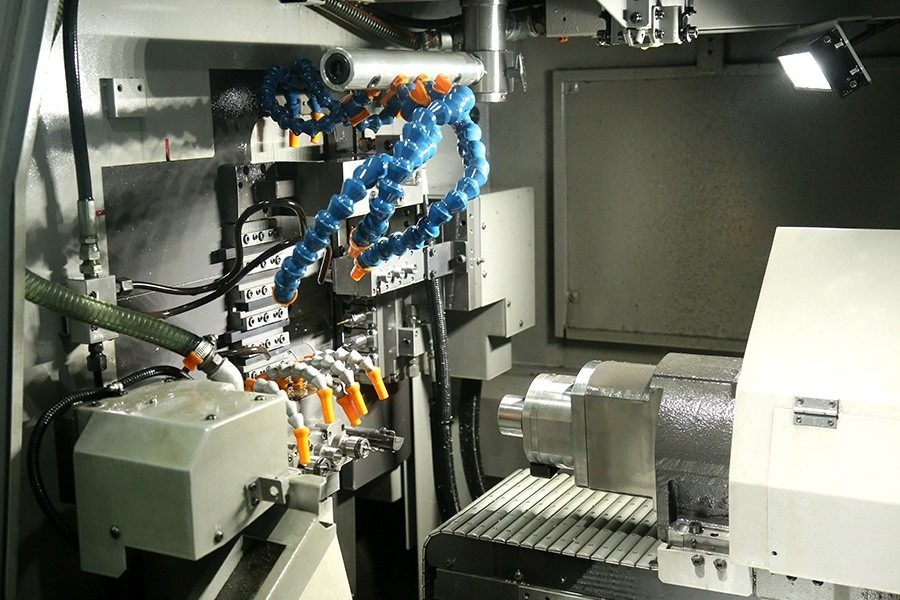
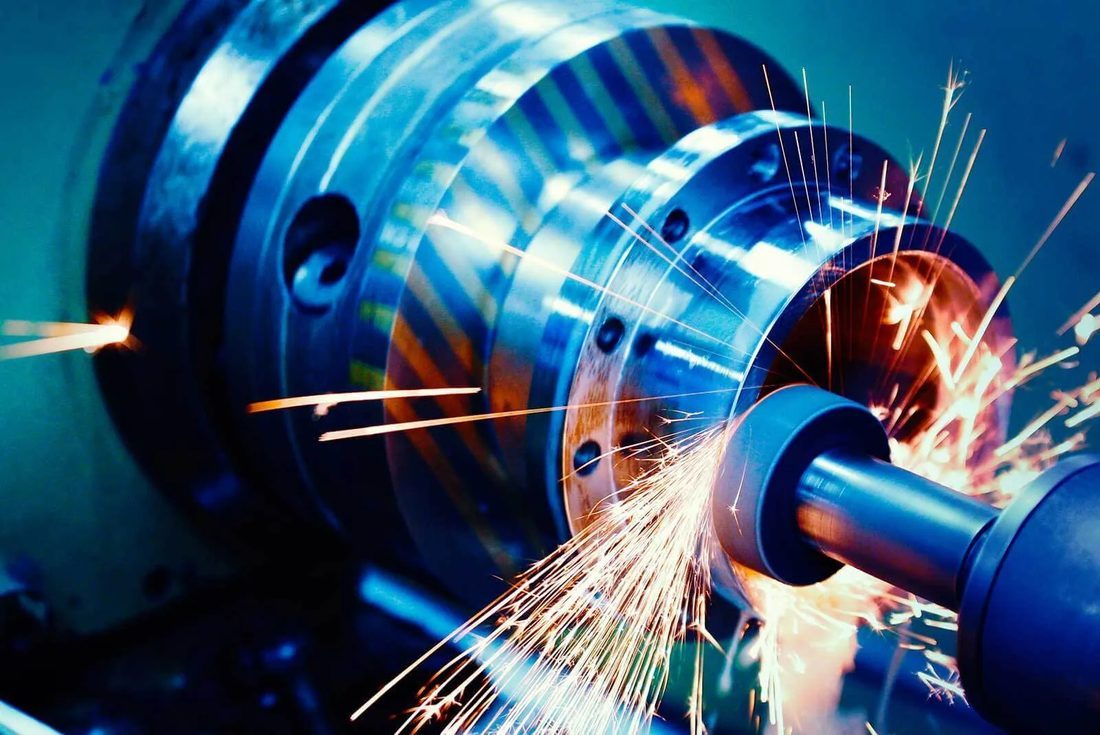
We machine nozzles the same way we machine surgical-grade components: turn-mill compound and 5-axis centres cut the bore and the outer profile in a single setup so the orifice axis and the locating datum share one coordinate system. Multi-setup work is where most shops lose accuracy, because every re-chuck adds its own error budget. For a bore that meters flow, one setup and one truth is not a nicety — it is the difference between a nozzle that sprays true and one that streaks.
From bar stock to finished nozzle: the steps
- Material verification — the incoming lot is logged and the mill certificate matched to the batch before any cutting begins.
- Rough + finish turn on Swiss-type or turn-mill centres to cut the bore and profile in a single setup, protecting the orifice axis.
- Micro-bore finishing and electrolytic polishing of the inner wall where flow matters, reaching standard Ra ≤ 0.6 µm and up to 8K Ra 0.2 µm.
- Passivation to ASTM A967 for any 300-series stainless nozzle that will see washdown, chemical or humid duty.
- First-article CMM inspection of the bore and cone, SPC sampling on the running batch, and serial-level traceability before shipment.
The reason this matters to you: a bore cut in one setup and finished to a verified surface will meter the same on cycle 100,000 as on cycle 1. That is the difference between a dosing system that ships within spec and one that needs a service call in week six.
| Process choice | What it protects | Typical result at LusterControl |
|---|---|---|
| Single-setup turn-mill | Bore-axis integrity | ±0.005 mm on the orifice |
| Swiss-type turning | Small-bore consistency | Clean repeatable micro-orifices |
| Electrolytic polish | Bore-wall cleanliness | Ra 0.2 µm / 8K mirror |
| ASTM A967 passivation | Corrosion resistance | Washdown-safe stainless |
You can read more about our turn-mill and 5-axis capability map on the company capabilities page, or browse related precision machining articles for deeper process detail.
Tight Tolerance CNC Nozzles: Holding ±0.005 mm in Volume
Prototype accuracy is easy. Holding it across 50,000 pieces is the real test — and where most suppliers quietly fail.
High-mix fluid-control buyers often receive a beautiful first-article report and then watch bore sizes wander by week three. The cause is almost never the machine; it is the system around it — tool wear on the micro-bore drill, thermal drift, inconsistent incoming material, no SPC. We hold ±0.005 mm on critical nozzle bores by running SPC with a Cpk target above 1.33 on the dimensions that meter flow, and by replacing micro-boring tooling on a schedule rather than on failure.
| Nozzle function in your system | Bore tolerance we hold | Why it matters |
|---|---|---|
| Dosing / metering orifice | ±0.005 mm | Volume accuracy follows the square of the bore |
| Spray / atomising tip | ±0.008 mm | Spray cone stays symmetric and streak-free |
| Valve trim seat | ±0.008 mm | Seat seals without chatter or leakage |
| Washdown jet | ±0.010 mm | Pattern coverage stays consistent |
Pros
- Single-setup machining keeps the bore axis intact
- SPC with Cpk > 1.33 catches drift before it ships
- Serial-level traceability lets you recall a bad lot fast
Cons
- Holding ±0.005 mm costs more than a 'close enough' nozzle
- Mirror finishing the bore adds a process step and lead time
Fluid Control&Valve CNC precision component
Nozzles for Fluid Control: A Buyer's Material Comparison
Material choice is the single biggest lever on nozzle cost, corrosion life and flow cleanliness. Here is the honest trade-off table we show buyers.
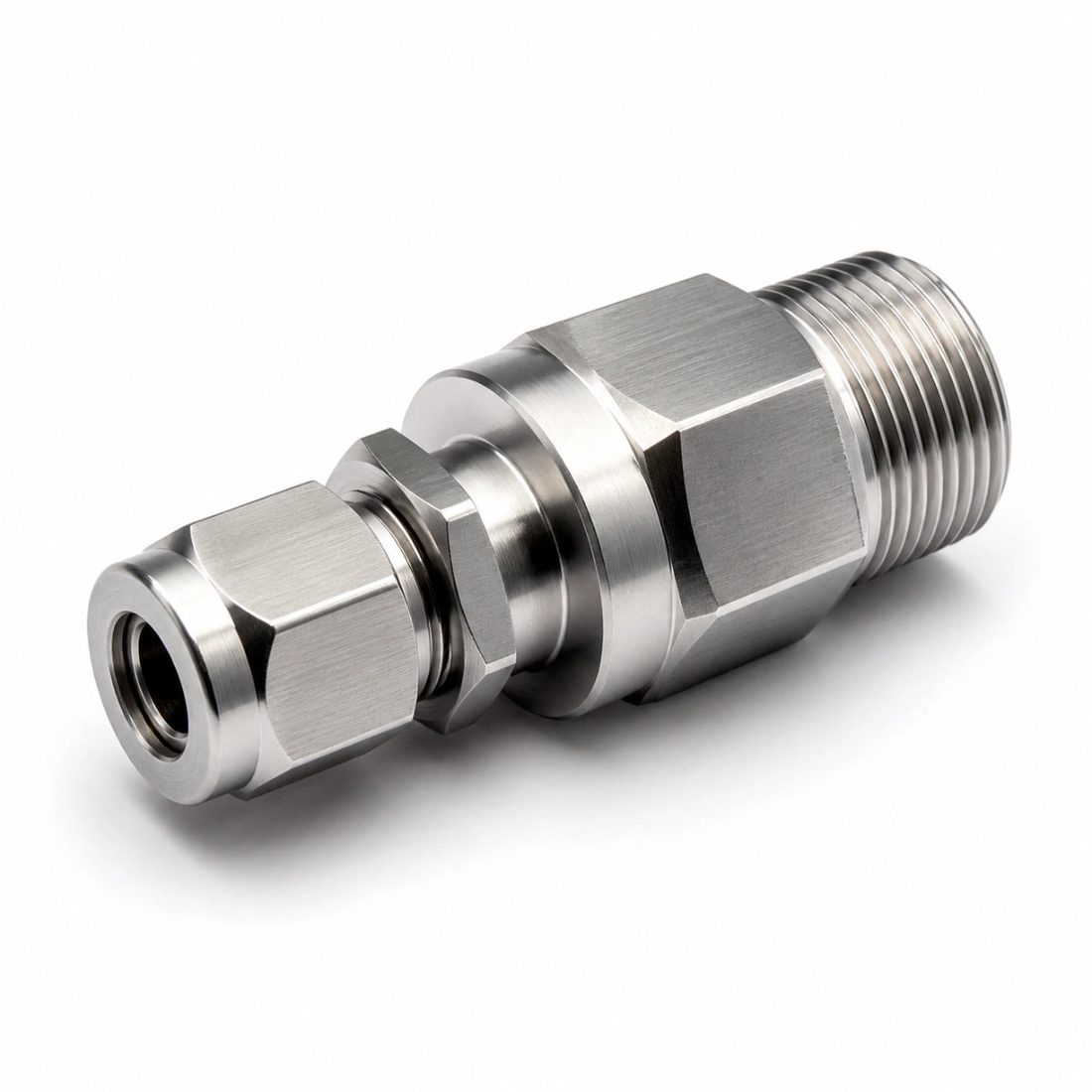
Most buyers default to 'stainless because it is strong.' For nozzles, that instinct is often wrong. Brass machines beautifully and gives a naturally smooth bore at low cost, ideal for clean-water and dosing duty; 303 stainless is the free-machining grade for general duty; 316 resists corrosion best for chemical or marine spray; 17-4 PH adds strength for high-pressure valve trim; PEEK or PTFE liners handle aggressive chemicals but need a metal carrier. The right answer depends on what flows through the orifice and how dirty the duty is.
| Material | Best for | Trade-off you accept |
|---|---|---|
| Brass (CW614N) | Clean-water, dosing, low-pressure spray | Softer; avoid abrasive slurries |
| Stainless 303 | General fluid-control duty | Work-hardens; moderate corrosion resistance |
| Stainless 316 | Chemical, marine, washdown spray | Hardest to micro-bore; highest cost |
| 17-4 PH | High-pressure valve trim seats | Needs post-heat-treat finish grind |
| PEEK / PTFE liner | Aggressive chemical metering | Needs a metal carrier body |
If you are unsure which grade your fluid calls for, send the media, pressure and cycle count to our engineering team via the inquiry page and we will recommend the alloy during a free DFM review.
Custom CNC Parts: How We Machine Nozzles to Your Drawing
A nozzle is rarely a catalogue item. Here is exactly what happens after you send a drawing.
- You send the STEP/PDF, the fluid media, pressure and the flow or spray target you must hit.
- We run a DFM review flagging impossible bore tolerances, thin lands or features that will burr in use.
- You approve the revised drawing and we cut a first-article nozzle for CMM verification of the bore and cone.
- On sign-off we schedule volume on the 60-machine floor with SPC from lot one.
- Every nozzle ships with its inspection record and a serial-linked batch ID.
Because LusterControl runs both Swiss-type turning lines for small, complex bores and 60 CNC centres for volume, we can take a nozzle from a one-off proof to a 50,000-piece run on the same process knowledge. That continuity is why customers such as De'Longhi, Donlim and Breville trust us with repeat production — the prototype and the millionth part come from the same playbook.
- Send the drawing with the orifice bore clearly dimensioned — not just an overall tolerance block.
- State the fluid media, pressure and required flow or spray angle.
- Tell us the annual volume so we pick the right process (Swiss vs turn-mill vs 5-axis).
- Ask for the first-article CMM report and the SPC plan before approving volume.
- Confirm the traceability depth you need (lot-level vs serial-level).
These five items are the difference between a nozzle that 'looks right' and one that meters for a year. Treat the checklist as your red-flag filter: any supplier who cannot answer item 4 is guessing at your flow.
Fluid Control&Valve CNC precision component
LusterControl's Nozzles Capacity: 60 CNC Machines, 4,000 m²
The 2026 expansion is not a marketing line — it is a measurable change in how much precision work we can ship.
| Metric | 2026 capacity | What it means for your order |
|---|---|---|
| Plant area | 4,000 m² (2026 expansion; old 2,000 m² retired) | Dedicated cells for fluid-control nozzles |
| CNC count | 60+ centres incl. Swiss-type and 5-axis | Parallelise prototype and volume |
| Monthly output | Up to 500,000 parts | Stable lead time at scale |
| Mirror finishing | Standard Ra ≤ 0.6 µm, up to 8K Ra 0.2 µm | Clean bore walls, no turbulence nucleation |
We are a South China source factory, not a trading desk. That means the engineer who reviews your DFM is the same organisation that owns the floor, the furnaces and the CMM room. For fluid-control buyers tired of relaying messages through three layers, that single point of accountability is the real capacity story.
Nozzles Quality Framework: ISO 9001, ISO 13485 & Batch Traceability
Anyone can claim 'high quality.' Here is the actual framework that backs the claim on every nozzle we ship.
Quality on a nozzle is not a final inspection — it is a chain. We start at incoming material verification, move through first-article CMM of the bore, run SPC on the production lot, perform final QC/OQC against an AQL, and close with serial-linked traceability. If a field issue appears, we can pull the exact lot, the machine, the operator shift and the material certificate in minutes.
- DFM review to remove infeasible bore features before cutting.
- First-article CMM report of the orifice and cone against the approved drawing.
- SPC with Cpk > 1.33 on critical bore dimensions.
- Final QC/OQC against an agreed AQL.
- Serial-level traceability recorded before shipment.
- Batch retention sample kept for the contract window.
| Standard / method | What it certifies for your nozzles |
|---|---|
| ISO 9001 | Documented quality management across the whole plant |
| ISO 13485 | Medical-grade process control, applied to all precision work |
| IATF 16949 (in progress) | Automotive-tier discipline coming online |
| ASTM A967 | Correct passivation of stainless bores |
| Batch / serial traceability | Lot-to-material-cert recall in minutes |
Fluid Control&Valve CNC precision component
How to Audit Nozzles Suppliers Before You Order
Use this checklist on any nozzle vendor. If they stumble on more than one item, keep looking.
- Can they show a current ISO 9001 (and ideally ISO 13485) certificate — not a screenshot from a brochure?
- Will they send a first-article CMM report of the bore tied to your drawing, not a generic capability sheet?
- Do they run SPC with a stated Cpk target, or inspect only at the end?
- Can they trace a shipped nozzle back to its material certificate and machine?
- Do they sign an NDA before you release the drawing (see the next section)?
- Can they show a real reference program in fluid control, not just 'we make precision parts'?
A second mistake is accepting a 'stainless' answer instead of a bore-tolerance number. Alloy does not meter flow; the orifice and its tolerance do. Make suppliers commit to a number you can verify on incoming inspection.
Real Nozzles LusterControl Has Shipped for Fluid Control
We do not lead with adjectives. Here is the kind of work that already runs through the floor.
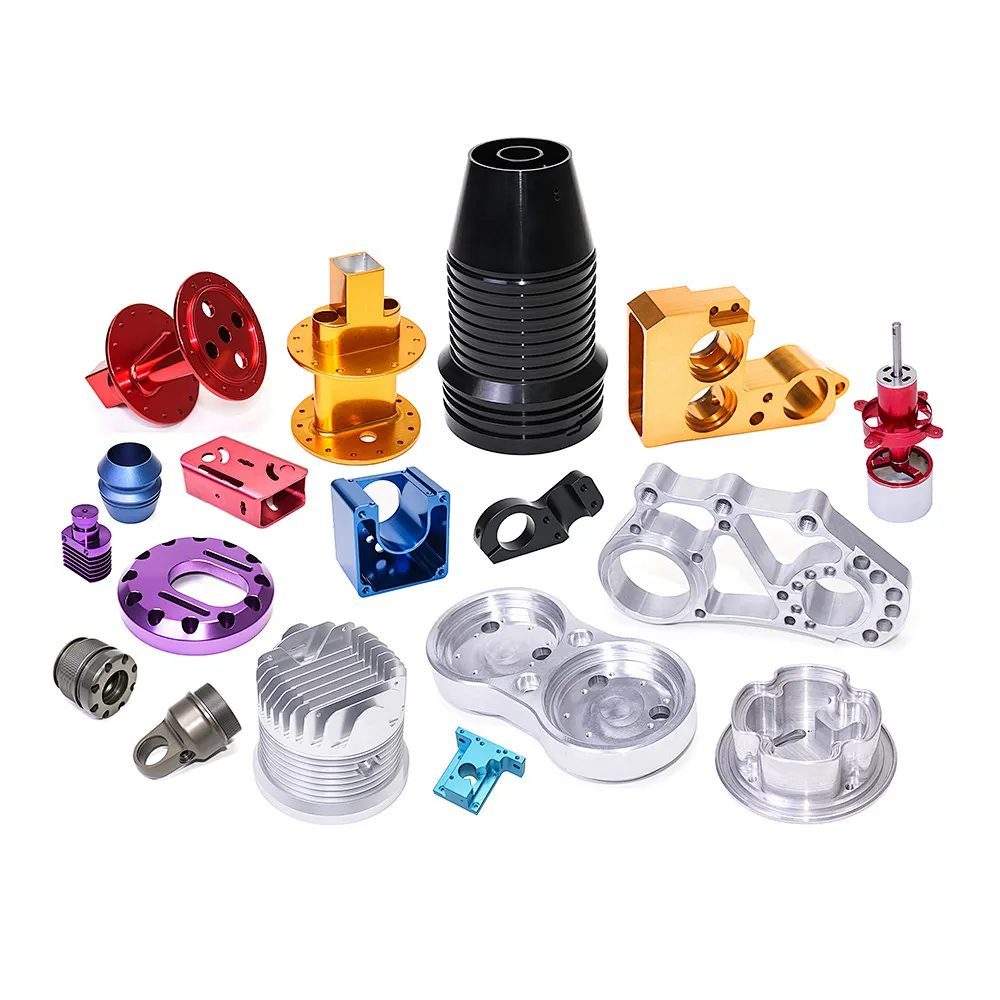
Our nozzle and fluid-component experience sits inside broader programs we have shipped. For the coffee-machine and small-appliance sector — brands including De'Longhi, Donlim and Breville — we machine mirror-finished stainless and brass metering parts where the bore is the product. For a drone / UAV customer, a first order reached RMB 1.2 million for structural and locating parts held to tight tolerances. In medical work under ISO 13485, we deliver deburred, traceable components where a single burr is a failure.
The point is not the brand names — it is that the same process discipline, the same 60-machine floor and the same inspection chain serve a EUR coffee-machine giant and a CNY 1.2M drone program alike. Your fluid-control nozzle gets that same treatment.
Fluid Control&Valve CNC precision component
NDA & Drawing Security for Your Nozzles
Sending a nozzle drawing to a shop should not feel like leaking your IP to three factories at once. With us, it does not.
For brand owners and R&D engineers, the drawing is often more valuable than the part. We treat it that way. An NDA is a routine front-door step, not a special favour — we already run NDA programmes for De'Longhi, Donlim and Breville-tier projects. CAD data is handled under controlled access, prototypes are packed discreetly, and access is scoped to the people actually making your nozzle.
- Request the NDA before uploading any drawing — we return it signed, not 'we'll sort it later'.
- Confirm CAD access is role-scoped to the production team only.
- Ask how prototype shipments are labelled and packed (discreet, no part-number leakage).
- Verify the supplier does not sub-contract your design without consent.
If a vendor hesitates on any of these, that hesitation is your answer. Drawing security is table stakes for serious fluid-control buyers, and we would rather show you the procedure than talk around it.
Fluid Control&Valve CNC precision component
Fluid Control&Valve CNC precision component
Fluid Control&Valve CNC precision component
FAQ: nozzles & Fluid Control&Valve Buyer Questions
A: We hold ±0.005 mm on critical metering bores and ±0.008 to ±0.010 mm on secondary features, verified by first-article CMM and SPC with a Cpk target above 1.33 during production.
A: For clean-water and dosing duty, brass machines to the smoothest bore at the lowest cost; 303 stainless covers general fluid-control work. Choose 316 only when corrosion resistance — not strength — is the binding constraint, and passivate to ASTM A967.
A: Yes. An NDA is a standard front-door step for us, already in use for De'Longhi, Donlim and Breville-tier programs. CAD access is role-scoped and prototypes are packed discreetly.
A: Yes. We run Swiss-type turning lines for small complex bores and 60+ CNC centres (including 5-axis and turn-mill) for volume, so a nozzle can go from first article to 50,000 pieces on the same process knowledge.
A: Our plant operates under ISO 9001, with ISO 13485 certification completed and IATF 16949 under application. Stainless bores are passivated to ASTM A967, and every lot carries batch or serial-level traceability.
A: Lead time depends on complexity and volume, but the 2026 expansion to a 4,000 m² plant with 60+ CNC machines lets us parallelise prototype and production work, so a rush nozzle order does not bump your scheduled parts. Send the drawing via our inquiry page for a concrete date.
Sending us your nozzle drawing for a free DFM review is the fastest way to learn whether your bore spec is manufacturable as drawn — and what it would cost at volume. Our engineering team replies with a tolerance reality-check, not a sales pitch.
Request a Free CNC Quote