Ti-6Al-4V Machining for Aerospace Components: 2026 Challenges & Fixes
If you are sourcing brackets for an aircraft, a satellite bus, or a UAV airframe in 2026, the material conversation has already changed. Designers are swapping machined aluminium and sheet-steel brackets for Ti-6Al-4V and Inconel because the same part weighs 30 to 45 percent less and survives higher loads and temperatures. The problem is that those metals are exactly the ones that fight back at the spindle.
This article is written from the buyer's side of the table. We walk through what actually happens when you put Ti-6Al-4V or Inconel on a 5-axis CNC machining center, where programs slip (heat, work-hardening, tolerance drift, traceability), and what to ask a supplier before you release a purchase order. LusterControl machines these alloys daily under ISO 9001 and ISO 13485 controls, so the examples below come from real production, not a textbook.
By the end you will have a practical checklist of the seven specs to hand your machinist, a comparison of Ti-6Al-4V machining versus Inconel machining, and a clear read on whether 5-axis CNC machining is worth the premium for your lightweight brackets.
Table of Contents
- 1. Why Lightweight Brackets Are Reshaping Aerospace Components in 2026
- 2. Ti-6Al-4V Machining: Why This Titanium Alloy Fights Back
- 3. 5-Axis CNC Machining Unlocks Complex Aerospace Brackets
- 4. Inconel Machining: Heat, Work-Hardening and How to Win
- 5. Ti-6Al-4V Machining vs Inconel Machining: Which Metal for Your Part?
- 6. Tolerance Reality for Aerospace Components: Holding ±0.005 mm at Volume
- 7. Lightweight Brackets Buyer's Checklist: 7 Specs to Hand Your Supplier
- 8. How 5-Axis CNC Machining Cuts Lead Time on Aerospace Components
- 9. Why LusterControl Invests in Aerospace-Grade 5-Axis CNC Machining
Aerospace AI part image
Why Lightweight Brackets Are Reshaping Aerospace Components in 2026
Weight is the one variable that touches every other aerospace trade-off.
Every gram removed from a bracket cascades. A lighter bracket means a lighter airframe, which means less fuel or longer range, which means a smaller battery or a higher payload. For UAV and eVTOL programs the math is brutal: a 40-gram saving per bracket across 200 brackets is 8 kilograms of airframe mass you no longer have to lift. That is why lightweight brackets have moved from a nice-to-have to a release-critical requirement on new aerospace components.
What a bracket actually carries
A bracket looks trivial until you map the loads. It transfers vibration, holds a sensor or a hydraulic line, resists flutter, and sits in a corrosive or high-temperature zone. The material has to be strong, stable, and light at the same time. That is the exact profile of Ti-6Al-4V and, for the hottest zones, Inconel. The catch is that both are classified as 'difficult' metals to cut, and difficult cutting is where cost and scrap hide.
At LusterControl we see the same pattern from aerospace buyers: the CAD is clean, the tolerance is tight, and the deadline is short, but nobody has budgeted for the reality that titanium work-hardens under the tool and Inconel welds itself to the insert. The rest of this guide is about removing that surprise before it reaches your production line. You can review our full capability list on our company profile page.
Aerospace AI part image
Ti-6Al-4V Machining: Why This Titanium Alloy Fights Back
Titanium is not hard in the way tool steel is hard. It is sneaky.
Ti-6Al-4V (also specified under AMS 4928 for bar stock) is the workhorse aerospace titanium. It is strong, corrosion-resistant, and biocompatible. On the shop floor, three behaviours make Ti-6Al-4V machining expensive if you treat it like steel.
Low thermal conductivity traps heat at the cutting edge
Titanium conducts heat about one-sixth as well as steel. Instead of carrying heat away through the chip, the energy stays at the tool tip. The insert gets hot, the edge softens, and you get premature wear or built-up edge. The fix is not more speed; it is rigid fixturing, sharp coated tools, and controlled, generous coolant directed at the shear zone.
Work-hardening under the wrong parameters
If you let the tool rub instead of cut, the surface work-hardens and the next pass meets a tougher layer. That is how a simple bracket turns into a tool-breaking job. Stable 5-axis CNC machining setups with consistent feed-per-tooth avoid the rub-and-harden loop. At LusterControl we run titanium on rigid turn-mill and 5-axis cells precisely because rigidity is the cheapest insurance against hardening.
Springback and thin-wall deflection
Aerospace brackets are often thin-walled to save weight, and thin titanium deflects under clamping and cutting forces. You machine to size, release the clamp, and the part springs back out of tolerance. The counter is smart fixturing and sometimes machining in a fixtured 'soft' state then stress-relieving. None of this is exotic, but it has to be planned before the first bar is loaded.
| Challenge in Ti-6Al-4V machining | What it costs you | How LusterControl controls it |
|---|---|---|
| Heat concentrates at tool tip | Fast insert wear, built-up edge | Rigid cells, sharp coated tools, targeted coolant |
| Work-hardening on rub | Broken tools, scrap brackets | Stable 5-axis feed, no dwell, consistent depth |
| Thin-wall springback | Out-of-tolerance aerospace components | Stress-relief cycle + soft-jaw fixturing |
| Long chip evacuation | Re-cut chips scratch Ra | Through-spindle coolant, optimised tool paths |
5-Axis CNC Machining Unlocks Complex Aerospace Brackets
Most aerospace brackets are not flat, and 3-axis forces you to lie about the geometry.
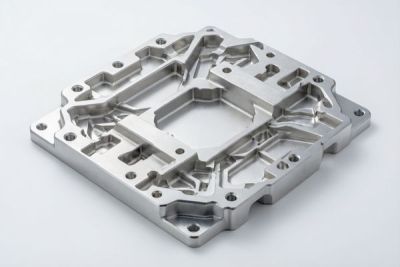
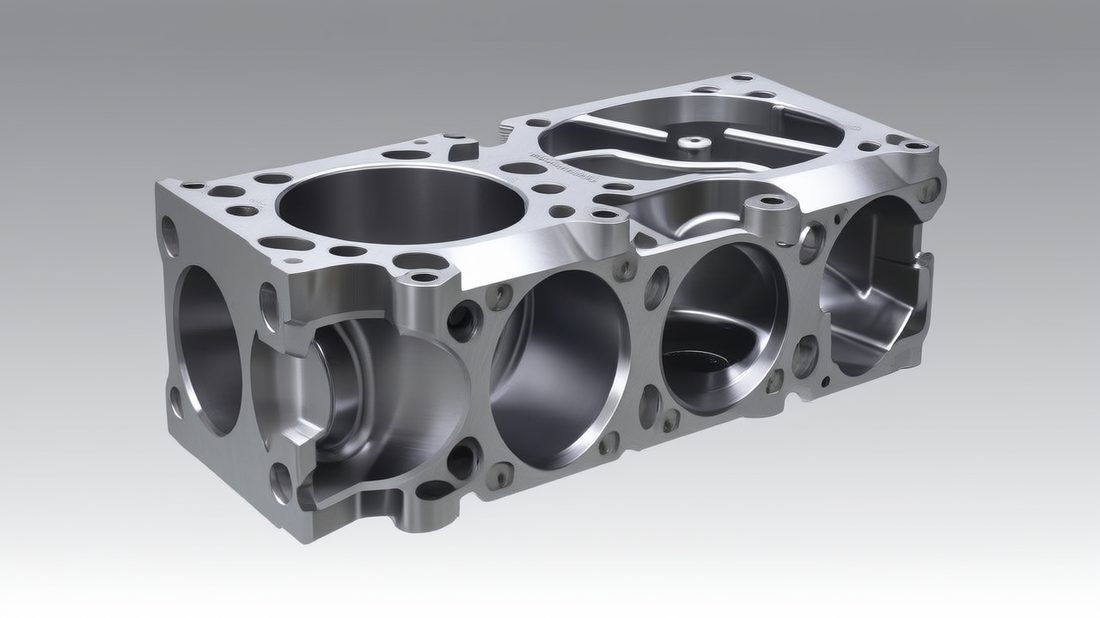
A bracket with angled mounting faces, internal ribs, and a contoured seat is a 5-axis CNC machining job by nature. On a 3-axis machine you fixture, cut one side, re-fixture, cut the next, and hope the datums line up. Every re-fixture is a chance to lose ±0.005 mm. On a 5-axis center the part sits once and the tool reaches every face. Fewer setups means fewer errors and a bracket that actually matches the drawing.
Single-setup accuracy for lightweight brackets
Because 5-axis CNC machining holds the part in one coordinate system, the relationship between the bolt holes and the contoured seat is locked by the machine, not by your inspector's re-measurement. For lightweight brackets where wall thickness is pushed to the minimum, that consistency is the difference between a part that passes first article and one that goes back for rework.
Shorter, stiffer tools reach deep features
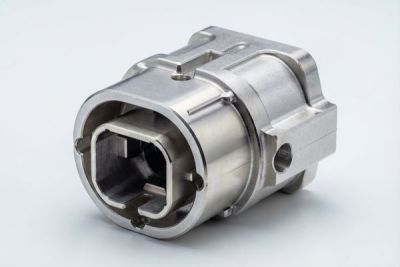
Tilting the spindle lets you use a short tool at a steep angle instead of a long tool reaching sideways. A short tool deflects less, so you hold tighter tolerance and get a better surface finish, often without a separate polishing pass. The result is fewer operations and a cleaner Ra on aerospace components.
| Factor | 3-axis bracket route | 5-axis CNC machining route |
|---|---|---|
| Setups | 3 to 5 re-fixtures | 1 setup, single datum |
| Tolerance risk | Cumulative per setup | Locked by machine |
| Tool length | Long, deflects | Short, stiff |
| Lead time | Longer, more handling | Shorter, fewer queues |
| Best for | Simple flat plates | Complex lightweight brackets |
Aerospace AI part image
Inconel Machining: Heat, Work-Hardening and How to Win
Inconel is the metal that tests whether your process is actually disciplined.
Inconel families (nickel-chromium superalloys) sit in the hottest, most corrosive zones of an engine or exhaust-adjacent bracket. They keep strength past 650 C where titanium fades. The price is that Inconel machining is the most demanding work in the shop: it work-hardens aggressively, generates intense heat, and abrades tools.
The hardening trap
Like titanium, Inconel surface-hardens if the tool rubs. Unlike titanium, the hardened layer is extremely tough on the next insert. You must maintain a constant chip load; any hesitation or dwell paints a hard skin that destroys tool life. Rigid 5-axis CNC machining with high-pressure coolant is the standard defense.
Tool life and cost control
Inconel machining lives or dies on tool selection. Ceramic or whisker-reinforced inserts at the right parameters can devour it; the wrong carbide will disappear in minutes. The cost is not the tool, it is the downtime and the scrap. A disciplined shop tracks insert life per part and batches Inconel work to keep the process warm and consistent.
For buyers, the practical question is simpler: does your supplier machine Inconel often enough to have a repeatable recipe, or are you funding their learning curve? LusterControl runs nickel alloys on the same ISO 9001 and ISO 13485 quality system used for medical and automotive work, with batch-level traceability on every lot. See how we structure quality control on our engineering blog.
Ti-6Al-4V Machining vs Inconel Machining: Which Metal for Your Part?
Pick the metal by the zone the bracket lives in, not by habit.
Both metals make excellent lightweight brackets. The decision is environmental. If your bracket lives below about 300 to 400 C and in a corrosive-but-not-extreme zone, Ti-6Al-4V machining gives you the best weight-to-cost story. If it sits near exhaust heat or sustained high temperature, Inconel machining is the only safe choice even though it costs more.
| Property | Ti-6Al-4V machining | Inconel machining |
|---|---|---|
| Service temperature | Up to ~400 C | Sustained 650 C+ |
| Density / weight | Low (4.43 g/cm3) | Higher (8.0+ g/cm3) |
| Corrosion resistance | Excellent | Excellent, extreme zones |
| Machining difficulty | High | Very high |
| Tool wear | Moderate to high | Very high |
| Rough cost to machine | Lower of the two | Higher |
| Best bracket use | Airframe, UAV, structural | Engine-adjacent, hot zones |
Choose Ti-6Al-4V if
- Your bracket is structural but stays below high heat
- Weight saving is the top priority for range or payload
- You want the best strength-to-weight per dollar
- Corrosion resistance matters more than extreme heat
Choose Inconel if
- The bracket sits in or near a heat source
- Sustained temperature exceeds what titanium tolerates
- Life-cycle cost beats up-front machining cost
- Regulatory or OEM spec names a nickel alloy
Aerospace AI part image
Tolerance Reality for Aerospace Components: Holding ±0.005 mm at Volume
A drawing that says ±0.005 mm is a process spec, not a measurement hope.
Tight tolerance on aerospace components is where capability separates shops. LusterControl's 5-axis cells hold ±0.005 mm repeatably on demanding metals. But 'hold the tolerance' means more than a good machine; it means thermal stability, calibrated gauges, and a measurement loop that catches drift before it becomes scrap.
What actually holds the number
Temperature-compensated measurement, first-article inspection, and in-process checks keep the bracket inside the band across a 500-piece lot, not just on the first part. For buyers, the question to ask is not 'what tolerance can you hold' but 'how do you prove you held it on my lot.' The answer should include CMM reports and traceable gauges.
| Requirement | What LusterControl delivers | Why it matters to you |
|---|---|---|
| Tolerance | ±0.005 mm repeatable | Bracket fits without shimming |
| Surface finish | Ra 0.2 µm achievable (8K mirror) | Reduced stress risers, cleaner fit |
| Traceability | Batch-level material + process | Audit-ready aerospace components |
| Verification | CMM + first-article | Proof, not promise |
| Volume | Up to 500K parts/month capacity | Prototype to production in one house |
Lightweight Brackets Buyer's Checklist: 7 Specs to Hand Your Supplier
The quote you get is only as good as the package you send.
Before you release an RFQ for titanium or Inconel brackets, assemble these seven items. They are what separate a real number from a guess, and they are what let a shop like LusterControl return a capable, on-time quote instead of a padded one.
- Complete 3D model plus 2D drawing with all critical dimensions and datums called out
- Specified alloy with grade (Ti-6Al-4V per AMS 4928, or the exact Inconel grade)
- Tolerance only on functional surfaces, with GD&T where it matters
- Required surface finish (Ra target) and any passivation or ASTM A967 cleanliness need
- Intended service environment: temperature, corrosion, vibration
- Volume and phasing so the shop can plan 5-axis CNC machining capacity
- Quality paperwork expected: CMM report, material cert, first-article, traceability
When your package is complete, a supplier can run a free DFM review and flag thin walls, hard-to-reach features, or tolerance that fights the material. That conversation before tooling saves more money than any negotiation after.
Aerospace AI part image
How 5-Axis CNC Machining Cuts Lead Time on Aerospace Components
Lead time is mostly hidden handling, not cutting time.
On paper, cutting a titanium bracket might take 40 minutes. In reality the clock that hurts you is the queue between operations: inspect, move, re-fixture, inspect again. 5-axis CNC machining collapses those steps because one setup covers most of the part. Fewer touches means the part spends its time on the machine, not on a cart.
From prototype to production without re-tooling
Because LusterControl runs both prototype and volume on the same 5-axis philosophy, your aerospace components scale without a process change. The first article and the ten-thousandth part come off comparable cells, which means the learning is captured once. That continuity is why a 60-machine, 4,000 m2 source factory can take a bracket from drawing to volume without handing you a surprise at the production gate.
For programs on a deadline, ask for a phased plan: first-article in week one, then a ramp validated against the same fixturing. You can read more about our production scale on the LusterControl homepage.
Why LusterControl Invests in Aerospace-Grade 5-Axis CNC Machining
Aerospace brackets are a stress test for the whole process.
We did not add titanium and Inconel capability to chase a badge. We added it because the same discipline that aerospace components demand, rigid 5-axis CNC machining, ±0.005 mm control, batch traceability, and honest DFM, is exactly what makes every other industry's parts better. A bracket program sharpens the whole floor.
The quality system underneath the metal
Every aerospace-grade bracket at LusterControl is made under ISO 9001 and ISO 13485 controls, with IATF 16949 in progress, and with passivation where ASTM A967 cleanliness is required. For buyers that means the paperwork trail is built in, not bolted on after the fact. You get material certs, CMM data, and batch records that survive an audit.
One house from drawing to volume
LusterControl has served precision parts to brands such as De'Longhi, Donlim and Breville, and supports industries from medical and automotive to semiconductor and UAV. That breadth means the 5-axis cell machining your titanium bracket has also cut parts held to medical and automotive discipline. The cross-pollination is why aerospace components leave our floor production-ready. Our drone-lightweighting work shows the same 5-axis logic in action, covered in this 5-axis CNC machining article.
Aerospace AI part image
Aerospace AI part image
Aerospace AI part image
Aerospace AI part image
FAQ: aerospace components & Aerospace Buyer Questions
A: Yes. Ti-6Al-4V has low thermal conductivity and work-hardens if the tool rubs, so it needs rigid 5-axis CNC machining, sharp coated tools and targeted coolant. LusterControl machines it under ISO 9001 and ISO 13485 controls with ±0.005 mm repeatability.
A: Our 5-axis cells hold ±0.005 mm repeatably, with Ra 0.2 µm (8K mirror) achievable where the finish matters. We prove it per lot with CMM reports and first-article inspection rather than quoting a best-case number.
A: Many aerospace programs require AS9100 or a customer-specific quality approval. LusterControl currently holds ISO 9001 and ISO 13485 and is pursuing IATF 16949; buyers should confirm program certification during supplier qualification, which we support with full batch-level traceability.
A: Thin-wall lightweight brackets have angled faces and contoured seats that 3-axis machines need several re-fixtures to cut. Each re-fixture risks losing tolerance. 5-axis CNC machining holds the part in one setup, locking the relationship between features and protecting ±0.005 mm.
A: Every lot carries material certification, in-process records and inspection data tied to the batch. Combined with ISO 9001 and ISO 13485 discipline, this gives aerospace buyers an audit-ready trail from raw bar to finished aerospace component.
A: Send the 3D model and 2D drawing with critical dimensions and datums, the exact alloy grade, tolerance only on functional surfaces, required Ra and any ASTM A967 passivation need, service environment, volume phasing, and the quality paperwork expected. A complete package enables a free DFM review and a real number.
Send us your bracket drawing for a free DFM review and a realistic lead-time quote, whether it is Ti-6Al-4V, Inconel, or another aerospace-grade alloy.
Request a Free CNC Quote