LusterControl Expands Surgical Tweezers for Industrial Automation (2026)
If you buy surgical tweezers for industrial automation, you already know the silent failure mode: a tip that closes clean on the metrology bench but twists half a degree under gripping load, drops a 0.4 mm component on a pick-and-place line, and stalls a cell for the rest of the shift. In micro-assembly, semiconductor handling, and lab automation, the tweezer is not a commodity hand tool, it is the last micron of your process control, and most buyers spec it like a commodity anyway.
This guide is written for the automation engineer, procurement lead, or robotics integrator who has to select a supplier, read a tolerance drawing, and defend the choice to a production manager. We walk through what actually decides tweezer performance in automated cells, the hard numbers that separate a passing lot from a scrap lot, and a sourcing checklist you can use the same day. LusterControl has just expanded capacity for surgical-grade tweezers for industrial automation on our 60-machine CNC floor in Dongguan, and we are sharing the buyer-side logic we use internally.
Everything below is grounded in real, verifiable facts, our plant, our tolerances, our certifications, and the programs we have shipped. No inflated capacity numbers, no borrowed case studies, just the criteria you should apply to any shop, including ours.
Table of Contents
- 1. Why Surgical Tweezers Demand Tight Tolerance CNC in 2026
- 2. How CNC Precision Machining Shapes Surgical-Grade Tweezers
- 3. Surgical Tweezers Specs: Tight Tolerance CNC and Mirror Finish
- 4. Industrial Automation CNC Parts: Tweezers vs Grippers
- 5. Custom CNC Parts for Robotic Micro-Assembly Lines
- 6. Tight Tolerance CNC: +/-0.005 mm for Surgical Tweezers
- 7. How to Verify a Supplier's CNC Precision Machining for Tweezers
- 8. Custom CNC Parts Sourcing Checklist for Automation Buyers
Industrial Automation CNC precision component
Why Surgical Tweezers Demand Tight Tolerance CNC in 2026
Tip alignment, not raw hardness, decides whether an automated tweezer keeps your cell running.
A surgical tweezer in an automated cell is a precision micro-gripper. The two tips must meet within microns over thousands of open-close cycles, hold a part without marring it, and return to zero after every stroke. In semiconductor die handling, photonic fiber placement, and medical-device micro-assembly, a tip that is off by 20 microns is not 'close enough', it is a dropped part, a scratched wafer, or a contaminated sterile build. For a buyer, the lesson is simple: the tip-closure tolerance is a process spec, not a cosmetic detail.
Three terms every automation buyer should read first
- Surgical tweezers
- Precision stainless forceps whose tips meet flush and symmetrically; in automation they act as repeatable micro-grippers for small, delicate parts.
- Tip-closure tolerance
- How far the two tips deviate from perfect alignment when closed; the single number that predicts drop rate in a pick-and-place cell.
- Spring rate
- The opening and closing force the tweezer returns after each cycle; it must stay stable so gripping force does not drift and crush or release the part.
At LusterControl we hold a standard mirror finish of Ra 0.6 um and can reach an 8K mirror of Ra 0.2 um on stainless tweezer tips. For surgical tweezers where the tip face contacts the part, that 0.2 um finish is what prevents micro-scratching on delicate components and keeps tip-closure repeatable. You should ask every supplier for the actual tip-closure tolerance and tip-face roughness they can lock in, not the number on their brochure.
Why 2026 is the year to re-check your tweezer supply base
Cobots, lab automation, and semiconductor back-end packaging are pulling micro-gripping out of the lab and onto volume lines. That shifts the buyer's problem from 'can anyone make a precise tweezer' to 'can a shop make fifty thousand that all close the same on day 30.' In 2026, repeatability and scale matter more than a hero prototype. Our own expansion, 60 CNC machines across a 4,000 sqm Dongguan plant after our 2026 capacity build-out, is a direct response to that shift toward volume industrial automation cnc parts.
Industrial Automation CNC precision component
How CNC Precision Machining Shapes Surgical-Grade Tweezers
The path from bar stock to a clean-closing tip is three process steps, each guarding a different failure mode.
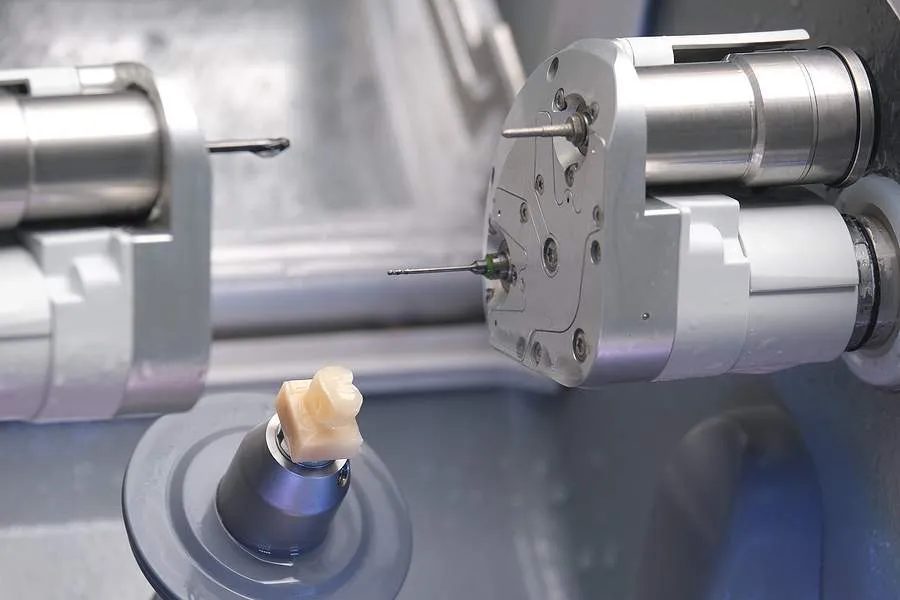
CNC precision machining is what lets us hold both the tip geometry and the tip-face finish on the same part. A tweezer may need a 0.4 mm tip gap held to +/-0.005 mm and a face polished to Ra 0.2 um, two requirements that fight each other unless the process is staged. Here is the sequence we run for surgical-grade work, and why each stage exists.
Step 1: 5-axis and turn-mill roughing
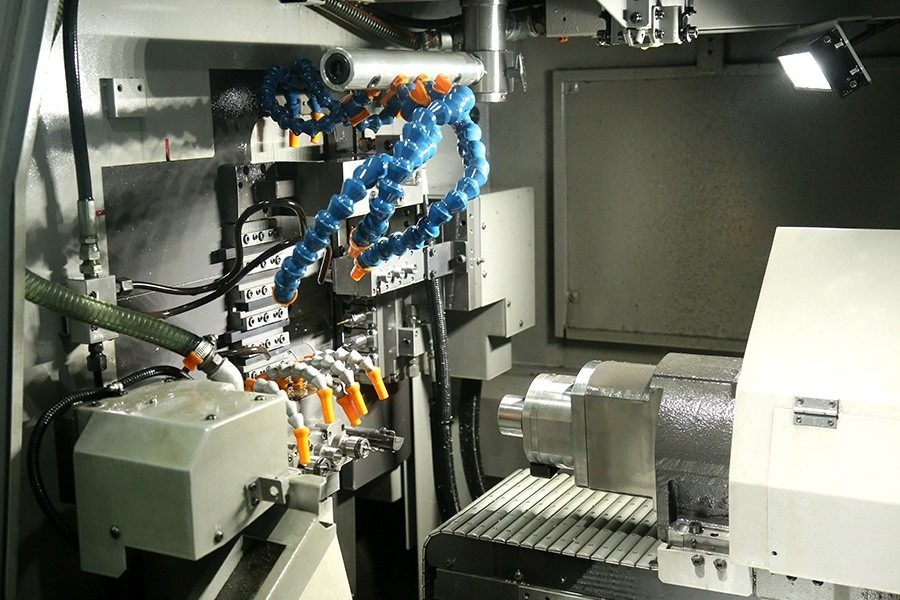
We start on 5-axis machining centers and turn-mill composite units to cut the body and legs in one setup. Single-setup machining removes the stack-up error you get from re-fixturing, the quiet enemy of tight tolerance CNC work. For thin-leg tweezers, Swiss-type turning keeps deflection under control so the legs do not bell out under the cutter and close off-axis.
Step 2: Stress and burr control
Before any finishing pass, we manage burrs and residual stress. A burr on a tip face is a guaranteed marring site on a delicate component, and untreated stress warps the legs after you measure them. Our medical and semiconductor programs already run batch-level material traceability, so the same discipline carries into tweezers: you can tie a finished tweezer back to its incoming lot.
Step 3: Mirror finishing and passivation
- Machine the tip geometry to print tolerance, leaving a controlled stock allowance for finishing.
- Run mirror finishing or electropolishing to reach Ra 0.2 um on the tip contact face.
- Verify tip closure and face on CMM and surface profiling, not by eye.
- Passivate stainless per ASTM A967 so the tip resists corrosion in cleanroom use.
Surgical Tweezers Specs: Tight Tolerance CNC and Mirror Finish
Read these five numbers before you approve any tweezer drawing release.
When you compare quotes for surgical tweezers, the spec sheet should read like a contract, not a wish list. Below is the real capability table we publish for surgical-grade work, with the 'why it matters' column a buyer actually needs. Use it as a template when you ask a supplier what they can lock in.
| Spec | LusterControl capability | Why it matters to your automation cell |
|---|---|---|
| Tip-closure tolerance | +/-0.005 mm | Keeps both tips aligned so delicate parts are held, not dropped. |
| Tip-face roughness | Ra 0.6 um std, Ra 0.2 um (8K) max | Lower micro-scratch risk on wafers, fibers, and sterile parts. |
| Leg thinness | Down to 0.3 mm on Swiss-type | Enables fine reach into tight cavities without bell-out. |
| Material traceability | Incoming lot tracked per batch | Lets you recall or re-verify a field failure to its source stock. |
| Passivation | ASTM A967 on stainless | Protects the tip from corrosion in cleanroom and lab use. |
Notice we did not list a tolerance we cannot hold every day. Tight tolerance CNC only helps you if the shop can repeat it across the lot, not just on the first-article part. Our ISO 9001 system and completed ISO 13485 program are what let us promise repeatability, and IATF 16949 is in application to extend that discipline into automotive-grade automation supply.

Industrial Automation CNC precision component
Industrial Automation CNC Parts: Tweezers vs Grippers
Not every micro-handling job needs a tweezer; here is how to decide between the two.
Buyers often conflate two purchases: surgical tweezers, a passive, compliant two-tip micro-gripper, and actuated automation grippers, powered jaws for larger parts. The table below separates them on the metrics that change your drop rate, cycle time, and cost.
| Factor | Surgical tweezers (passive) | Actuated gripper (powered) |
|---|---|---|
| Part size handled | 0.2 to 5 mm delicate | 5 mm to 50 mm and up |
| Gripping force control | Inherent compliance, low mar | Programmable, can crush small parts |
| Best when | Wafers, fibers, sterile parts | Rigid parts, higher payload |
| Wear / drift | Tip closure drifts if un-finished | Seal and actuator wear |
| LusterControl fit | Ra 0.2 um tip, +/-0.005 mm | Tolerance +/-0.005 mm bodies |
| Unit cost | Lower for passive tip | Higher, includes actuator |
Pros
- Choose surgical tweezers if your parts are sub-5 mm, delicate, and you need zero marring from compliant tips.
- Choose actuated grippers if payload and speed dominate and the part can take defined force.
Cons
- Do not buy passive tweezers if your part needs positive gripping force above what spring steel gives.
- Do not buy powered grippers if the part is a bare wafer or sterile component that an actuator will crush or contaminate.
Either way, the underlying CNC precision machining is the same discipline. The question is only which gripping principle fits your cell, and that should follow from your part, not from a catalog photo.
Custom CNC Parts for Robotic Micro-Assembly Lines
Material and process choice set the ceiling on both tip life and cleanroom compatibility.
Surgical tweezers for automation are rarely made from a single magic alloy. The right material depends on whether you need corrosion resistance, non-magnetic behavior, or cleanroom compatibility. As a source factory doing both small-batch custom CNC parts and volume runs, we see the same materials recur across automation programs.
- 303 / 304 stainless
- Easy to machine and passivate per ASTM A967; the default for corrosion-resistant tips.
- 316L stainless
- Higher corrosion resistance for lab and medical automation; slightly softer, plan finish carefully.
- Non-magnetic 304 / 316
- Used when the cell has magnetic sensors that a ferromagnetic tip would disturb.
- Titanium
- Used when weight and biocompatibility justify the extra machining cost in sterile handling.
- Pick stainless when the tip sees the environment and you need ASTM A967 passivation.
- Pick non-magnetic grades when your cell uses magnetic part-presence sensors.
- Pick titanium only when biocompatibility or weight justifies the extra cost.
- Confirm the shop can mirror-finish your specific alloy before you release the drawing.
Our 4,000 sqm Dongguan plant and 60 CNC machines let us run these materials from prototype through monthly volume of up to 500,000 pieces, so a custom CNC parts program can scale without re-qualifying a second shop. You can see the full process scope on our company page and recent programs on our blog.
Industrial Automation CNC precision component
Tight Tolerance CNC: +/-0.005 mm for Surgical Tweezers
Tolerance and finish are not the same decision; match each to where the part actually fails.
A common buyer mistake is demanding +/-0.005 mm everywhere and Ra 0.2 um everywhere. That doubles cost with no benefit, because only the tip faces and closure actually decide drop rate. The smarter move is to tier your spec: tight tolerance CNC on the tip-closure feature, mirror finish on the tip contact face, and commercial tolerances on the body and handle.
| Feature on the tweezer | Recommended spec | Reason |
|---|---|---|
| Tip closure / alignment | +/-0.005 mm, Ra 0.4 um | Alignment drives drop rate; finish is secondary. |
| Tip contact face | Ra 0.2 um, +/-0.02 mm | Surface marring dominates; position is forgiving. |
| Body and handle | +/-0.05 mm, Ra 1.6 um | Pure structure; no handling role. |
| Thin leg | 0.3 mm min, Ra 0.8 um | Flexure and definition beat polish here. |
Pros
- Tiering cuts cost by not over-specifying polish on structural faces.
- Targets the spec where parts are actually dropped, improving first-pass yield.
- Makes the drawing a clearer contract for any shop you quote.
Cons
- Requires you to decide which features are critical versus structural up front.
- A supplier without profiling gear may push back on the Ra 0.2 um tip face.
If a shop cannot measure Ra 0.2 um on a profilometer, they cannot hold it. Put tip-face surface-profile data in the first-article report, not just a CMM dimensional check. That single requirement filters out most shops that say 'we can do surgical-grade' but have never proven the finish.
How to Verify a Supplier's CNC Precision Machining for Tweezers
Five checks separate shops that can do surgical-grade from shops that say they can.
- Ask for a surface-profile report (Ra) on the actual alloy tip face, not just a CMM dimensional report.
- Confirm they run ASTM A967 passivation on stainless tweezer tips.
- Request incoming-lot material traceability, not just a CoC PDF.
- Verify they have 5-axis or turn-mill composite to hold tight tolerance CNC in one setup.
- Check certifications: ISO 9001 at minimum, ISO 13485 or IATF 16949 as a plus for medical or auto.
- Run a paid first-article batch and cycle-test 50,000 open-close strokes before committing volume.
These checks sound basic, yet most dropped-part incidents we are asked to rescue trace back to one of them being skipped. A shop that publishes its Ra capability and cert status up front, like we do, is simply easier to qualify. You can review our credentials and facility on the about page before sending a drawing.
Industrial Automation CNC precision component
Custom CNC Parts Sourcing Checklist for Automation Buyers
Use this as your RFQ attachment so every quote answers the same questions.
- State which features are critical versus structural, and tier the Ra and tolerance per feature.
- Require tip-face Ra surface-profile data in the first-article report, not a CMM-only check.
- Specify ASTM A967 passivation for any stainless tip touching the environment.
- Demand incoming-lot traceability so field failures are traceable to source stock.
- Ask for real repeatability evidence, SPC or CPK, on prior tweezer lots.
- Confirm scale: can the shop go from prototype to 500,000 pieces a month without re-qualification?
LusterControl's expansion for industrial automation clients is built around exactly this buyer logic: one plant, one quality system, prototype-to-volume on 60 CNC machines, with mirror finishing and passivation done in house. If your drawing is ready, the fastest next step is a design-for-manufacturing review where we flag tip-closure and finish conflicts before you cut metal. See our inquiry page to start.
Industrial Automation CNC precision component
Industrial Automation CNC precision component
Industrial Automation CNC precision component
Industrial Automation CNC precision component
FAQ: surgical tweezers & Industrial Automation Buyer Questions
A: Tip-closure alignment should target +/-0.005 mm so both tips meet flush and do not drop sub-5 mm parts. LusterControl holds +/-0.005 mm on tip-closure features using 5-axis and turn-mill composite machining in a single setup.
A: The tip contact face should target Ra 0.2 um, 8K mirror, to avoid micro-scratching wafers, fibers, and sterile parts. Structural faces need only Ra 1.6 um. LusterControl holds Ra 0.6 um standard and Ra 0.2 um mirror on request.
A: Yes. Stainless surgical tweezers are passivated per ASTM A967 to resist corrosion in cleanroom and lab use. Passivation is specified on the drawing and verified, not assumed.
A: Yes. Our Dongguan plant runs 60 CNC machines in 4,000 sqm with monthly capacity up to 500,000 pieces, under one ISO 9001 and ISO 13485 quality system. The same line that makes your first article makes your volume.
A: Yes, confidentiality is routine, not a special request. We run NDA programs for global brands such as De'Longhi, Donlim, and Breville, with controlled CAD access and discreet packaging on prototype shipments.
A: LusterControl is ISO 9001 certified and ISO 13485 completed, with IATF 16949 in application. Founded in 2015, we bring 15 years of CNC stainless mirror machining to automation and medical programs.
Send us your drawing for a free DFM review, we will flag tip-closure and finish conflicts before you cut metal, and quote prototype-to-volume on one quality system. Start at https://www.lustercontrol.com/sendinquiry.htm
Request a Free CNC Quote