CDU Coupler Assemblies: From Drawing to 20k/Month in 30 Days (2026)
If you integrate liquid cooling into AI servers, you already know the uncomfortable truth: the rack does not fail at the pump or the chiller. It fails at a connector. A CDU coupler assembly the size of a coin, weeping a few drops after a thermal cycle, can take down a row of GPUs. Yet in 2026 most sourcing teams still treat the coupler as a commodity fitting — until the first leak report lands on their desk.
This article is a shop-floor case record from LusterControl (Dongguan Licun Technology). It follows one anonymous customer program for CDU coupler assemblies — a quick-disconnect style fitting and matching manifold connector for a coolant distribution unit — from a first drawing to a stated ramp of 20,000 parts per month within a 30-day window. The client is not named, at their request, and no competitor is compared or diminished. What we share is the machining and quality logic that made the ramp verifiable, not marketing.
We will walk through what the drawing had to define, why turn-mill composite held the sealing geometry in one setup, how tight tolerance CNC and a documented inspection chain kept every batch traceable, and where programs like this most often go wrong. Every capability figure below comes from our own plant: 60 CNC machines, a 4,000 m² facility (2026 expansion; the former 2,000 m² figure is obsolete), ±0.005 mm held tolerance, mirror finishes to 8K Ra 0.2 µm, ISO 9001 certification, an ISO 13485 quality system established with certification advancing, and an IATF 16949 application in progress.
Table of Contents
- 1. Why CDU Coupler Assemblies Became the Bottleneck in AI-Server Cooling (2026)
- 2. Liquid-Cooling Coupler Machining: What the Drawing Must Define Before You Quote
- 3. Turn-Mill Composite: One Setup for the Coupler Body, Bore and Ports
- 4. Tight Tolerance CNC: Holding the Seal Land, Bore and Thread Geometry
- 5. CDU Coupler Assembly Quality: From First Article to Batch Traceability
- 6. CNC Precision Machining Capacity: How a 30-Day Ramp Reaches 20k/Month
- 7. Real-World Verification: CDU Coupler Assemblies and Traceable Batch Records
- 8. Common Mistakes in Liquid-Cooling Coupler Machining (and How to Avoid Them)
- 9. Buyer's Checklist: Vetting a Tight Tolerance CNC Partner in 2026
- 10. Why LusterControl's CNC Precision Machining Fits CDU Coupler Assembly Programs
Liquid Cooling (AI Compute) CNC precision component
Why CDU Coupler Assemblies Became the Bottleneck in AI-Server Cooling (2026)
The smallest part in the loop often sets the longest lead time.
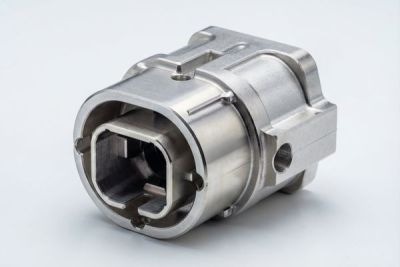
As rack densities rise through 2026, direct-to-chip liquid cooling has moved from a niche deployment to a default requirement for new AI compute halls. At the center of each loop sits the CDU — the coolant distribution unit that regulates flow, pressure and temperature before coolant reaches the cold plates. Between the CDU manifold and the server rack sit the connection points: CDU coupler assemblies that must seal, align and survive repeated mate-unmate cycles without a single weep.
That is where the schedule risk hides. A coupler is simultaneously a fluidic seal, a mechanical locator and often an electrical or sensing interface. It has a sealing land, a thread or bayonet feature, a flow bore and a datum relationship between them. If the concentricity between bore and seal drifts, the O-ring does not compress evenly. If the seal face is rougher than specified, it weeps under pressure. If the thread is cut in a second setup, the stack-up eats the tolerance. Each failure is invisible until the assembly is pressurized — usually after it has been installed in an expensive rack.
- CDU
- Coolant Distribution Unit — the subsystem that manages coolant flow, pressure and temperature between the facility loop and the IT equipment loop in a liquid-cooled rack.
- CDU coupler assembly
- A multi-feature fitting — seal land, flow bore, thread or locking feature, and datum faces — that connects a CDU manifold or quick-disconnect to the server-side liquid-cooling loop.
- Weep / leak rate
- The small, often slow fluid loss at a sealed interface; in demanding liquid-cooling programs it is verified by pressure-decay or helium testing against a documented acceptance limit.
For the integrator, this means the coupler is not a line item to be sourced last. It is a design-for-manufacture problem that belongs in the first review. The case below shows what happened when a buyer brought the drawing in early and asked for a ramp plan instead of a unit price alone.
Liquid Cooling (AI Compute) CNC precision component
Liquid-Cooling Coupler Machining: What the Drawing Must Define Before You Quote
A coupler cannot be priced responsibly from a 2D outline and a material callout.
The fastest way to lose a month on a liquid-cooling program is to release a drawing that leaves the sealing and inspection intent ambiguous. In our DFM review, the first question is never 'what does it cost' — it is 'what must this part prove'. For CDU coupler assemblies the answer is a short list of measurable features, each with a datum, a limit and an inspection method. If any of them is missing, the quote is a guess.
- Sealing interface: define the seal-land diameter, surface finish and the O-ring or gasket standard, plus the acceptable leak-test method and limit.
- Flow bore: define bore diameter tolerance, concentricity to the seal land, and the internal roughness target that governs pressure drop and debris retention.
- Thread or locking feature: name the thread standard and class, and state whether it must be machined in the same setup as the seal.
- Material and condition: specify alloy, temper and any passivation or cleaning requirement, ideally by standard number rather than a trade description.
- Cleanliness and packaging: state the particulate limit, flushing/deburring expectation and whether parts ship capped for a sealed loop.
- Traceability: decide up front whether material certs, first-article CMM data and lot records must accompany each shipment.
| Drawing field | Why it decides the quote | What our shop can put behind it |
|---|---|---|
| Seal land + finish | Sets leak performance and mate-unmate life | Standard mirror Ra ≤ 0.6 µm; up to 8K mirror Ra 0.2 µm |
| Bore concentricity | Uneven O-ring compression causes weeping | Turn-mill composite in one setup; ±0.005 mm held tolerance |
| Thread standard | Wrong class = cross-thread or leak path | Cut and verified in-process with thread gauging |
| Material / surface | Corrosion and contamination risk | ASTM A967 passivation referenced where stainless is specified |
| Batch evidence | Decides how fast a field issue is closed | Incoming lot control + batch-level traceability |
Turn-Mill Composite: One Setup for the Coupler Body, Bore and Ports
Concentricity is not inspected into a part — it is set by how the part is held.
What the process actually does
Turn-mill composite — machining turning and milling operations on a single platform without moving the part between machines — is the core reason a complex coupler can hold its internal geometry. The blank is clamped once. The rotating spindle turns the outside diameter and the sealing land, live tooling mills the flats, cross-ports and drive features, and the same coordinate system carries through to the bore. There is no second fixture, no re-datum error and no stack-up between operations that were cut on different machines.
- Setup: one clamping for OD, seal land, bore and milled features — the datum relationship is preserved by the machine, not by the operator.
- Motion: turning for round features, live-tool milling for flats and ports, all under one CNC program.
- Result: bore-to-seal concentricity that survives the transition from a first article to a 20,000-part month.
Why this matters on a CDU coupler assembly
A quick-disconnect coupler is unforgiving of eccentricity. The seal land and the flow bore must share an axis within a tight band; if the O-ring lands on a bore that wanders, compression varies around the circumference and the joint weeps under thermal cycling. Conventional routing — turn on a lathe, move to a mill for the ports, then drill the bore on a third fixture — introduces a datum shift at every handoff. Turn-mill composite removes those handoffs entirely. On our floor, these cells sit alongside 5-axis and Swiss-type capability, so the same discipline covers both the coupler body and smaller manifold inserts.
| Factor | Turn-mill composite (one setup) | Split lathe → mill → drill routing |
|---|---|---|
| Bore-to-seal concentricity | Held by one datum frame; ±0.005 mm capability | Limited by re-clamping and datum transfer |
| Setup count | One primary clamping | Two to three handoffs |
| Stack-up error | Minimal — features share a coordinate system | Accumulates at each transfer |
| First-article consistency | Program-driven, repeatable | Operator-dependent alignment |
| Best fit | Sealing couplers, manifold inserts, ported bodies | Simple parts with loose concentricity |
Pros
- Choose turn-mill composite when the seal land and bore must share an axis and the drawing carries a concentricity callout.
- Choose it when you want first-article geometry to repeat unchanged across a volume ramp.
- Choose it when the program combines round and milled features in one small part.
Cons
- A split routing may be acceptable for simple fittings with generous concentricity and no sealing land.
- Very large bodies or unusual aspect ratios may need dedicated fixtures regardless of route.
Readers who want the deeper process background can review our CNC precision machining technical guides, where turn-mill and 5-axis selection are covered in more detail.
Liquid Cooling (AI Compute) CNC precision component
Tight Tolerance CNC: Holding the Seal Land, Bore and Thread Geometry
A tolerance is only as credible as the inspection behind it.
Tight tolerance CNC is easy to claim and expensive to prove. On a CDU coupler assembly, the features that matter are few but demanding: the sealing land diameter and finish, the bore diameter and its concentricity to the seal, the thread class, and the flatness of the mating face. Our production tolerance of ±0.005 mm is not a lab result — it is held on the shop floor across the same cells that run appliance and medical programs.
- Seal land
- The machined surface against which the O-ring or gasket compresses; its diameter, finish and concentricity govern leak performance.
- Tolerance stack-up
- The accumulation of individual feature errors across setups; reducing setup count is the most direct way to control it.
- CPK
- A process-capability index used in SPC to show how consistently a process holds a spec; a stable, capable process is the goal of in-process monitoring.
| Critical feature | Why it is critical | Verification method |
|---|---|---|
| Seal-land OD | Controls O-ring squeeze | CMM + micrometer, per lot first article |
| Bore diameter | Sets flow and pressure drop | Bore gauge / CMM in-process |
| Bore-to-seal concentricity | Prevents uneven compression and weeping | CMM with shared datum scheme |
| Seal-face finish | Leak path at the interface | Surface roughness trace |
| Thread class | Mating and sealing integrity | Thread gauge, in-process |
The practical lesson for a buyer is to tie each tolerance to a method. A number printed on a drawing without a stated gauge or CMM datum is an aspiration, not a requirement. In this program the inspection plan was agreed during DFM, so first-article data and later batch records used the same datums — which is what made the ramp auditable.
CDU Coupler Assembly Quality: From First Article to Batch Traceability
The ramp was fast because the evidence chain was designed before the first chip was cut.
Quality is where a 30-day ramp either holds or collapses. A supplier can cut a beautiful first article and still fail the tenth lot if there is no system linking material, machine and inspection record. Our CNC precision machining quality chain is the same for a ten-piece prototype and a 20,000-piece month, which is precisely why it scales.
- DFM review: seal strategy, datum scheme, tool reach and inspection access checked before programming.
- Incoming material check: mill certificates verified, batch recorded and stock screened before it enters the cell.
- First-article CMM: critical diameters, concentricity and mating-face geometry measured against the agreed datum scheme.
- In-process SPC/CPK: special characteristics monitored statistically, not spot-checked at the end of a run.
- Final FQC/OQC: deburr, clean, flush, cap where specified, then visual and dimensional release.
- Lot traceability: each batch tied back to material lot, machine and inspection records.
Where stainless is specified for a sealing or wetted surface, we reference ASTM A967 for chemical passivation treatments in our documentation. Naming the standard on the purchase order removes the ambiguity of a phrase like 'stainless finish' and gives both sides a verifiable criterion — a small detail that matters a great deal when coolant chemistry and long service life are involved.
For an integrator, the value is practical: if a coupler is questioned in the field, a traceable batch record lets you isolate material, machine and inspection history in hours rather than weeks. That is the difference between a contained quality notice and a program delay.

Liquid Cooling (AI Compute) CNC precision component
CNC Precision Machining Capacity: How a 30-Day Ramp Reaches 20k/Month
Capacity is not a single number — it is a curve you can inspect.
In this case the customer asked a pointed question: can a small Dongguan source factory take a coupler from drawing to a 20,000-per-month rate inside 30 days? The honest answer depends on three things — whether the design is frozen, whether the process is stable at first article, and whether there is spare machine capacity to absorb the ramp without competing with other programs. We answered it with a staged plan rather than a promise.
| Ramp stage | Focus | Evidence released |
|---|---|---|
| Days 1–5: DFM + programming | Freeze seal strategy, datums and toolpath | DFM sign-off, process plan |
| Days 6–12: first article | Prove geometry in one setup | CMM report, roughness trace, thread-gauge record |
| Days 13–20: pilot batch | Confirm repeatability and SPC stability | In-process data, CPK snapshot |
| Days 21–30: volume ramp | Scale to the stated 20,000/month rate | Lot traceability, FQC/OQC release records |
Our turn-mill, 5-axis and Swiss-type cells give the schedule redundancy: a coupler body and its smaller manifold insert can run on parallel cells, which is how a ramp avoids becoming a single-machine bottleneck. With a 4,000 m² plant following the 2026 expansion, there is physical room for dedicated inspection and packaging alongside production — an underrated factor when a sealed-loop part must ship clean and capped.
A ramp is not a sprint at full speed. It is a sequence of gates — and each gate needs data before the next one opens.
Real-World Verification: CDU Coupler Assemblies and Traceable Batch Records
Evidence from programs already shipped, not hypothetical capability.
What connects a coffee-machine fitting, a surgical-instrument part and a CDU coupler is not the end industry — it is the transferable problem of holding a fine surface and a critical geometry while documenting every batch. A sealing face that must reach Ra 0.2 µm for an appliance is the same metallurgical and process challenge as a low-Ra seal land in a coolant loop. The tolerances travel; the application changes. Fifteen years of CNC mirror-finish work is why this transfer is routine rather than experimental.
In the coupler program, each released batch carried material lot, machine and inspection records linked to the same datum scheme used at first article. That continuity is what turns a machining claim into a defensible quality record — and it is the part of the story buyers should ask about first.
We are a Dongguan source factory serving new-energy vehicles, medical devices, aerospace, smart home, UAVs, semiconductor, robotics, optics, industrial automation, fluid control, energy storage, transmission and tooling programs, with annual output value above RMB 20 million. Small-lot custom work and volume production run under the same quality system. Learn more about our Dongguan plant and team.
Liquid Cooling (AI Compute) CNC precision component
Common Mistakes in Liquid-Cooling Coupler Machining (and How to Avoid Them)
Most coupler failures are decided at the drawing stage, long before the leak test.
- Mistake 1 — ignoring setup count. If the drawing carries a concentricity callout, ask the supplier which single setup holds it. A multi-fixture answer is a risk signal.
- Mistake 2 — a finish with no measurement location. Require a roughness trace on the actual seal land, not a convenient outer face.
- Mistake 3 — vague material and surface callouts. Name the alloy and, where relevant, the passivation standard by number.
- Mistake 4 — skipping the pilot batch. A first article proves geometry; a pilot batch proves repeatability. Both are needed before a ramp.
- Mistake 5 — no cleanliness or capping plan. A perfectly machined bore contaminated with cutting debris will fail in the loop.
A supplier who welcomes these questions is usually the supplier who has already solved them. In this program, the buyer put each item into the RFQ as a requirement rather than discovering it in a failure review — a small shift in process that removed most of the usual ramp risk.
Buyer's Checklist: Vetting a Tight Tolerance CNC Partner in 2026
Five documents to demand before you release a coupler PO.
Whether you are sourcing CDU coupler assemblies or any sealing component, the supplier's documentation tells you more than a polished sample. Use this buyer's checklist as a gate. It is the same evidence we expect you to ask of us.
- A first-article CMM report with the datum scheme and measured concentricity — not a pass/fail stamp alone.
- A surface roughness trace taken on the seal land, with the measurement location stated.
- A documented leak-test method, calibration record and acceptance limit for the sealed interface.
- Material certificates and lot-level traceability that can be tied to your specific batch.
- A written process plan naming the route (turn-mill composite, 5-axis or Swiss-type), critical steps and inspection holds.
Red flags worth walking away from
- A quote that ignores the concentricity callout or proposes multiple setups without explaining datum control.
- Finish claims with no trace, or traces taken on an easy-to-reach face rather than the seal.
- No material certs, or certs that cannot be tied to your batch.
- A process route that changes between sample and production without re-qualification.
- Unwillingness to sign an NDA or to control access to your CAD files.
None of these are exotic demands — they are the minimum file a serious CNC precision machining partner already keeps. You can review more of our technical guides on process selection before you write the RFQ.
Liquid Cooling (AI Compute) CNC precision component
Why LusterControl's CNC Precision Machining Fits CDU Coupler Assembly Programs
A source factory built for the transition from sample to stable volume.
LusterControl (Dongguan Licun Technology) was founded in 2015 and has spent 15 years in CNC precision machining with a focus on stainless-steel mirror finishing. The same plant that reaches 8K mirror Ra 0.2 µm for appliance clients runs the tight tolerance CNC cells that hold a coupler's seal geometry. There is no subcontracting of the critical operations: turning, milling, finishing and inspection sit under one quality record.
| Capability | LusterControl reality | Buyer value in a coupler program |
|---|---|---|
| Equipment | 60 CNC machines (35 lathes, 20 4/5-axis, 5 turn-mill; Swiss-type available) | Parallel cells protect the ramp schedule |
| Facility | 4,000 m² (2026 expansion; old 2,000 m² obsolete) | Room for dedicated inspection and clean packaging |
| Tolerance | ±0.005 mm held in production | Concentricity and fit confidence |
| Surface | Standard mirror Ra ≤ 0.6 µm; up to 8K Ra 0.2 µm | Low-Ra seal lands and mating faces |
| Quality | ISO 9001 certified; ISO 13485 quality system established, certification advancing; IATF 16949 application in progress | Auditable system, not ad-hoc QC |
| Traceability | Incoming lot control and batch records | Fast root-cause on any field issue |
For a 2026 liquid-cooling program, the practical offer is simple: send the drawing and we will return achievable tolerance, seal-finish and leak-test guidance, a process route, and a unit-price curve across sample, pilot and volume. If you are planning a ramp and want a second engineering opinion on your CDU coupler assembly drawing, send it for a free DFM review — we will tell you what is achievable before you commit.
Liquid Cooling (AI Compute) CNC precision component
Liquid Cooling (AI Compute) CNC precision component
Liquid Cooling (AI Compute) CNC precision component
FAQ: CDU coupler assemblies & Liquid Cooling (AI Compute) Buyer Questions
A: It is the multi-feature fitting — seal land, flow bore, thread or locking feature and datum faces — that connects a coolant distribution unit manifold to the server-side liquid-cooling loop. Because a single weeping coupler can shut down a rack, its concentricity, finish and traceability often decide the program schedule.
A: In the anonymous case described here, the customer-stated target of 20,000 parts per month was reached within a 30-day window using a staged plan: DFM, first article, pilot batch, then volume. It was supported by our capacity of 60 CNC machines and 500,000 parts per month overall. Results depend on a frozen design and a stable first article.
A: Turn-mill composite cuts the OD, seal land, bore and milled ports in one clamping, so the bore and seal share a datum and concentricity is held by the machine rather than by re-fixturing. Split lathe-mill-drill routing adds datum transfer error at every handoff.
A: Tie each tolerance to a verification method. LusterControl holds ±0.005 mm in production and can reach standard mirror Ra ≤ 0.6 µm or 8K mirror Ra 0.2 µm. Require a roughness trace on the actual seal land and a CMM report with the datum scheme, rather than a number with no measurement location.
A: Material certificates, first-article CMM data, in-process SPC/CPK records, final FQC/OQC release and lot-level traceability linking material, machine and inspection. We are ISO 9001 certified, with an ISO 13485 quality system established (certification advancing) and an IATF 16949 application in progress.
A: Yes. NDA-backed programs are routine, including De'Longhi, Donlim and Breville-grade work. CAD files are held under controlled access, customer designs are not reused or offered to competing programs, and prototype shipments are packaged discreetly. Send your drawing for a free DFM review to start.
Planning a liquid-cooling or CDU program for 2026? Send LusterControl your coupler drawing for a free DFM review — we will return achievable tolerance, seal-finish and leak-test guidance, a process route and a unit-price curve, backed by 15 years of CNC precision machining.
Request a Free CNC Quote